5 LEI Checks Before Opening a Trading Account
If you are opening a UK trading account in the name of a company, trust, charity, pension, or other legal structure, the LEI should be checked before you submit the application, not after. For many entity accounts, it is a practical go or no-go item because the broker may not be allowed to execute certain trades without it.
TL;DR: Summary
- For a UK entity trading account, an LEI is often a pre-trade requirement, especially where UK MiFIR transaction reporting or UK EMIR derivative reporting applies.
- The FCA states that firms subject to UK MiFIR reporting cannot execute a trade for an eligible legal-entity client that does not have an LEI.
- All UK counterparties entering derivative trades need an LEI for UK EMIR reporting, so derivative capability usually means the LEI check belongs at account-opening stage.
- Before opening the account, confirm five points: who the legal account holder is, whether the products trigger reporting, whether the LEI exists, whether its GLEIF record matches current entity data, and whether the status is current enough for the broker’s onboarding rules.
- The Global LEI Index is updated daily by GLEIF and can be searched free of charge, making it the quickest place to verify an LEI before forms are submitted.
- If the account is urgent, apply early: fast issuance is possible, but lapsed records, duplicate applications, and entity-data mismatches are the mistakes most likely to delay trading access.
A useful rule is simple: if a firm will act on your entity’s instructions, or may make a decision to trade on its behalf, assume the LEI question will surface during onboarding. That makes five pre-opening checks far more valuable than treating the LEI as a back-office task.
Why can an LEI stop a trading account from being opened?
Yes, an LEI can block trading access. Under FCA guidance on UK MiFIR, a firm with transaction reporting obligations cannot execute a trade for an eligible legal-entity client that does not have an LEI.
That matters because many brokers do not wait until the first order ticket to deal with the issue. They ask for the LEI during account opening so they do not onboard an entity that later cannot trade reportable instruments. In practice, the LEI is often part of account eligibility, alongside KYC, tax forms, and authority checks.
"LEI Service can issue LEIs from 10 minutes to 48 hours, with a 2-hour VIP option for orders placed before 5pm."
The same logic becomes even stricter for derivatives. The FCA states that all UK counterparties entering derivative trades need an LEI to meet UK EMIR reporting obligations, so a derivatives-enabled account usually cannot treat the LEI as optional admin.
Which UK entities need an LEI for a trading account?
Companies, charities, and trusts are all potential LEI users. The FCA describes the LEI as a unique identifier for legal entities or structures, not for individual retail investors acting in a personal capacity.
If the trading account is in the name of a UK limited company, LLP, charity, pension arrangement, or trust, the broker will often assess the account as an entity relationship. A common mistake is assuming the director or trustee’s personal identity checks remove the need for the entity’s LEI. They do not serve the same purpose.
"LEI Service supports UK companies, trusts, pensions, wills, and charities with English-speaking phone and email support."
One useful check is to ask a precise question during onboarding: “Who is the legal account holder for reporting purposes?” If the answer is the entity or structure, not the individual signatory, the LEI requirement becomes much more likely.
What are the 5 LEI checks before opening a trading account?
The five checks are straightforward: legal holder, product scope, LEI existence, LEI status, and data accuracy. If you verify those before applying, most avoidable delays disappear.
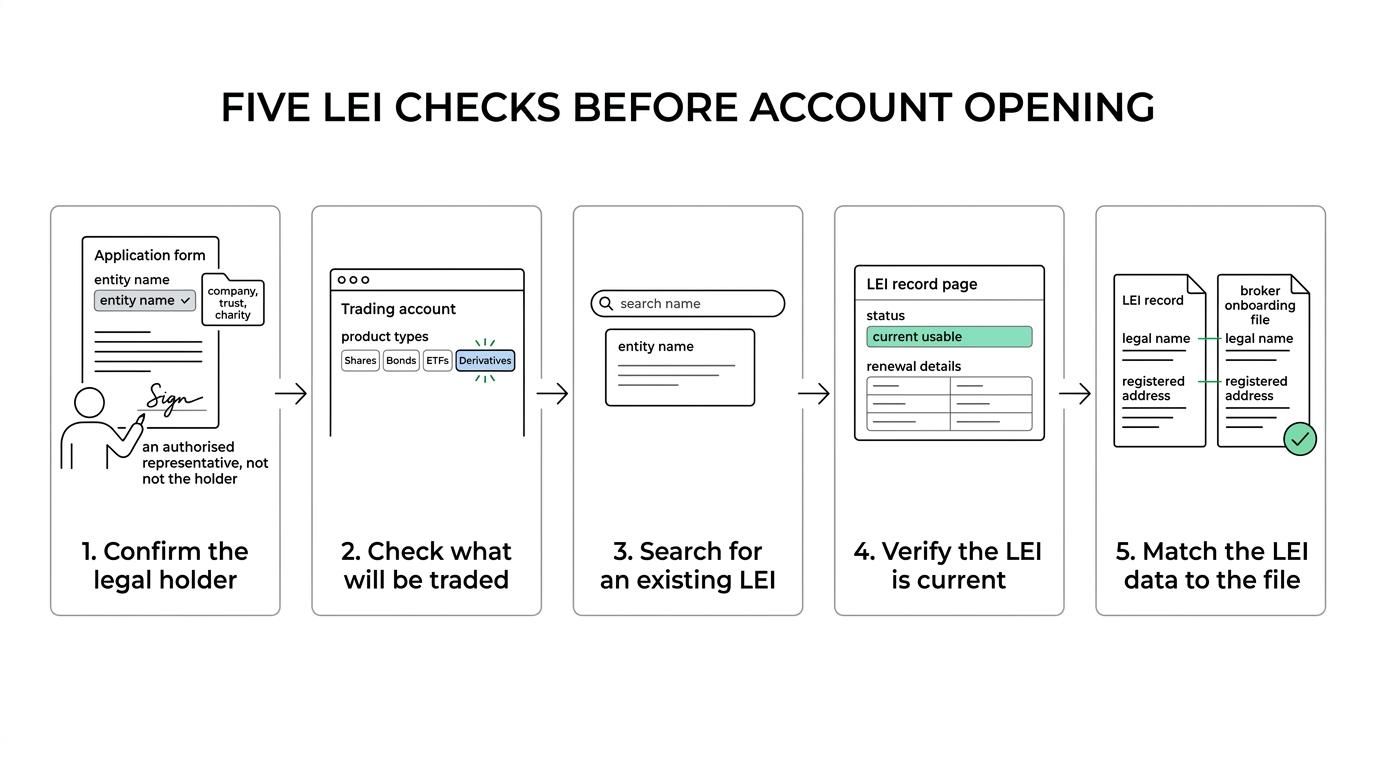
These checks work because they follow the same path a broker’s compliance team follows when deciding whether an entity can be onboarded for trading.
- Who is the legal account holder? If the account is in the name of a company, charity, trust, or pension, treat the LEI as a live requirement until proven otherwise.
- What will the account trade? Shares, bonds, ETFs, and especially derivatives can trigger reporting obligations under UK MiFIR or UK EMIR.
- Does the entity already have an LEI? Search first before applying. Duplicate applications create confusion and can slow onboarding.
- Is the LEI record current and usable? Check the Global LEI Index for the entity name, status, and latest renewal position.
- Does the LEI data match the onboarding file? Legal name, registered address, and entity status should match official records and the broker’s forms.
How can you check whether your trading account falls under UK MiFIR or UK EMIR?
You can usually narrow this down in a few minutes. FCA rules on UK MiFIR and UK EMIR follow the product being traded and the status of the account holder.
Start with the products and the broker’s permissions, then work back to the reporting rule most likely to apply.
- Check the instrument: Cash equities, bonds, and similar investment products often point toward UK MiFIR transaction reporting, while swaps, options, futures, and other derivatives point toward UK EMIR reporting.
- Check the account holder: If the client is a legal entity or structure, the LEI question is usually relevant; if the client is an individual in a personal account, it usually is not.
- Check the firm’s role: If the broker acts on the entity’s instructions or may make a decision to trade on its behalf, the FCA says the entity needs to arrange an LEI.
A practical tip is to ask the broker two direct questions in writing: “Will you refuse execution without an LEI?” and “Do you need the LEI at application stage or only before first trade?” That often gives a clearer answer than generic onboarding FAQs.
How do you verify that an LEI is active on the Global LEI Index?
Use the GLEIF search first. GLEIF publishes the Global LEI Index daily, and it is free to search, so it is the fastest public verification step.
Do not rely on an old PDF, a past trading confirmation, or a copied code from internal records. The public record is the reference point most firms use.
- Search the entity name or LEI on the Global LEI Index.
- Match the official legal name and registered details against your onboarding documents.
- Review the registration status and renewal position to confirm the LEI is still in good standing for the broker’s requirements.
A common misconception is that “issued once” means “valid forever in practice”. The identifier itself stays with the entity, but the record still needs maintenance and periodic renewal. If the record is lapsed or the reference data is stale, many brokers will stop and ask questions.
Is an LEI the same as a Companies House number or tax reference?
No, an LEI is different from both a Companies House number and an HMRC tax reference. They identify different things for different systems.
A Companies House number identifies a company on the UK corporate register. An HMRC reference identifies the taxpayer for tax administration. The LEI identifies the legal entity for financial transaction and reporting use in the Global LEI System. A broker may ask for all of them because each solves a different compliance problem.
This is where many first-time corporate traders get caught out. Incorporation does not automatically create an LEI. The reverse is also important: some entities that can obtain an LEI, including certain trusts or charities, may not fit the usual Companies House pattern a finance team expects.
Should you apply for a new LEI, renew an old one, or transfer it?
The right option depends on whether the entity already exists in the Global LEI System. Search first, then choose the action that matches the current record.
This is one of the highest-value checks because applying for a second LEI when one already exists can create avoidable friction with brokers and registrars.
- Apply for a new LEI: Use this when the entity has never had an LEI and no record appears in the Global LEI Index.
- Renew an existing LEI: Use this when the LEI exists but needs its reference data revalidated and the renewal date is due or has passed.
- Transfer and renew: Use this when the LEI already exists with another provider but you want a different renewal route, pricing model, or support channel.
The LEI itself stays the same when transferred, which is the point many firms miss. You are changing the service relationship, not creating a new identifier. If the account opening deadline is close, search before you apply so you do not lose time on the wrong path.
How quickly can you get an LEI if account opening is urgent?
Fast issuance is possible, but only when the entity data is clean. UK companies with clear public records are usually simpler than more document-heavy structures.
Speed depends less on the trading account and more on the entity’s source data, supporting evidence, and whether a previous LEI record exists. If the legal name, address, or registration details do not line up, even an urgent application can stall while the mismatch is checked.
"As an official agent of Ubisecure RapidLEI, LEI Service offers registration, renewal, transfer, and free LEI data updates for UK entities."
If timing matters, treat the LEI like a critical path item. LEI Service states issuance from 10 minutes to 48 hours, with a 2-hour VIP option for orders placed before 5pm, but urgency works best when the application starts before the broker’s final review queue begins.
What mistakes delay entity trading accounts most often?
Most LEI delays come from preventable admin errors. FCA and GLEIF rules are usually clear enough; the problem is that firms check them too late.
The recurring pattern is that the account team assumes the broker will sort it out after onboarding, while the broker assumes the entity will arrive ready to trade.
- Personal-account process used for a company or trust
- LEI searched too late, after account forms are submitted
- Existing LEI found but left lapsed
- Legal name mismatch against official records
- Duplicate LEI application started instead of renewal or transfer
One useful habit is to ask about future product upgrades as well as current ones. A cash-equity account may look fine without urgency, but if the plan is to add derivatives later, the LEI should be sorted upfront so the account does not need to be re-papered.
Should you use an LEI registration agent or go direct to an issuer?
Both routes can work. Local Operating Units issue LEIs within the Global LEI System, while agents handle the application experience and support around that process.
Going direct may suit firms with strong in-house compliance resources, especially when the team is already used to entity validation and annual renewals. Using an agent may suit SMEs, charities, pension arrangements, and trusts that want clearer forms, phone support, and a UK-focused process. The trade-off is not validity, because the LEI must still sit within the same global framework either way.
An agent becomes more useful when the task is not just first registration. Renewal planning, transfer of an existing LEI, bulk orders across a group, and fixing stale reference data are the moments where support can save time. LEI Service, for example, acts as an official agent of Ubisecure RapidLEI and focuses on UK legal entities, which can be a practical fit when onboarding deadlines are tight and the entity is not a plain-vanilla limited company.
The key test is simple: if you already know the correct entity data, the right registration route, and the renewal timetable, direct filing may be enough. If not, paying for a smoother process can be the cheaper choice once broker delays, missed trading windows, and repeat form submissions are taken into account.