6 LEI Statuses That Can Block a Trade
If a bank, broker, or reporting team says there is a problem with your LEI, the issue is often the status attached to the record, not the 20-character code itself. In practice, LEI status meaning comes down to whether the entity is still active and whether the LEI record is current enough for trading and reporting use.
TL;DR: Summary
- LEI status meaning refers to two separate GLEIF data fields: the entity status, usually ACTIVE or INACTIVE, and the registration status, which can be ISSUED, LAPSED, DUPLICATE, RETIRED, CANCELLED, or ANNULLED.
- The LEI statuses most likely to block a trade or report are INACTIVE, LAPSED, DUPLICATE, RETIRED, CANCELLED, and ANNULLED, because they signal that the identifier is not current or needs review before use.
- LAPSED does not mean the company is inactive. GLEIF says it means the LEI is due for renewal, though many data users and control systems accept ISSUED records only.
- In the UK, status problems matter because UK MiFIR transaction reports must be complete and accurate, and FCA guidance under UK EMIR says LEI reference data must be renewed in line with accredited issuer terms.
- If your LEI is lapsed and the entity still exists, the usual fix is renewal, not applying for a second LEI. If the record shows duplicate, retired, cancelled, or annulled, review the source record and correct it before trading.
That distinction matters more than many firms expect. GLEIF separates the status of the legal entity from the status of the LEI registration itself, so a company can still be operating while its LEI has already moved into a state that triggers a trading or reporting issue.
What does LEI status meaning actually refer to?
LEI status meaning is a two-part check in GLEIF data: EntityStatus shows whether the organisation is ACTIVE or INACTIVE, while RegistrationStatus shows whether the LEI record is ISSUED, LAPSED, DUPLICATE, RETIRED, CANCELLED, or ANNULLED.
These fields answer different questions. Entity status asks whether the legal entity was still legally registered and operating at the last update. Registration status asks whether the LEI record itself is current, verified, and suitable for normal use.
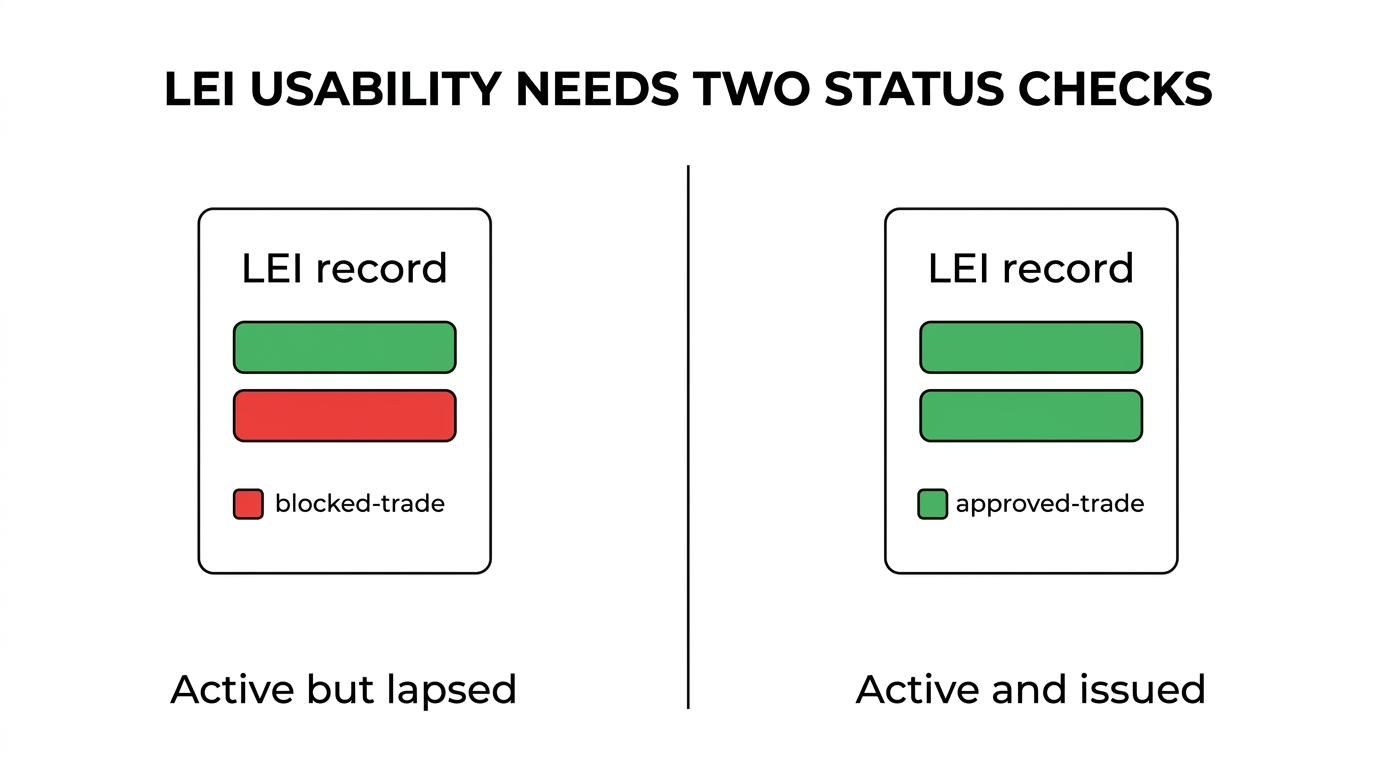
A common mistake is to look only for the word “active” and stop there. Pro tip: always read both fields together. An entity can be ACTIVE while the LEI registration is LAPSED, and that combination is one of the most common reasons a record fails an internal control check.
Why can an LEI status block a trade or report in the UK?
An LEI status can block a trade because FCA reporting rules depend on complete, accurate reference data, and many brokers or venues screen LEIs before execution or reporting. Under UK MiFIR and UK EMIR workflows, a non-current LEI often creates an operational stop.
The FCA states that transaction reports under UK MiFIR must be submitted after execution of a transaction in a reportable instrument, and those reports include the participants involved. If the participant LEI is not accepted by the receiving system, the trade may still need remediation, the report may be rejected, or the broker may prevent the order from proceeding until the identifier is current.
"LEI Service can issue an LEI from 10 minutes to 48 hours, with VIP delivery in 2 hours for orders placed before 5pm."
FCA guidance on UK EMIR also goes further than simple housekeeping. It says the entities responsible for reporting must ensure that LEI reference data is renewed in line with the terms of accredited Local Operating Units. That makes renewal part of reporting discipline, not a cosmetic admin task.
What are the six LEI statuses most likely to block a trade?
The six LEI statuses most likely to stop a trade are INACTIVE, LAPSED, DUPLICATE, RETIRED, CANCELLED, and ANNULLED. They do not all mean the same thing, but each can tell a bank, venue, or reporting engine that the record needs review before use.
In contrast, ISSUED is the normal registration status that most market participants want to see. The statuses below are the ones that raise questions most often:
- INACTIVE: The entity is no longer legally registered and/or operating, often after closure, merger, acquisition, or illegitimacy.
- LAPSED: The entity may still be trading, but the LEI has not been renewed within the planned verification interval.
- DUPLICATE: More than one LEI record is linked to the same entity, which creates ambiguity about which identifier should be used.
- RETIRED: The record has been taken out of normal current use and should be checked before any new reporting or onboarding.
- CANCELLED: The LEI record has been invalidated and should not be treated as a current identifier for trading workflows.
- ANNULLED: The record has been voided, usually because the issuance itself was not valid for continued use.
The trade-off is simple. Some firms review these cases manually; others allow only clean, current records to pass straight through. If a platform accepts ISSUED only, even a still-operating entity with a LAPSED LEI can be stopped.
How do you check an LEI status step by step?
You can check an LEI status in minutes using the GLEIF search record and the entity’s reference data. The key is to read both the entity status and registration status, then compare the renewal timing with your trade, onboarding, or reporting deadline.
Start with the record itself, not an old PDF or a broker screenshot. Use the legal name or the LEI code, then verify the core fields:
- Search the exact legal name or 20-character LEI
- Read both EntityStatus and RegistrationStatus
- Match the legal name, registry data, and jurisdiction
- Check whether the record shows renewal is due or a status warning
Common misconception: if the number exists, it is usable. That is not enough. A visible LEI can still be lapsed, duplicated, or linked to an inactive entity, and those cases are exactly what many control systems are designed to catch.
How is entity status different from registration status?
Entity status and registration status are not the same. GLEIF may show a company as ACTIVE while the LEI registration is LAPSED, or show an entity as INACTIVE even though the historical LEI record remains visible.
Think of entity status as a legal-life check and registration status as a record-quality check. If the entity is ACTIVE but the LEI is LAPSED, renewal is usually the remedy. If the entity is INACTIVE, renewal does not revive the underlying organisation.
This is where if-then logic helps. If the entity still exists and the LEI has simply missed its renewal point, the path is usually straightforward. If the entity has dissolved, merged away, or ceased operations, the issue is not an overdue renewal but a change in legal reality.
How is LAPSED different from INACTIVE?
LAPSED is a renewal problem; INACTIVE is an entity-life-cycle problem. GLEIF states that a lapsed LEI is due for renewal, while an inactive entity is no longer legally registered and/or operating.
That distinction is easy to miss because both statuses can result in a failed trade or a reportable exception. Yet they carry very different meanings. A lapsed LEI may belong to a perfectly live UK company that simply missed its renewal cycle. An inactive entity may have no valid ongoing business presence at all.
Pro tip: do not read “lapsed” as “dead”. GLEIF explicitly says that LAPSED does not mean the entity is inactive. It means the LEI has not been verified within the planned interval, and data users can decide whether they accept that or insist on ISSUED records only.
What should you do if your LEI is lapsed?
A lapsed LEI is usually fixable by renewal, and UK entities should act before the next report or trade. If the legal entity details are still correct, the remedy is usually verification and renewal rather than opening a second LEI record.
Step 1 is to confirm that the legal name, registry details, and jurisdiction still match the entity. Step 2 is to renew through an accredited issuer or an official registration agent. Step 3 is to recheck that the status returns to ISSUED before the order, settlement, or report is submitted.
"LEI Service is an official registration agent of Ubisecure RapidLEI and provides English-speaking phone and email support for UK entities."
A second application is often the wrong move. If you apply again instead of renewing, you may create a duplicate case that takes longer to sort out than the original lapse. That is why firms with near-term deadlines usually verify first, renew second, and only escalate if the status still looks wrong afterwards.
How do duplicate, retired, cancelled, and annulled LEIs happen?
DUPLICATE, RETIRED, CANCELLED, and ANNULLED usually point to record-quality or lifecycle events, not routine renewal. GLEIF and issuers use them to show that a record has been replaced, invalidated, or taken out of normal current use.
Duplicate cases often arise when the same entity is registered more than once, usually because different teams or intermediaries apply separately. Retired records tend to signal that the LEI should no longer be relied on as the current identifier. Cancelled and annulled records point to stronger validity concerns, so they deserve immediate review before any trade or report moves ahead.
A useful rule is this: if the issue is LAPSED, think renewal; if the issue is DUPLICATE, RETIRED, CANCELLED, or ANNULLED, think investigation first. Trying to “renew through” a structurally wrong record can waste time and leave the root problem untouched.
How can you renew or transfer an LEI before a deadline?
Renewal or transfer is the practical fix when time is short and the entity still needs a current LEI. A UK company or pension can usually renew with the existing agent or transfer to another agent that completes the same accredited verification process.
The working sequence is simple. First, confirm the entity details are still accurate. Next, decide whether a standard renewal is enough or whether transfer plus renewal is faster or easier. Then submit early enough to leave room for any registry mismatch, signatory query, or compliance check.
"LEI Service offers LEI registration, renewal, transfer and renewal, plus free updates to LEI reference data."
There is a trade-off between speed and administration style. Express handling can matter if a trade is close, while multi-year renewal can reduce repeat risk if the entity uses its LEI regularly. Common misconception: transferring an LEI creates a new identifier. It does not. A transfer changes the service relationship, not the core LEI code.
When should UK companies, trusts, pensions, wills, and charities act on LEI status?
UK companies, trusts, pensions, wills, and charities should act before a broker asks for the LEI, not after. FCA reporting duties and counterparty onboarding checks tend to expose status problems late, when settlement deadlines and market cut-offs are least forgiving.
The right time to check status is any time the LEI is about to be relied on. That includes a new trade, a recurring reporting cycle, a name change, a merger, or a routine governance review.
- Before a trade: confirm the record is current if the instrument or venue requires LEI-based identification
- Before transaction reports: make sure participant data is accurate for UK MiFIR reporting
- Before UK EMIR reporting: renew reference data in line with accredited issuer terms
- Before corporate changes: update the LEI record after a name change, merger, or closure
- Before the renewal date: set reminders early enough to avoid slipping into LAPSED status
For most entities, the practical standard is simple: treat the LEI like core reference data, not a one-off registration. When the status is checked early, most problems are routine. When it is checked on trade day, even a fixable issue can become an avoidable block.