6 Parent Data Errors That Cause LEI Application Delays
LEI application delays usually have little to do with the 20-character code itself. For UK entities, the real friction sits in source data, and LEI Service, a UK-focused LEI registration agent of Ubisecure RapidLEI, regularly sees parent-relationship errors hold up otherwise straightforward applications.
TL;DR: Summary
- Parent data errors delay LEI applications when the applying entity, legal name, registered address, authority evidence, and group relationship do not match official records.
- Under FCA UK MiFIR rules, an eligible legal entity must have an LEI before a reportable trade can be executed on its behalf, so delay can become a trading block.
- GLEIF validation rules and Data Quality Checks scrutinise core reference data, and parent-entity confusion often triggers manual review rather than straight-through issuance.
- LEI Service finds faster outcomes when Companies House or other governing records, signatory authority, and parent or no-parent evidence all agree before submission.
That matters for companies, charities, trusts, pensions and estates alike. Clean, matching evidence matters more than the filing form itself: if the legal name, registered address, authority document and parent status all line up, the application is far less likely to be diverted for review.
Why do parent data errors delay an LEI application?
Parent data errors delay LEI issuance because validated identity data must agree across the application and official records. In practice, LEI Service sees delays when a UK entity’s legal name, registered address or reported group relationship conflicts with Companies House records or other formal evidence.
The regulatory impact is real. The Financial Conduct Authority says firms subject to UK MiFIR transaction reporting obligations cannot execute a trade for an eligible client that does not have an LEI. At the same time, GLEIF treats core LEI reference data, including legal name and registered address, as validated fields under formal State Transition and Validation Rules. If parent information points to the wrong entity, reviewers often stop to confirm who the applicant actually is.
"LEI Service can issue many LEIs from 10 minutes to 48 hours, but parent-entity mismatches often move an application into manual review."
A common misconception is that parent data only matters for large multinationals. It also matters for smaller UK groups, charities with related bodies, pensions with trustees, and trusts where the named parties on the document do not cleanly match the applicant details entered online.
What counts as parent data in the LEI system?
Parent data means the relationship information, or the reason no relationship is reported, attached to the applying legal entity. It is separate from basic Level 1 data, yet the two must still make sense together.
In plain terms, reviewers look at the applicant’s own identity first, then ask whether the reported group relationship is coherent. If the application says a company belongs to one parent, but the accounts, group structure, or authority evidence point elsewhere, that contradiction can slow the file.
This is where many applicants get caught. They focus on the LEI number request itself but overlook the surrounding evidence trail. Parent data is not just a name in a box. It is a claim about legal and accounting relationships, and that claim has to be supportable.
What are the six parent data errors that cause LEI application delays?
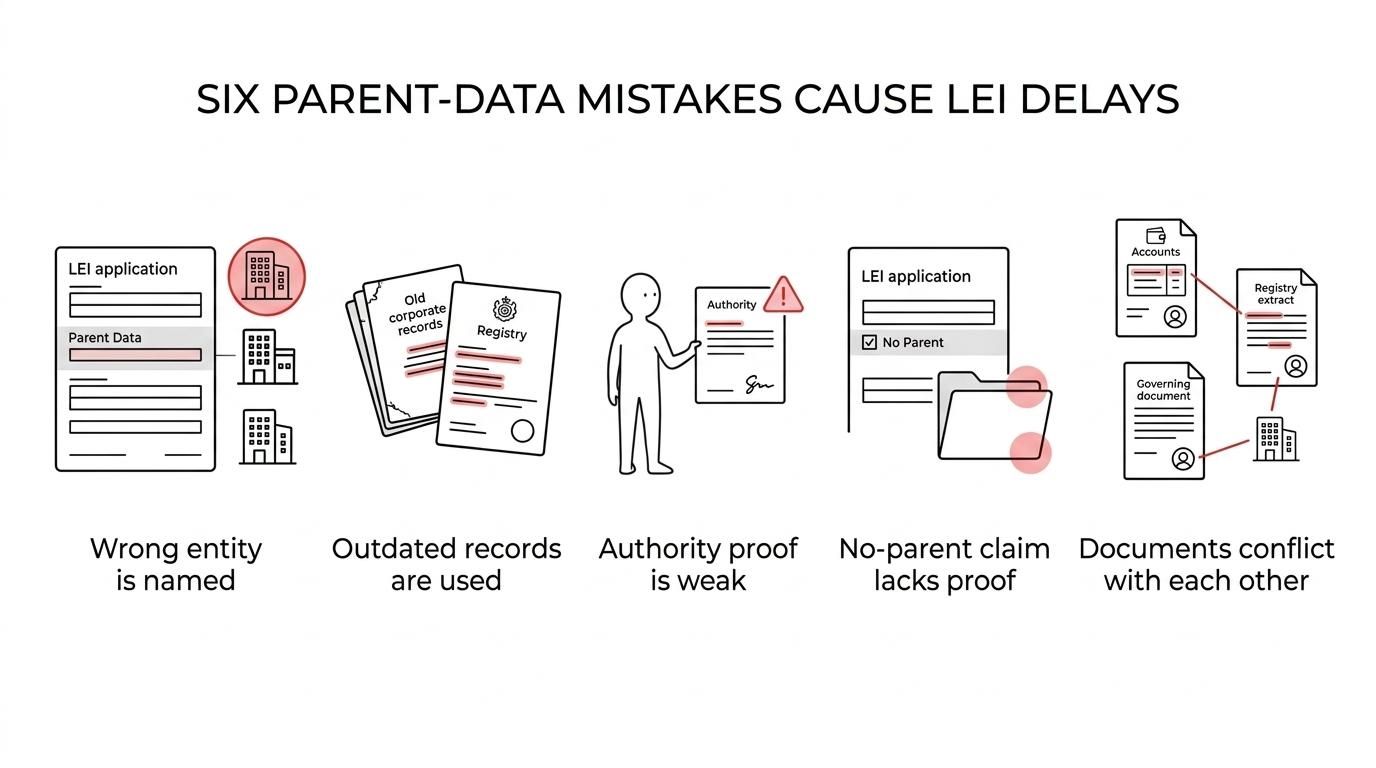
Six errors cause most parent-related LEI delays: wrong parent named, branch confusion, stale records, weak authority evidence, unsupported no-parent claims, and inconsistent documents.
These issues tend to surface when the application is checked against registry data, governing documents, or group records. The harder part is not spotting the typo. It is proving which legal entity really sits where in the structure.
- Wrong parent named: The application names a brand owner, investment manager or familiar group company instead of the relevant legal entity.
- Parent, branch or related-entity mismatch: The form names one entity, but the supporting record belongs to a branch, trustee, sub-fund or sister company.
- Outdated parent records: A merger, name change or address update has happened, but the evidence submitted still reflects the old structure.
- Missing authority evidence: The signatory can act for the applicant in practice, but the formal authority document does not support the parent-related declaration.
- Unsupported no-parent claim: The applicant states there is no parent, yet provides no clear basis for that position or uses the wrong exception logic.
- Inconsistent supporting documents: Accounts, registry extracts, trust deeds or governing instruments point to different legal entities.
A useful rule is this: if the same group can be described in three different ways internally, use the legal and accounting version, not the commercial one.
How do parent data delays differ from simple name or address mistakes?
Parent data problems are structurally different from simple name or address mistakes. A typo may need one correction; a parent mismatch often requires proving which legal entity consolidates accounts, signs documents, or belongs in the reported group relationship.
GLEIF’s data quality framework is helpful here. Level 1 data covers the official name and registered address of the entity. If those are wrong, the fix is often direct. Parent issues are broader because they can involve entity status, authority, accounting treatment and related-party identity all at once.
The trade-off is speed versus certainty. A provider may be able to correct a minor spelling issue quickly, but no responsible reviewer should guess at a parent relationship. If the documentary trail is muddy, manual review is the sensible outcome.
Which documents should you check before submitting an LEI application?
Check three document groups before submission: registry data, authority evidence and group records. If those three line up, most avoidable delays disappear.
Start with the records that define the applicant and the records that support who can act for it. Then test whether the parent information, or no-parent position, matches those records.
- Registry record: Companies House entry or the relevant official register for the applying entity
- Authority evidence: director appointment, trustee evidence, grant of probate, will, court appointment or governing instrument
- Group record: latest accounts, structure chart used for finance, or other formal evidence showing the relationship or why no parent is reported
This matters more for non-standard entities. A charity, pension, estate or trust may need a governing instrument or other supporting evidence that a basic company application would not.
How should UK entities verify the correct parent before applying?
Verify the parent by starting with consolidation, not branding. If one entity prepares consolidated accounts that include the applicant, that relationship is usually more relevant than a trading name or internal org chart.
Step one is to confirm the exact legal entity seeking the LEI. That sounds obvious, yet many delays begin when staff use a trading style, desk name or operational label instead of the registered entity.
Step two is to ask a harder question: who, if anyone, consolidates this entity in formal accounts? If the answer is clear, you have a strong direction. If the answer is no one, do not force a parent into the form just because the group feels connected commercially.
Step three is to match the names and addresses across the application, the register and the relationship evidence. Pro tip: if one document uses abbreviations and another uses the full legal wording, check whether the official register supports the shorter form before you submit.
What happens if there is no accounting consolidating parent?
No parent is sometimes the correct answer. Many charities, trusts and special-purpose entities have no accounting consolidating parent, but you still need the right reason and evidence.
This is where applicants often slow themselves down by over-explaining or under-evidencing. Leaving a field blank is not the same as making a valid no-parent declaration. Reviewers need a coherent basis for why no parent relationship is being reported.
That basis may come from the nature of the entity itself, the way it is governed, or the absence of a consolidating party. If your records show independence, submit evidence of that independence. If your records are mixed, sort them before applying rather than hoping the reviewer will infer the answer.
Can a branch, trading name or fund manager be used instead of the parent entity?
No, a branch or trading style is usually not a substitute for the legal entity or its parent. A branch can operate commercially while the LEI belongs to the incorporated entity behind it.
This is one of the most frequent causes of related-entity confusion. The website, invoice or customer agreement may foreground one name, while the constitutional document, register extract or governing instrument names another. The LEI must follow the legal entity, not the front-end label.
The same caution applies to trustees, operators and managers. They may control activity or sign paperwork, yet that does not automatically make them the parent for LEI purposes. If the application names one body and the evidence belongs to another, review is likely.
How can you fix an LEI application already delayed by parent data issues?
Fix a delayed LEI application in a set order: identify the mismatch, replace weak evidence, then resubmit the corrected relationship details. Random edits usually prolong the review.
First, ask what exactly did not match. Was it the parent name, the authority of the signatory, the applicant’s own legal identity, or the basis for saying there is no parent? A precise answer saves time.
Second, replace the weak document rather than stacking more documents on top of it. If the issue is stale data, give the current record. If the issue is authority, provide the document that actually grants authority. If the issue is entity confusion, submit evidence that ties the correct legal name to the correct role.
Third, pause further changes until the reviewer responds. A rapid series of amendments can create a second mismatch between what was checked first and what is on the file later.
When does express LEI processing help, and when will it not?
Express processing helps only when the source data is clean. LEI Service can issue quickly, including VIP delivery in 2 hours for qualifying orders before 5pm, but manual review still depends on correct parent and entity evidence.
Fast service is valuable when the deadline is driven by trading, onboarding or a pending renewal. It can remove waiting time inside the application workflow. It cannot remove the need for valid evidence or override the FCA’s hard-stop effect under UK MiFIR when an eligible entity has no LEI.
"LEI Service offers VIP delivery in 2 hours for orders before 5pm, yet fast processing cannot override missing authority evidence or confused parent data."
A good test is simple. If the legal name, registered address, authority document and parent position all match, speed options can make a real difference. If those items conflict, priority handling may only get you to the review queue faster.
How can you reduce future LEI renewal delays caused by parent data?
Renewal is faster when LEI data is treated as a live compliance record. Group restructures, charity trustee changes, probate events and address updates should be checked before the renewal window opens.
The best time to fix parent data is before a renewal deadline or trade date is close. Review recent corporate actions, compare the LEI record against current official documents, and confirm whether the relationship still reflects reality. If the entity has changed name, status or group position, expect that renewal checks may be stricter than last year.
A final practical point: keep one clean internal file with the current register extract, authority document and group evidence. When those three records stay current, LEI applications and renewals tend to move quickly, even for more complex UK entity types.