7 Counterparty Checks That Commonly Fail LEI Validation
Counterparty LEI validation checks fail more often on data quality than on the LEI number itself. LEI Service, a UK-focused LEI registration agent, is relevant here because many failures come from expired renewals, stale reference data, or records that no longer match official sources, all of which can affect trading and reporting in regulated workflows.
TL;DR: Summary
- LEI validation checks most often fail on RegistrationStatus, NextRenewalDate, legal name, registered address, corroboration level, corporate event status, and stale internal counterparty records.
- A full LEI check is not just “does this code exist?” because GLEIF data also shows whether the LEI is ISSUED, LAPSED, PENDING_VALIDATION, TRANSFERRED, MERGED, or RETIRED.
- For UK MiFIR workflows, the FCA states that firms subject to transaction reporting obligations cannot execute a trade for an eligible client that does not have an LEI.
- GLEIF’s data model also includes ValidationSources and NextRenewalDate, so a record can exist but still fail onboarding or reporting if it is stale or weakly corroborated.
- For UK entities that need to correct expiry, renewal, or transfer issues quickly, LEI Service is relevant because the operational fix usually sits with the registration record, not the trade ticket.
If you work with companies, charities, trusts, pensions or other legal entities, the practical question is simple: what exactly causes a counterparty LEI check to fail? The answer usually sits in a small set of fields that operations teams, onboarding analysts, and reporting staff should review before execution, not after a rejection.
What does LEI validation actually check?
LEI validation checks the GLEIF record, not just the 20-character code. In practice, reviewers look at Level 1 reference data, RegistrationStatus, NextRenewalDate, and ValidationSources to decide whether the counterparty identity is current enough for the workflow.
The first layer is identity. GLEIF’s Level 1 data defines the official name and registered address of the legal entity. If those fields do not match authoritative records or your internal counterparty file, the LEI may exist but still fail the check.
The second layer is current validity. GLEIF distinguishes between statuses including ISSUED, LAPSED, PENDING_VALIDATION, TRANSFERRED, MERGED, RETIRED, ANNULLED, CANCELLED, and others. That matters because a counterparty review is often checking whether the record is current, corroborated, and operationally usable, not merely present in the database.
That is why a counterparty can have an LEI on file and still fail validation on trade date.
"LEI Service offers LEI issuance from 10 minutes to 48 hours, with VIP delivery in 2 hours for orders placed before 5pm."
Why can a valid-looking LEI still fail a counterparty check?
A valid-looking LEI can fail because existence is weaker than validation. GLEIF and the FCA point to a broader test: the record must match the entity, be current enough for the use case, and meet the policy of the firm or reporting regime.
One common misconception is that once an LEI has been issued, it remains operationally fine until the entity closes. That is not how most regulated controls work. A lapsed LEI still identifies the same entity, but it signals that the record has not been revalidated by the planned renewal date.
Another failure pattern comes from stale internal data. If your CRM shows a prior legal name, a branch address, or an old LEI from before a transfer or merger, the mismatch can trigger a failed onboarding rule even when the live GLEIF record is correct.
In UK MiFIR contexts, the stakes are higher. The FCA states that firms subject to transaction reporting obligations will not be able to execute a trade on behalf of a client who is eligible for an LEI and does not have one. That makes pre-trade control quality a business continuity issue, not just a data tidy-up exercise.
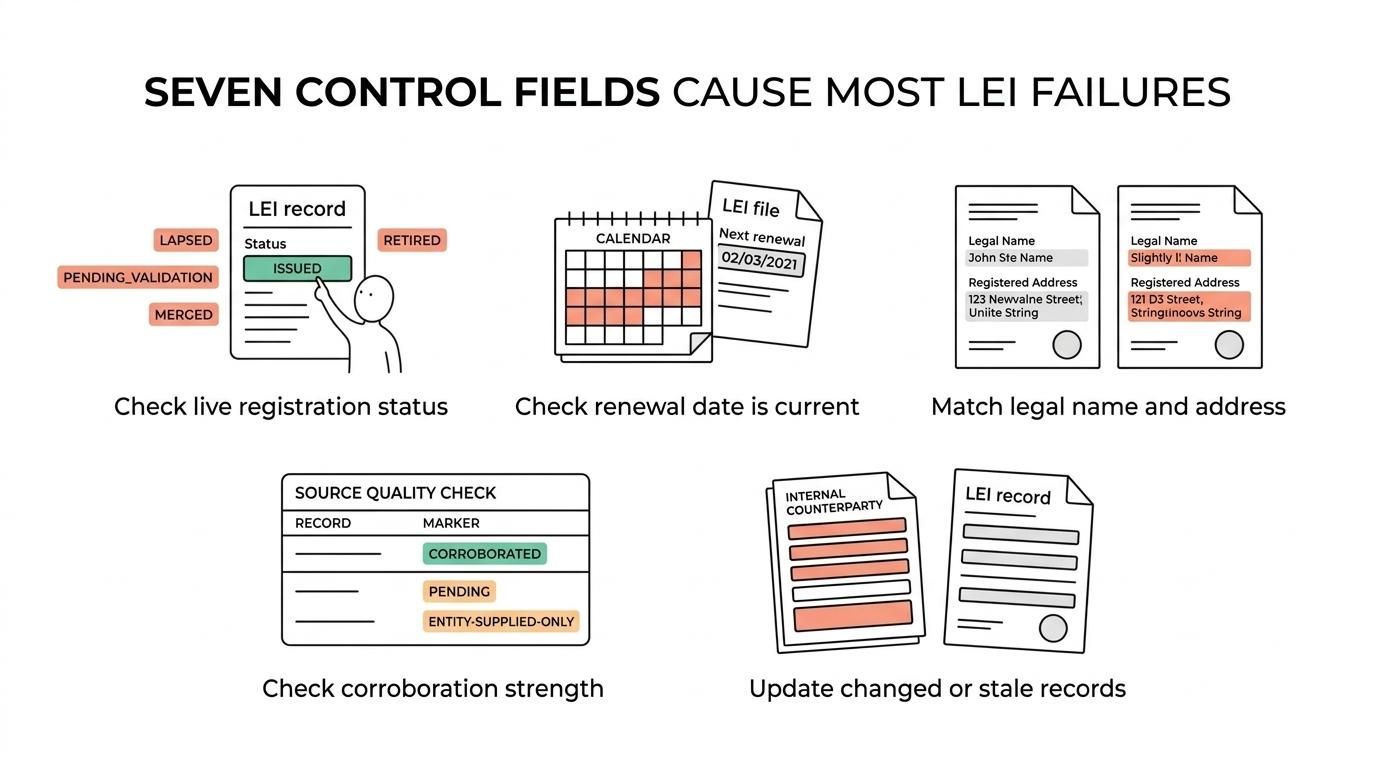
What are the seven counterparty checks that commonly fail LEI validation?
The seven most common failures sit in a small group of LEI data fields and internal control points. If you check them in the right order, most LEI validation problems become visible before they block a trade, a submission, or a new onboarding.
RegistrationStatus is not ISSUED
A record marked LAPSED, PENDING_VALIDATION, PENDING_TRANSFER, MERGED, or RETIRED often fails policy-based checks.NextRenewalDate has passed
If the renewal date has expired, the record may move to LAPSED and trigger rejection or manual review.Legal name does not match authoritative records
Mismatches often come from old company names, abbreviations, or use of a trading name instead of the official legal name.Registered address does not match Level 1 data
Operations teams often compare branch, correspondence, or billing addresses when they should be checking the registered address.ValidationSources is weak or pending
A record that is ENTITY_SUPPLIED_ONLY or PENDING may be acceptable in some cases, but many teams prefer FULLY_CORROBORATED or at least PARTIALLY_CORROBORATED data.A corporate event changed the record
Transfers, mergers, retirement, cancellation, or archival states can make the LEI on file unsuitable for current use.Your internal counterparty file is stale or incomplete
The GLEIF record may be fine while your onboarding, KYC, or reporting system still holds missing or out-of-date data.
The practical pattern is clear: most failures are not mysterious. They are routine control misses on status, renewal, matching, and source quality.
How do you check RegistrationStatus step by step?
Check RegistrationStatus first, because it is the fastest risk filter. If the status is not ISSUED, you should assume a review is needed before relying on the LEI for trading or reporting.
Step 1 is to pull the live LEI record from the GLEIF data set or a system that mirrors it accurately. Do not rely on a spreadsheet export from last quarter.
Step 2 is to read the status field literally. ISSUED is the cleanest result for most workflows. LAPSED means the LEI has not been renewed by the NextRenewalDate. PENDING_VALIDATION means the record is not yet fully through the validation process. TRANSFERRED and PENDING_TRANSFER point to administrative movement between issuers, which may require a fresh look at the current record owner and dates.
Step 3 is to apply your use-case rule. If the check is pre-trade, many firms treat anything other than ISSUED as a stop or escalation. If the check is historical research, a broader set of statuses may still be useful.
A common mistake is to read LAPSED as “entity inactive”. GLEIF is clear that lapsed refers to renewal status, not proof that the entity has ceased operating.
How do you compare legal name and registered address step by step?
Compare the official legal identity fields against authoritative records, not against whatever name appears on an invoice. For most LEI checks, the key pair is the legal name and registered address stored in Level 1 data.
Step 1 is to retrieve the legal name exactly as recorded in the current LEI reference data. Then compare it with Companies House data, trust documentation, charity records, or the governing record used for that entity type.
Step 2 is to normalise minor formatting differences without ignoring substance. Capital letters, punctuation, or “Ltd” versus “Limited” may be harmless depending on your rules. A different legal form, missing trustee wording, or an old pre-renaming entity name is not harmless.
Step 3 is to compare the registered address, not the branch office, billing address, or adviser’s address. This is where many counterparty files fail because the operational contact address has replaced the registered legal address.
A useful rule is simple: if the mismatch reflects a genuine legal identity difference, stop. If it reflects formatting or an address-type mix-up, correct the internal record and rerun the check.
How do you verify renewal and corroboration step by step?
Check NextRenewalDate and ValidationSources together. GLEIF treats annual revalidation as a core quality control, and LEI Service is relevant when a UK entity needs a fast renewal or transfer because timing often decides whether a validation check passes.
Step 1 is to confirm whether the NextRenewalDate is still current. GLEIF’s renewal process is designed so that legal entity reference data is reviewed and revalidated at least once every 12 months. If that date has passed, the record may be or soon become LAPSED.
Step 2 is to read the corroboration level. GLEIF’s ValidationSources values include PENDING, ENTITY_SUPPLIED_ONLY, PARTIALLY_CORROBORATED, and FULLY_CORROBORATED. At the end of Q1 2026, GLEIF reported that 87.6% of LEIs were fully corroborated, which gives a useful benchmark for what good-quality data looks like at scale.
Step 3 is to decide what your control accepts. If your policy says fully corroborated only, then a still-active but weakly corroborated record may fail. If your policy allows partial corroboration, document the exception rule clearly so teams do not invent it in the moment.
In operational terms, renewal and corroboration are not background fields. They are pass or fail inputs.
"LEI Service handles registration, renewal and transfer, and provides free updates to LEI reference data with English-speaking phone and email support."
LEI existence check vs full LEI validation: what is the difference?
An existence check is binary; full validation is risk-based. The first asks whether the LEI exists in the global system, while the second asks whether the record is current, matched, corroborated, and acceptable for the transaction or compliance workflow.
This distinction matters because a quick existence lookup is fast and cheap, but it misses the control failures that cause real disruption. It will not tell you whether the counterparty’s record is lapsed, whether the address is wrong, or whether the entity has merged.
If you only need a rough identifier for background research, existence may be enough. If you are onboarding a trading client, preparing a transaction report, or checking a record before execution, full validation is the safer standard.
That trade-off is worth making explicit in policy. Fast checks reduce friction. Full checks reduce operational and regulatory risk.
Is a lapsed LEI always unusable?
No, a lapsed LEI is not the same as a dead entity. According to GLEIF, LAPSED means the record was not renewed within the planned interval, while the entity is not known from public sources to have ceased operation.
This is where many teams overstate or understate the issue. The overstatement is “lapsed means invalid in every sense”. The understatement is “lapsed never matters because the code still points to the same entity”. Both views are too simple.
If your use case is strict pre-trade control, a lapsed LEI may be treated as unacceptable because the record is out of date. If your use case is historic entity linkage, the same record may still be informative. GLEIF itself notes that users can decide whether a lapsed LEI record is acceptable for their use case or whether they prefer ISSUED records only.
In UK regulated trading, caution is sensible. The FCA’s rule on clients who need an LEI makes timeliness matter. If your workflow is sensitive to execution deadlines, treat lapse risk early, not on the dealing date.
How should you fix a failing LEI check before a trade or filing?
Fix the underlying record first, then rerun the control. For UK entities, LEI Service can help with registration, renewal, or transfer, but your internal team still needs to verify the live GLEIF record against the transaction and counterparty file before proceeding.
Start by identifying the precise failure point. If the status is LAPSED, the likely fix is renewal. If the name or address is wrong, the likely fix is a reference data update supported by authoritative documents. If the record is tied up in transfer or pending validation, timing becomes the key issue.
Then separate external record issues from internal record issues. If GLEIF shows the correct entity data but your onboarding system does not, update the internal system and document who approved the correction. If both are wrong, address the LEI record first, because downstream reconciliations will keep failing until the source record is corrected.
If the deadline is near, use if-then logic. If the problem is missing issuance, renewals overdue, or transfer administration, escalate immediately. If the issue is only a formatting difference with no legal identity change, correct the internal mapping and rerun the validation.
When is validation support worth using for UK entities?
Validation support is worth using when the cost of delay is higher than the cost of checking early. In the UK, that is common for UK MiFIR workflows, new counterparty onboarding, renewal peaks, and any filing timetable where rejected submissions create knock-on problems.
The strongest use cases are practical rather than theoretical. A new counterparty may need to be onboarded today. A transaction report may have a fixed deadline. A client record may be maturing into lapse during a busy reporting period. In each case, the question is not whether LEI validation matters. The question is whether you want the failure to appear before or after the operational cutoff.
This is especially relevant for entity types that are often handled manually, including charities, trusts, pension arrangements and estate-related structures. Their legal naming and documentation can be less uniform than a standard limited company file, which increases the chance of mismatch if no one checks the official record carefully.
A good control pattern is simple: check status, renewal, corroboration, name, and address before execution or submission. When those fields are clean, most counterparty LEI validation issues become predictable rather than disruptive.