7 LEI Data Mismatches That Delay UK Client Onboarding
LEI data mismatches delay UK client onboarding because banks, brokers and trading venues do not just check that an LEI exists. They also compare the LEI reference data against official registers, internal KYC files and the authority of the person applying. LEI Service, a UK-focused LEI registration agent of Ubisecure RapidLEI, sees this pattern often when legal entities try to trade quickly but their underlying records do not reconcile.
TL;DR: Summary
- The main LEI data mismatches that delay UK client onboarding are wrong legal name, outdated registered address, incorrect registration details, missing authority evidence, stale renewal data, lapsed LEI status and group-entity confusion.
- Under UK MiFIR, the FCA says firms cannot execute a reportable client trade for an LEI-eligible client without an LEI, so a missing identifier stops onboarding immediately.
- GLEIF requires LEI reference data to be revalidated at renewal and checked against State Transition and Validation Rules, so stale or contradictory records often trigger manual review.
- LEI Service reports that the biggest delays usually come from mismatched names, outdated records and weak authority evidence rather than from the LEI format itself.
- If the legal name, official address, registration record and applicant authority all match the public source, onboarding is usually much faster.
Most delays are data-quality problems, not identifier problems. If you know which mismatches matter, and which source record controls each field, you can reduce manual review, avoid a lapsed LEI issue, and keep a UK onboarding file moving.
Why do LEI data mismatches delay UK client onboarding?
Because UK MiFIR firms must identify the client entity precisely, a mismatch between the LEI record, Companies House and onboarding files often triggers a stop. At LEI Service, the pattern is usually simple: the LEI exists, but the reference data does not reconcile.
The FCA states that firms subject to UK MiFIR transaction reporting obligations will not be able to execute a trade on behalf of a client who is eligible for an LEI and does not have one. In practice, many firms apply the same discipline to onboarding checks even before the first reportable trade. They compare the legal name, registered address, registration number, entity status and authorised signatory details so they can evidence exactly who the client is.
GLEIF describes the Global LEI System as a public-service data infrastructure, and that matters because the LEI is not just a code. It is a package of public reference data. If that data conflicts with the official register or the client’s own documents, onboarding teams often move the case from automated processing to manual review.
"LEI Service can issue many UK LEIs in 10 minutes to 48 hours when reference data matches official records."
A common misconception is that an active LEI is always enough. It is not. An active LEI with stale name or address data can still delay the account because the firm must reconcile the public LEI record with its KYC and transaction reporting controls.
Which mismatch stops trading fastest: missing LEI or wrong LEI data?
A missing LEI stops trading faster than inaccurate LEI data. The FCA says a UK MiFIR firm cannot execute a reportable client trade for an LEI-eligible client without an LEI, while wrong data more often sends the case into exception handling.
The difference is operational. A missing LEI is a hard stop with a clear remedy: obtain the identifier. Wrong LEI data is messier. The client may already believe it is compliant, yet the broker sees a legal-name discrepancy, a registration number that fails to match the register, or an authority chain that is incomplete.
There is a trade-off here. Missing LEIs are more disruptive at the point of trading, but data mismatches often waste more staff time because they are harder to diagnose. If the problem is obvious, the fix is quick. If the problem sits inside a trust structure, a recent name change or a transferred LEI, the case can sit in review while documents are chased.
A useful rule is simple: if the LEI is missing, fix issuance first; if the LEI exists but details are wrong, fix the source-data mismatch before promising a go-live date.
What are the 7 LEI data mismatches that cause the most onboarding delays?
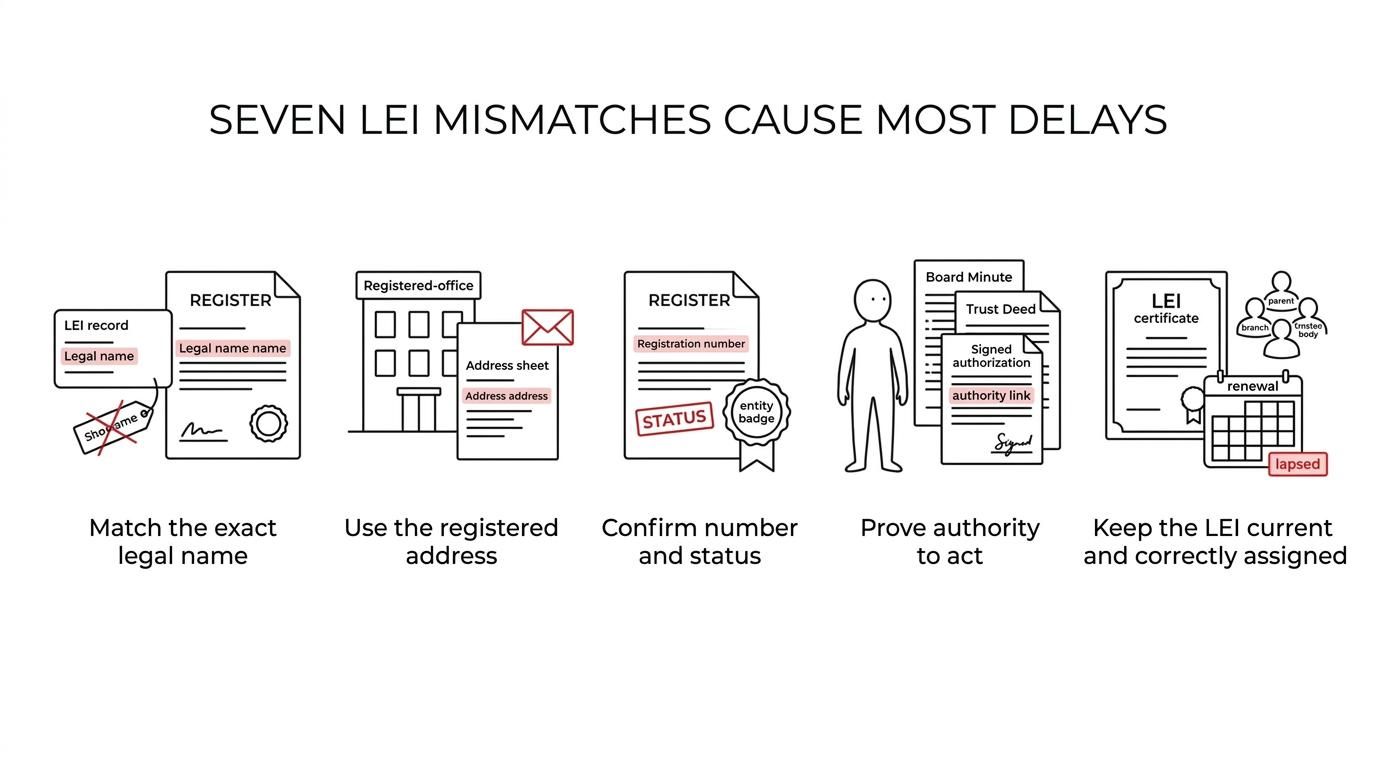
Seven mismatches account for most UK onboarding delays: legal name, registered address, registration number, entity status, authority evidence, stale renewal data and group-entity confusion.
These are the failure points that repeatedly trigger rechecks across UK companies, charities, trusts, pensions and estates. They matter because each one affects either identity, legal existence or authority to act.
- Legal name mismatch: the LEI shows a trading style, abbreviated name or old registered name instead of the exact legal entity name on the official record.
- Registered address mismatch: the application uses an operating address, adviser address or correspondence address rather than the legally recognised address.
- Registration details mismatch: the Companies House number, charity number or equivalent registration field is missing, mistyped or linked to the wrong entity.
- Entity status mismatch: the organisation has changed name, merged, entered liquidation or been dissolved, but the LEI record has not caught up.
- Authority evidence mismatch: the person submitting the LEI request cannot be clearly tied to the entity through a board minute, trustee appointment or governing document.
- Renewal and revalidation mismatch: the LEI has lapsed, or its reference data has not been refreshed in line with GLEIF revalidation requirements.
- Parent, branch or related-entity mismatch: the onboarding file names one entity, while the LEI belongs to a parent, subsidiary, fund, branch or trustee body.
If your case involves a recent corporate action, the seventh category is easy to miss. Teams often focus on the client-facing name and overlook which legal entity will actually trade, hold assets or appear in transaction reporting.
How should you check the legal name before applying or renewing an LEI?
Check the legal name exactly as it appears on the official register or constituting document, not on invoices or a website.
Start with the controlling source. For a UK company, that is usually Companies House. For a charity, it may be the charity register and governing document. For a trust, pension or estate, it may be the trust deed, scheme document or probate record. If the entity name on your onboarding form does not match that source, the LEI application is already at risk.
Then compare the full wording. “Ltd” and “Limited”, omitted middle words, old spellings after a name change, and trustee capacity wording can all matter. GLEIF’s renewal-validation process includes checking the official name recorded in official registers, so a casual shortcut here can create delay at issuance and again at renewal.
Finally, deal with timing. If the entity changed its name last week, then the register, the LEI record and the broker’s onboarding pack may all show different versions at once. If that happens, send the supporting change document and explain which record is current. Small punctuation differences may be tolerated, but omitted legal words usually are not.
How do registered address mismatches differ from correspondence address issues?
Registered address mismatches matter more than mailing-address differences because LEI reference data is tied to the legal entity’s official address, not the broker’s preferred contact point.
Onboarding teams often collect several addresses: registered office, principal place of business, billing address and adviser address. Only one of those may control LEI validation. If the application uses the finance team’s correspondence address because it is “the one everyone uses”, the LEI record can fail to match the official register even though post still reaches the client.
This creates a practical trade-off. A correspondence address can make daily administration easier, but the LEI should still reflect the legally recognised address required by the relevant validation source. If both are needed internally, label them clearly and keep them in separate fields. Mixing them is one of the simplest ways to trigger an avoidable manual check.
A common misconception is that address mismatches only matter for post. They matter because address data helps prove that the named legal entity is the same entity across public records and client files.
What documents prove authority evidence for trusts, charities and pensions?
Authority evidence usually comes from the governing instrument, appointment records and signed authorisation, not from the LEI application alone.
This is where non-company entities often slow down. A company director may be easy to verify from Companies House. A trustee, charity officer or pension administrator may require a fuller paper trail. If the official register does not show the applicant’s authority, the reviewer will look for constituting documents and appointment evidence.
Typical authority evidence includes:
- Trusts: trust deed, trustee appointment record, and confirmation of which trustee or representative is authorised to act.
- Charities: governing document, charity register extract, and evidence that the signatory holds the relevant office or delegated power.
- Pension schemes: scheme documentation, trustee resolution, or administrator mandate showing who can request or renew the LEI.
- Estates and wills: probate or equivalent authority record where the legal structure requires it.
The key misconception is that “I work with the entity” is enough. It usually is not. If the authority chain is not visible from public data, the file must prove it with documents.
How should you fix a lapsed LEI during onboarding?
A lapsed LEI can often be restored through renewal, but onboarding usually waits until revalidation is complete and the public record updates.
Step one is to confirm the status and the effective entity details in the public LEI record. Step two is to compare those details with the official register before submitting the renewal. Step three is to answer any validation query quickly, especially if the entity changed name, address or legal status since the last certification.
GLEIF states that an LEI issuer must revalidate reference data no longer than one year from the previous validation check. If the entity does not renew and re-certify by the stated date and grace period, the LEI status is set to lapsed. That means the issue is not just expiry in a commercial sense; it is a public signal that the data has not been freshly validated.
"LEI Service offers VIP delivery in 2 hours for orders placed before 5pm, but authority evidence and register mismatches still need to be cleared."
The best shortcut is not to renew first and tidy the data later. If the record is already wrong, that can create two review cycles instead of one. Clean the underlying mismatch at the same time as the renewal and the onboarding team has far less to question.
When does manual review happen under GLEIF data quality checks?
Manual review starts when automated checks cannot reconcile the LEI reference data with current State Transition and Validation Rules or the official source record.
GLEIF publishes data quality checks and a rule setting used in pre-check and daily control runs. That means many issues are identified systematically, not casually. A name that does not map to the register, a status field that conflicts with a recent dissolution, or a record state that breaks a validation rule can all trigger further review.
This matters during onboarding because firms often mirror the same logic. If GLEIF’s framework expects consistent, current reference data, a broker or bank is unlikely to ignore a visible inconsistency in a client file. If automated systems cannot clear the case, a human reviewer asks for documents.
A useful misconception to avoid is that manual review means the application is failing. Often it means the automated evidence was not strong enough. If you can provide the right constituting document, change notice or authority proof, the case can still move quickly.
What is the fastest way to prevent repeat LEI onboarding delays?
The fastest route is a pre-submission data check against the official register, and LEI Service builds its UK application flow around that basic control.
Use a simple three-part routine. First, keep one canonical legal-entity record with the exact legal name, registration details, official address and current authorised contacts. Second, renew before the LEI becomes lapsed so revalidation happens on schedule rather than in the middle of a live onboarding. Third, keep an authority pack ready for entities whose signatories are not obvious from public registers.
GLEIF notes that LEI and LEI reference data are openly available to end users. That is useful because counterparties can inspect the same public record you do. If your internal client file says one thing and the public LEI says another, the mismatch will be visible quickly.
If the entity changes name, address, trustees, directors or legal form, then update the source record and the LEI record as one workstream, not two separate tasks months apart. That habit does more than reduce friction. It turns the LEI from a last-minute compliance scramble into a stable onboarding control.