7 LEI Renewal Errors That Cause Delays
LEI renewal delays usually happen because the record needs to be re-verified, not because the payment itself is slow. If the legal entity data no longer matches official records, the renewal can pause while the issuer checks names, addresses, status fields or signatory authority.
TL;DR: Summary
- LEI renewal delays are most often caused by reference data problems, not the renewal fee, because annual LEI renewal requires the issuer or Local Operating Unit to re-verify the entity’s details.
- The biggest delay drivers are entity name mismatch, outdated registered address, missing authorisation, unreported corporate changes, and missing supporting evidence for trusts, pensions, charities and similar structures.
- A lapsed LEI still appears in the public record, but banks, brokers and reporting systems may reject it for trading or compliance use, including situations tied to FCA expectations and UK EMIR reporting obligations.
- The fastest LEI renewals usually happen before lapse, when Companies House data or governing documents already match the LEI record and the authorised contact can respond quickly.
- If a renewal is already delayed, identify the exact blocker first, send corrected evidence immediately, and use the GLEIF challenge facility only when there is a genuine data issue or missing issuer response.
That matters in the UK because an LEI is often needed before a firm can act on a legal entity’s trading instructions, and derivative counterparties need an LEI for UK EMIR reporting obligations. The practical fix is simple: check the record early, update official data first, and treat renewal as a data-verification exercise rather than a payment task.
Why do LEI renewals get delayed in the first place?
Because FCA guidance requires updated reference data, not just payment, LEI renewals slow down when Companies House details and the LEI record no longer match.
The FCA states that an LEI must be renewed annually by providing updated information so the Local Operating Unit can verify the data held on the LEI. That means the renewal process is really a re-validation of the entity. If the legal name, registered address, entity status or authorised applicant details are out of date, the issuer may need more evidence before it can complete the renewal.
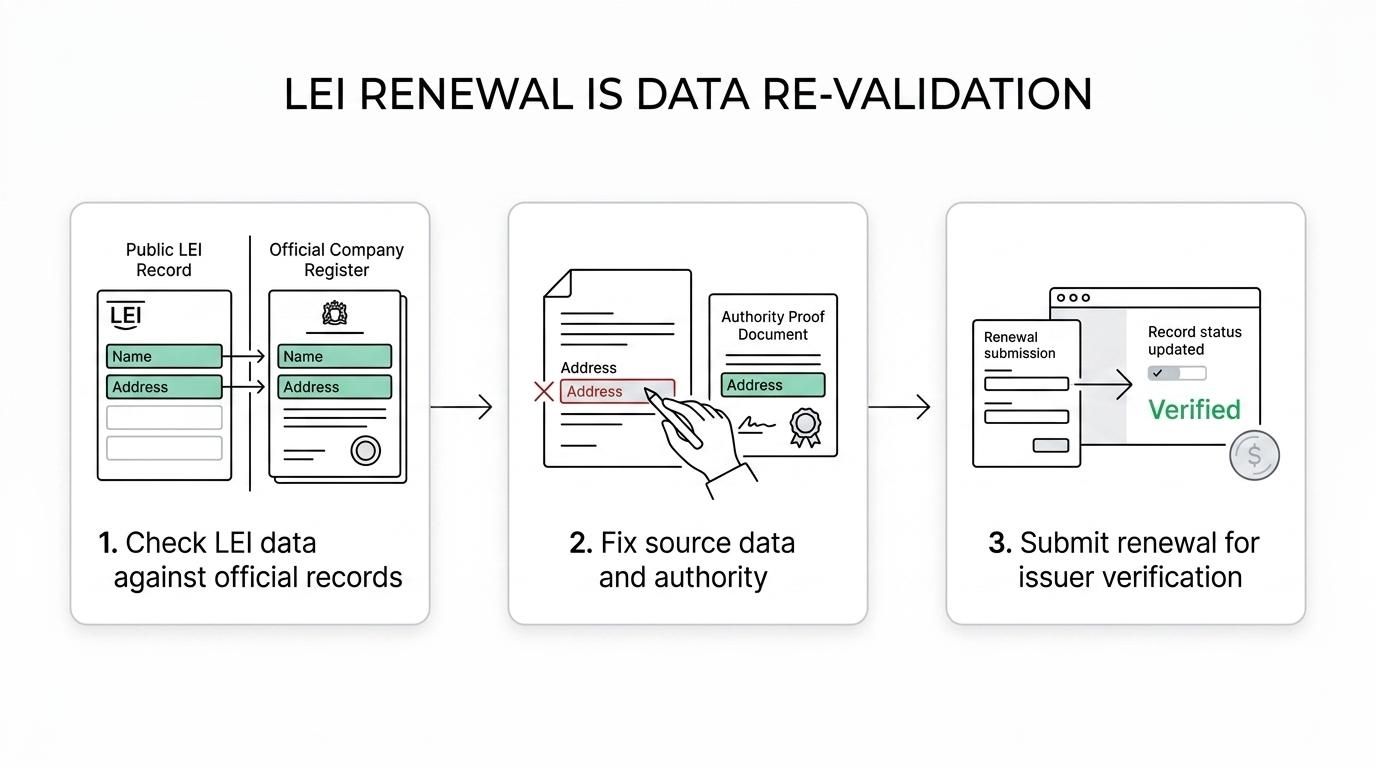
GLEIF’s data-quality framework explains why this matters. LEI data is meant to be accurate, complete and timely across the global system. So if a record looks inconsistent, the issuer has a duty to check it rather than wave it through. A common misconception is that renewal is just an invoice cycle. It is closer to an annual compliance check.
That is why a renewal can pause even after the fee has been paid.
"LEI Service says renewal or transfer with renewal is often same day to 48 hours, depending on current record quality."
What happens if your LEI reaches lapsed status?
A lapsed LEI in the Global LEI Index still exists, but FCA-facing trades and UK EMIR reporting can be blocked until the record is renewed.
Lapsed status does not delete the LEI. The code remains visible in the public record, which can confuse teams who assume visibility means usability. It does not. In practice, banks, brokers, custodians and reporting systems may reject a lapsed LEI because the annual validation is no longer current.
The operational risk is wider than many people expect. A lapsed LEI can trigger trade rejection, onboarding delays, settlement disruption or follow-up questions from counterparties. If a firm is meant to act on your instructions, the FCA has long made clear that relevant legal entities and structures need an LEI.
"LEI Service says a missed renewal moves the LEI to lapsed status in the Global LEI Index."
If your LEI has lapsed, the answer is usually renewal rather than re-registration. The code itself is still your code. The delay comes from restoring the record to a current, verified status.
What are the 7 LEI renewal errors that cause delays?
Most LEI renewal delays come from a small set of repeatable errors seen across Companies House records, trust paperwork and issuer verification checks.
If you want the quickest diagnosis, look for these seven issues first:
- Waiting until the final week to contact LEI Service or another registration agent: assistance can speed the process, but there is less room to fix data errors once the expiry date is close.
- Using a trading name instead of the legal entity name: issuers compare the LEI record against official registers and governing documents, not brand names.
- Leaving an outdated registered address on file: even a simple address change can trigger manual review if the LEI record and Companies House no longer agree.
- Submitting a renewal without clear authorisation: the entity may be valid, but the applicant still needs authority to act for it.
- Ignoring corporate actions: mergers, name changes, dissolutions and restructures often require record updates before renewal can be completed.
- Skipping supporting evidence for trusts, pensions or charities: where public registry data is limited, the issuer may need deeds, scheme documents or equivalent proof.
- Renewing while a data issue or duplicate concern is unresolved: if the record is already under challenge, normal renewal can pause until the data question is settled.
The pattern is consistent. Delays are rarely random. They usually reflect a mismatch between the LEI record and the entity’s current legal reality.
How can you check whether your LEI reference data will pass renewal?
The safest check is to compare your LEI record with the Global LEI Index and the underlying official record, usually Companies House or your governing document.
Start with the public LEI record. Then compare each field against the source document the issuer is likely to trust. Pro tip: check the legal name exactly as registered, including punctuation and suffixes, because minor differences can matter when an issuer is validating the record.
A quick pre-renewal review usually saves more time than an urgent correction later.
"LEI Service offers LEI issuance from 10 minutes to 48 hours, with VIP delivery in 2 hours for orders before 5pm."
Use this simple check before you submit:
- Match the legal name: compare the LEI record with Companies House, the charity register, trust deed or pension scheme document.
- Check the registered address: confirm the official address has been updated everywhere, not just on your internal records.
- Confirm status and dates: look at incorporation, registration or entity status fields if they appear in the record.
- Verify applicant authority: make sure the person renewing can evidence their role or permission to act.
If one of those items does not match, fix the official source first where needed. Renewing against outdated public data often creates a loop of avoidable emails.
Which documents and authorisation checks usually slow renewals down?
Companies House data often lets standard company renewals move quickly, while trusts and pension schemes face more document and signatory checks.
For a UK limited company, the issuer can often verify much of the record against public registry data. That does not guarantee instant renewal, though it usually reduces manual work. The process becomes slower when the entity is a trust, pension scheme, charity or will structure with less standardised public information.
In those cases, supporting evidence matters more. The issuer may ask for a trust deed, scheme documentation, proof of appointment, or written authorisation from a trustee or officer. Many teams assume the entity data is the main issue when the actual blocker is the person submitting the request. That is a costly mistake when a trade or report deadline is close.
If the entity recently changed name, address or structure, expect the issuer to ask how the change is evidenced. Clear, current documents nearly always beat long explanations.
How do LEI renewal delays differ between companies, trusts and pension schemes?
Private companies usually renew fastest; trusts, charities and pension schemes take longer when public registry data is limited or internal approvals are layered.
A company with current Companies House data often benefits from straightforward cross-checking. If the director or authorised employee is easy to identify, the renewal path is short. A trust is different. The legal entity details may sit across deed documents, trustee information and internal records rather than one public register.
Pension schemes often add another layer because authority can sit with trustees, administrators or sponsoring employers. The data may be correct, yet the issuer still needs confidence that the applicant is acting for the right legal structure. Charities can sit somewhere in between, depending on their registration footprint and governance setup.
If your entity type has limited public data, renew earlier than you would for a standard company. That is the simplest way to absorb document requests without creating a last-minute compliance problem.
How should you renew an LEI before the deadline?
The best time to renew is before the anniversary date, once the entity record, signatory details and any recent corporate changes are already confirmed.
First, check the anniversary date and start early enough to correct official records if needed. For many entities, 30 days before expiry is sensible. If there has been a name change, registered office move or restructuring, fix that at source before you submit the renewal.
Next, confirm who is authorised to request the renewal. That can be a director, trustee, employee or delegated contact, depending on the entity and the issuer’s rules. Keep the evidence ready rather than waiting to be asked for it.
Then submit the renewal and watch for follow-up emails. If the issuer asks a question, reply the same day with documents attached. Speed during the query stage often matters more than speed during the initial application.
What should you do if the renewal is already delayed or challenged?
If a renewal stalls, the fastest path is to identify the exact blocker, send the missing evidence, and only then escalate through the issuer or GLEIF challenge route.
Begin with the issuer’s last message. Is the issue the entity name, address, legal form, authority or missing document? Treat that as the single problem to solve first. Sending extra paperwork that does not answer the question usually slows review.
If the record appears inaccurate in the Global LEI Index, or the issuer is not responding properly, GLEIF’s challenge facility can help. GLEIF states that a challenge can cover accuracy, completeness, duplicates or failure to reflect corporate actions, and that the issuer aims to resolve a challenge within ten business days. That is useful, but it is not a shortcut for incomplete applications.
A common misconception is that opening a challenge speeds everything up automatically. It only helps when there is a real data issue or a response problem. If the delay is simply missing authorisation, the challenge route will not fix it.
Is renewing with your current LEI issuer or transferring first faster?
If the LEI record is clean, renewing with the current issuer is usually quickest; if support is slow or pricing is poor, transfer with renewal can be faster.
Staying with the current issuer works well when the existing record is accurate and the service team responds quickly. There is less administrative change, and the issuer already holds the record. If your only task is annual validation, that is often the shortest route.
Transfer with renewal becomes attractive when the current issuer is hard to deal with, when support is limited, or when the new agent can handle the renewal more clearly. Agents such as LEI Service, an official registration agent of Ubisecure RapidLEI, can manage transfer and renewal together for UK entities. The trade-off is simple: transfer adds one process step, but better responsiveness can still make the total timeline shorter.
If your LEI is close to expiry, judge the decision by record quality and response speed, not by loyalty to the existing issuer.
When is fast-track or assisted LEI renewal worth using?
Fast-track renewal is worth paying for when a bank, broker or reporting deadline depends on an active LEI within hours or a couple of days.
Express service makes sense when the commercial cost of delay is higher than the extra processing fee. That may be a same-day trade, an onboarding deadline, or a reporting cut-off under UK EMIR. It also helps when the entity type is more complex and you want direct support to avoid document back-and-forth.
Still, speed services do not erase data problems. If the name is wrong or the signatory lacks authority, urgent handling only reveals the issue faster. That is useful, though not magical. The value of assisted renewal is often the clearer triage, not just the clock speed.
For UK entities that prefer phone and email support in English, assisted handling can reduce internal friction, especially when compliance, operations and company secretarial teams are all involved.
How can you prevent LEI renewal delays every year?
Recurring LEI renewal delays are preventable when one person owns the process and official records are updated before the LEI anniversary arrives.
The strongest prevention plan is simple and repeatable:
- Set reminders early: use 60-day, 30-day and 7-day prompts rather than a single expiry alert.
- Update source records first: change Companies House or governing documents before expecting the LEI record to validate cleanly.
- Keep authority evidence ready: store trustee, director or delegated signatory proof in one place.
- Review after corporate events: check the LEI after a name change, merger, office move or restructuring, not just at renewal time.
If you do those four things, renewal becomes routine rather than urgent. In practice, the fastest LEI renewals are the quiet ones, where the data is already right before anyone clicks renew.