7 Reasons Brokers Reject an LEI for Corporate Trades
If your broker has rejected an LEI for a corporate trade, the cause is usually regulatory rather than commercial. LEI Service is a UK-focused LEI registration agent, and this topic matters because UK companies, trusts, charities and other legal entities can face a hard trading stop when an LEI is missing, lapsed or unusable for reporting.
TL;DR: Summary
- A broker usually rejects an LEI because UK MiFIR transaction reporting requires an eligible legal entity to have a current, usable LEI before certain trades can be executed.
- The Financial Conduct Authority says firms subject to UK MiFIR cannot execute a reportable trade for a client eligible for an LEI if that client does not have one.
- A validly issued LEI can still fail operationally if it is lapsed, expired in the broker’s workflow, or not valid on the trade date.
- Common rejection points are missing LEIs, lapsed status, entity-data mismatches, wrong client classification, and broker records not matching the Global LEI database.
- LEI Service is relevant when speed matters because it handles LEI registration, renewal and transfer for UK entities, with faster processing options when a broker is waiting on a live LEI.
The practical point is simple: a rejected LEI is usually fixable, but only if you identify whether the failure sits with regulation, status, data quality or timing. That distinction matters because a late renewal may restore an LEI for future trades, yet it will not necessarily solve a broker’s issue with an earlier trade date.
Why can a broker refuse a corporate trade without an LEI?
Yes, a broker can refuse the trade. Under UK MiFIR and FCA rules, an investment firm cannot execute certain reportable transactions for an eligible legal-entity client without a valid LEI.
This is not a broker preference or an internal policy quirk. The FCA states that firms subject to UK MiFIR transaction reporting obligations will not be able to execute a trade on behalf of a client who is eligible for an LEI and does not have one. The rule applies to legal entities and structures, including companies, charities and trusts.
The reporting logic sits behind the trading block. UK MiFIR transaction reporting, reflecting the Article 26 framework, requires brokers and investment firms to identify legal-person clients with an LEI. If the trade would trigger a transaction report and the client is eligible for an LEI, the firm has to obtain an LEI before providing that service.
“LEI Service can obtain an LEI in as little as 10 minutes to 48 hours, with VIP delivery in 2 hours for orders placed before 5pm.”
A common misconception is that the broker can “just book the trade and fix the reporting later”. In many cases, it cannot. The LEI requirement works as a pre-trade barrier, which is why the rejection often appears at onboarding, order entry or settlement preparation rather than after execution.
Does a validly issued LEI still get rejected if it is lapsed?
Yes, it can. An LEI may have been properly issued in the past, yet still be rejected if it has become lapsed or was not valid on the trade date.
This is one of the most misunderstood parts of the LEI system. GLEIF distinguishes between an LEI’s registration status and the fact that the legal entity still exists. A legal entity can still be operating, while its LEI is marked as lapsed because it was not renewed by the NextRenewalDate.
That matters operationally because FCA reporting discussions make clear that transaction reports submitted with LEIs that were not valid on the trade date are rejected. So the broker may decline the trade, or stop it before execution, even when the underlying company, charity or trust remains perfectly lawful and active.
The key misconception is this: “issued once” does not mean “usable forever”. LEIs need renewal within the required cycle if they are to remain current for trading and reporting.
What are the 7 most common reasons a broker rejects an LEI?
The seven most common reasons are missing LEIs, lapsed status, trade-date validity issues, entity-data mismatches, onboarding errors, scope confusion and unresolved provider records.
When a broker says “LEI rejected”, the phrase can cover several separate controls. Some are regulatory, some are data-driven, and some are simply operational. The list below maps the most common failure points.
No LEI on file for an eligible legal entity. If the client is a legal person and the trade is reportable, the broker may have to stop execution until an LEI is provided.
The LEI is lapsed. A lapsed LEI may still appear in the Global LEI database, but it may not pass the broker’s compliance checks.
The LEI was not valid on the trade date. This is especially serious where a transaction report would be rejected for that date.
The legal name does not match the LEI record. Differences in punctuation, legacy trading names, or post-reorganisation names can trigger a failure.
The registered address or entity details are stale. GLEIF Level 1 data includes official name and registered address, and mismatches can break broker validation.
The broker has classified the client incorrectly. Some entities are onboarded as individuals, some as legal persons, and the identifier logic changes with that classification.
The broker’s internal record is out of sync. The Global LEI database may show one thing while the broker’s static data still holds an older version.
If a broker gives only a generic rejection message, ask whether the issue is missing, lapsed, mismatched or invalid on the trade date. That single question saves time.
How can you check whether your LEI is active before trading?
The fastest check is to verify the LEI in the Global LEI database, confirm the registration status, and compare the broker’s client record against the same entity details.
Do this before you place the order, not when the market window is already open. A few minutes of checking can prevent a failed trade, a missed hedge or a delayed treasury instruction.
- Find the record: Search the LEI in the Global LEI database or GLEIF search tools.
- Check the status: Look for whether the record is issued or lapsed, and review the NextRenewalDate.
- Match the entity data: Compare the official name and registered address with your broker onboarding file.
- Confirm broker storage: Ask the broker to confirm that the same LEI is attached to the trading account that will place the order.
A useful habit is to repeat this check after any legal-name change, address change, merger, trustee update or administrator change. Many rejections happen because the entity updated one register but not the LEI record or broker file.
What is the difference between an issued LEI and a lapsed LEI?
An issued LEI is current and validated. A lapsed LEI has missed renewal by the NextRenewalDate, even if the entity itself still operates.
GLEIF’s terminology matters here. “ISSUED” means the registration has been validated and identifies an entity operating as of the last update. “LAPSED” means the registration has not been renewed by the NextRenewalDate and public sources do not show that the entity has ceased operation.
That distinction explains why many finance teams feel confused by broker rejections. They can still see the entity in the Global LEI system, and the code still exists, but the broker is focusing on current reporting usability rather than historical issuance.
The scale of the issue is not small. GLEIF’s statistics dashboard showed 3,200,373 active LEIs and 1,210,271 lapsed LEIs on 17 October 2026. A practical reading is that lapsed status is common enough to be a routine control point for brokers.
A common misconception is that “lapsed” means dissolved. It does not. It means the LEI record has fallen out of renewal, which is enough to create a trading problem.
How do name and address mismatches trigger an LEI rejection?
Name and address mismatches trigger rejection because brokers compare the LEI record against their KYC and static-data files, not just the 20-character code itself.
GLEIF Level 1 data includes the official legal name and registered address of the entity. If your company has changed name, your charity has updated its registered office, or trustees have altered the legal format used in onboarding, the broker may treat the LEI as unreliable until the records match.
This gets more complicated where groups use a trading style rather than the exact legal name, or where internal teams submit an LEI belonging to a parent company while the broker account sits under a subsidiary or pension vehicle. If the legal person in the transaction report is not the same legal person in the LEI file, the broker is right to stop the trade.
“LEI Service provides phone and email support plus free updates to LEI reference data, which is useful when a broker flags stale entity details.”
A practical tip is to check the broker’s onboarding record line by line rather than assuming the LEI alone is wrong. Quite often, the LEI is fine and the mismatch sits in the broker’s client master or a recently changed entity record.
What should you do if your broker says the LEI was not valid on the trade date?
You should verify the status history immediately. LEI Service can help with renewal or transfer, but a late fix does not make an LEI valid for an earlier trade date.
Start by asking the broker for the precise reason code or wording. “Rejected LEI” is too broad. You need to know whether the problem was missing status, lapsed status, a mismatch, or a trade-date validity failure. If the broker references the trade date specifically, treat that as a reporting issue first.
Next, check the LEI history and renewal timing. If the LEI had already lapsed when the order was placed, renewing it now may solve future trades but not the historic compliance question around the blocked instruction. That is why timing matters so much.
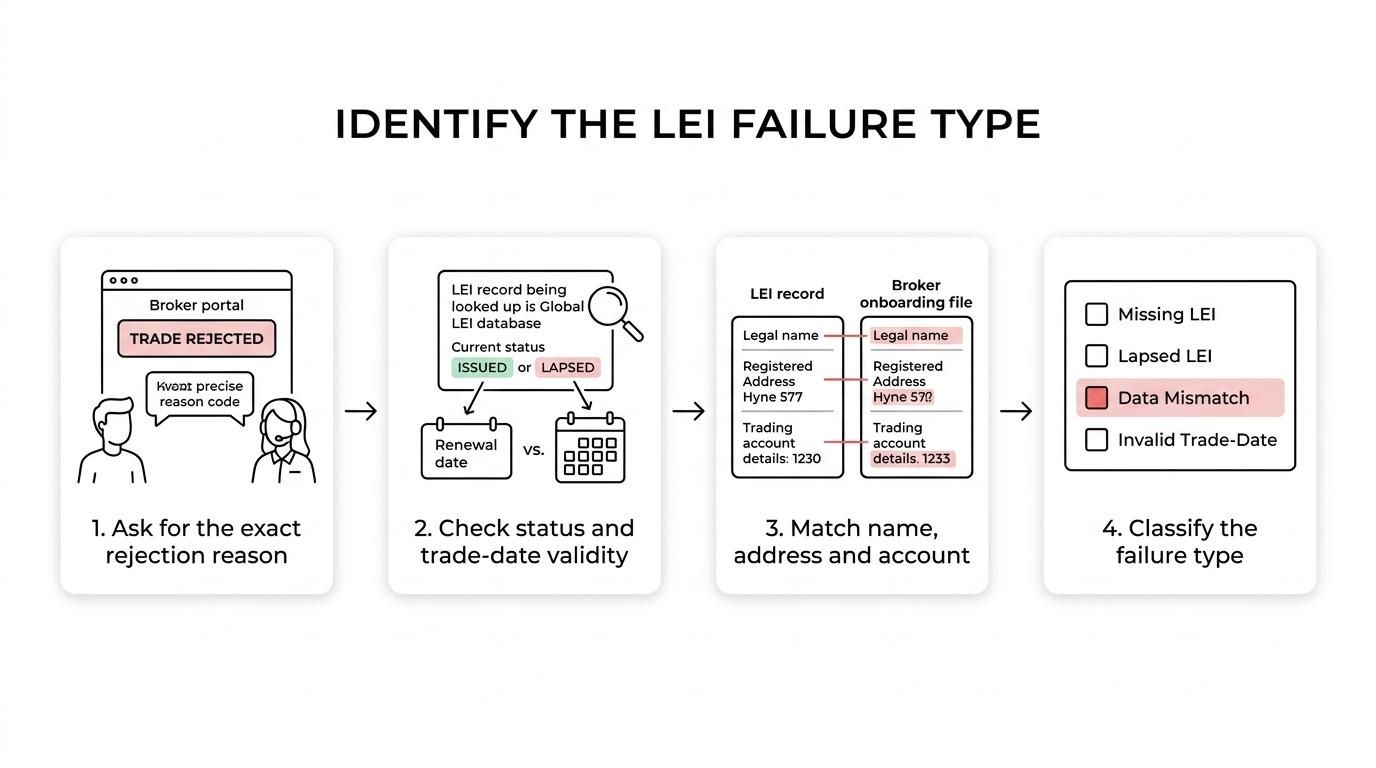
Then separate remediation into two tracks. One track is immediate trading continuity: renew, transfer, or correct the record so the broker can use the LEI going forward. The other track is historical clarification: ask the broker whether the trade can be resubmitted, rebooked, or must be abandoned because the client identifier was unusable on that date.
The common mistake is to argue about whether the entity exists. The broker is usually testing whether the identifier was compliant and reportable at the relevant moment.
Do trusts, charities and pension entities need an LEI in the same way as companies?
Often yes, in principle. The FCA identifies companies, charities and trusts as legal entities or structures that can be eligible for an LEI, but the reporting setup can differ by entity type.
The safest approach is not to assume that only limited companies need LEIs. If a trust, charity, pension structure or estate-related vehicle is the client for a reportable transaction, the broker may still need an LEI attached to that legal person.
There is an important nuance, though. Reporting rules can involve identifier choices in some edge cases, and FCA consultation work has discussed trust LEIs and national identifiers as live issues. That does not mean your broker can freely substitute another identifier whenever an LEI is missing. It means you should confirm the exact classification and reporting method before trading.
A useful rule is this: if the account is not in the name of a natural person, check LEI eligibility early. That is especially true for trustees, charities and pension administrators who may assume the broker has already handled the identifier question.
How can you renew or transfer an LEI quickly enough to avoid a failed trade?
Speed matters, but sequence matters more. LEI Service offers issuance from 10 minutes to 48 hours, with a VIP option in 2 hours before 5pm, yet you still need the broker to confirm the record is active and attached to the right account.
If your current LEI provider is slow, a transfer and renewal can be the practical route. If the LEI is missing altogether, fresh registration is the answer. If the code exists but the data is stale, update the reference data and make sure the broker refreshes its own records.
A simple response plan looks like this:
- Identify the exact failure: missing LEI, lapsed LEI, bad entity data, or trade-date validity.
- Choose the remedy: register, renew, transfer and renew, or update entity details.
- Send the broker evidence: the LEI code, entity details, and confirmation that the account should be mapped to that legal person.
- Ask for pre-trade confirmation: get the broker to confirm acceptance before you re-enter the order.
If time is tight, tell the broker when the LEI request was submitted and ask when their static-data refresh runs. Sometimes the registration is completed quickly, but the trade still fails because the broker has not yet refreshed its systems. That final operational step is easy to miss, and it is often the difference between a same-day trade and another rejection.