8 Documents Needed for an LEI Application
Most people asking about documents needed for an LEI application do not need a thick file of paperwork. In the UK, the real question is whether the entity can be verified from an official register like Companies House, or whether the application needs supporting evidence because the entity is a trust, estate, pension, charity, or another non-standard structure.
TL;DR: Summary
- The documents needed for an LEI application depend on the entity type: a UK limited company often only needs accurate Companies House details, while trusts, estates, pensions, wills and charities may need supporting records such as a trust deed, grant of probate, will, court appointment document, or governing instrument.
- GLEIF’s LEI model is built around official-register identity fields, including the legal entity name, register name, registry identifier, legal form, formation country, entity creation date and headquarters address, so applications are mainly a data-verification exercise.
- If an official register is enough, document upload may be minimal or unnecessary; if there is no usable registry record, the applicant usually needs constituting or authority documents that prove the entity exists and prove the applicant can act for it.
- FCA rules matter in practice: firms subject to UK MiFIR transaction reporting obligations cannot execute certain trades for a client who should have an LEI but does not, and annual LEI renewal is required in that regime.
- The eight most commonly relevant document types are official register evidence, certificate of incorporation or constituting document, trust deed, grant of probate, will, court order or appointment record, governing instrument for charities or pensions, and authorisation evidence for the person applying.
- A fast LEI application usually depends less on the number of documents and more on name matching, current address data, consistent registry records and clear authority evidence.
That is why “documents needed” can be a slightly misleading phrase. For many applicants, the fastest route is simply giving the exact legal details that match the register; for others, the right supporting document is what turns a stalled application into an approvable one.
Do you always need to upload documents for an LEI application?
No. GLEIF and Companies House data often let a UK company obtain an LEI with little or no extra paperwork, while trusts, estates and executor-led cases usually need supporting documents.
An LEI application is not meant to be a generic know-your-customer pack. It is mainly a check that one legal entity, and only one, is being matched to the correct official identity record. GLEIF’s data model supports one LEI per entity, so the issuing organisation needs reliable evidence of the entity’s legal existence and core reference data.
If the entity is a standard limited company with a clean Companies House record, the application can often be completed from register data plus the applicant’s declaration. If the entity does not have a company number, or exists through a deed, probate record or court appointment, the verifier may need uploaded documents to confirm the name, legal form, formation details and who is authorised to apply.
“LEI Service notes that where no company number is available, the application can still proceed using the legal name and supporting documents.”
A common misconception is that every LEI application needs the same bundle of files. In practice, document demand rises when the register trail becomes weaker, older or less standard.
Which entity details does an LEI application actually verify?
It verifies the entity’s legal identity. GLEIF requires fields such as legal name, official register, legal form, entity creation date and headquarters address, not just a trading name or contact person.
These are often called Level 1 reference data, the “who is who” part of the LEI record. The verifier may check the exact legal entity name, the official register name, the registry identifier, legal formation address and country, creation date, and headquarters address. If those fields can be sourced from an official register, the application is usually simpler.
A useful way to think about it is this: the LEI is about the entity first, and the applicant second. The applicant still matters, because someone must be authorised to request the LEI, but the core record is built around the legal entity’s identity rather than the personal identity of the individual filling in the form.
Pro tip: use the exact legal name from the constituting document or official register, including punctuation, suffixes and trust wording. Small naming mismatches can create manual review even when the entity is genuine.
What are the 8 documents needed for an LEI application?
The most relevant eight are evidence of registration, formation, authority and address. Which ones apply depends on whether the entity is a company, trust, estate, charity, pension or another UK legal structure.
Most applicants will not need all eight. A company may only need one or two of them, while an estate or trust may need several because there is no standard company register entry to rely on.
- Official register evidence: a Companies House record, charity register entry, pension register record, or equivalent official register reference.
- Certificate of incorporation or constituting document: used when register data is incomplete or when the entity’s formation document is the clearest evidence of legal existence.
- Trust deed: often needed for trusts because it shows the trust name, date, trustees and governing terms.
- Grant of probate: relevant where an estate needs an LEI and the executor’s authority must be verified.
- Will: useful when the estate name or executor authority needs support alongside probate or where the will is part of the constituting evidence.
- Court order or appointment record: used for administrators, deputies, insolvency appointments, or other court-recognised authority scenarios.
- Governing instrument for a charity, pension or similar body: this may be a scheme document, constitution, deed, or other founding record.
- Authorisation evidence for the applicant: board resolution, letter of authority, power of attorney, trustee status, directorship or executor appointment, depending on the entity.
The practical test is simple. If the document helps prove the entity exists, what it is called, where it is formed, and who can act for it, it is potentially relevant to the LEI application.
How do you apply for an LEI when your company is on Companies House?
Start with the register record. A UK limited company usually needs its exact Companies House name and number, current address details and an authorised applicant.
Step 1 is to pull the company details exactly as registered. That means the legal name, company number, registered office and status should all match the public record. If the company has recently changed name or address, it is worth checking that Companies House already shows the update before submitting the LEI request.
Step 2 is to enter the reference data in the LEI application and confirm who is applying. In many straightforward cases, the register itself supplies most of the required identity fields, which reduces the need for document upload.
“LEI Service states that straightforward LEI applications may be completed in 10 minutes to 48 hours.”
Step 3 is to review any manual queries quickly. If the verifier asks for a constituting document or authority evidence, reply with the exact file that resolves the mismatch. Pro tip: do not upload a random bundle of corporate papers. One precise document usually helps more than ten loosely related ones.
How do you apply for an LEI for a trust, estate, pension or charity?
Use the best constituting or authority document available. LEI Service and similar guided routes are often useful because non-standard entities need document-led verification rather than simple registry lookup.
Step 1 is to identify the legal entity correctly. For a trust, that may be the trust name as written in the trust deed. For an estate, it may be the estate name used in the probate context. For a charity or pension, it may be the formal name in the governing instrument and any relevant register.
Step 2 is to choose the primary evidence. A trust deed, grant of probate, will, court document or scheme instrument is usually stronger than informal correspondence because it directly establishes the entity or the applicant’s authority. If there is also a register entry, using both can reduce questions.
“LEI Service’s guided applications for estates, trusts and executors use the entity name, authority evidence, address details and a supporting record such as probate, a will, a trust deed or a court document.”
Step 3 is to confirm address details and the person acting. This is where many non-standard applications slow down. The entity name may be clear, but the address or authority trail may not be. If the executor has changed, or if the trustees have been updated, send the latest document rather than relying on an older deed alone.
How do you prove authority to act for the entity?
You prove authority with role-based evidence. Companies House, a trust deed, probate or a court appointment record usually matters more than the applicant’s passport alone.
For a company, directorship or explicit internal authority is often enough. For a trust, the trust deed may identify the trustees. For an estate, the grant of probate or letters of administration normally show who can act. For a charity or pension, a governing instrument or board authority may be needed if the person applying is not obviously listed on a public register.
If the person applying is an employee or adviser rather than the legal officeholder, then the verifier may ask for a letter of authority, board resolution or power of attorney. If the person applying is the named executor or trustee, then the constituting document itself may cover the authority point.
A common misconception is that the LEI issuer mainly wants personal ID. In most cases, the sharper question is, “What document connects this individual to this entity in an authorised capacity?”
What is the difference between official register data and supporting documents?
Official register data is primary evidence for standard entities. Supporting documents fill the gaps when Companies House or another register cannot prove enough on its own.
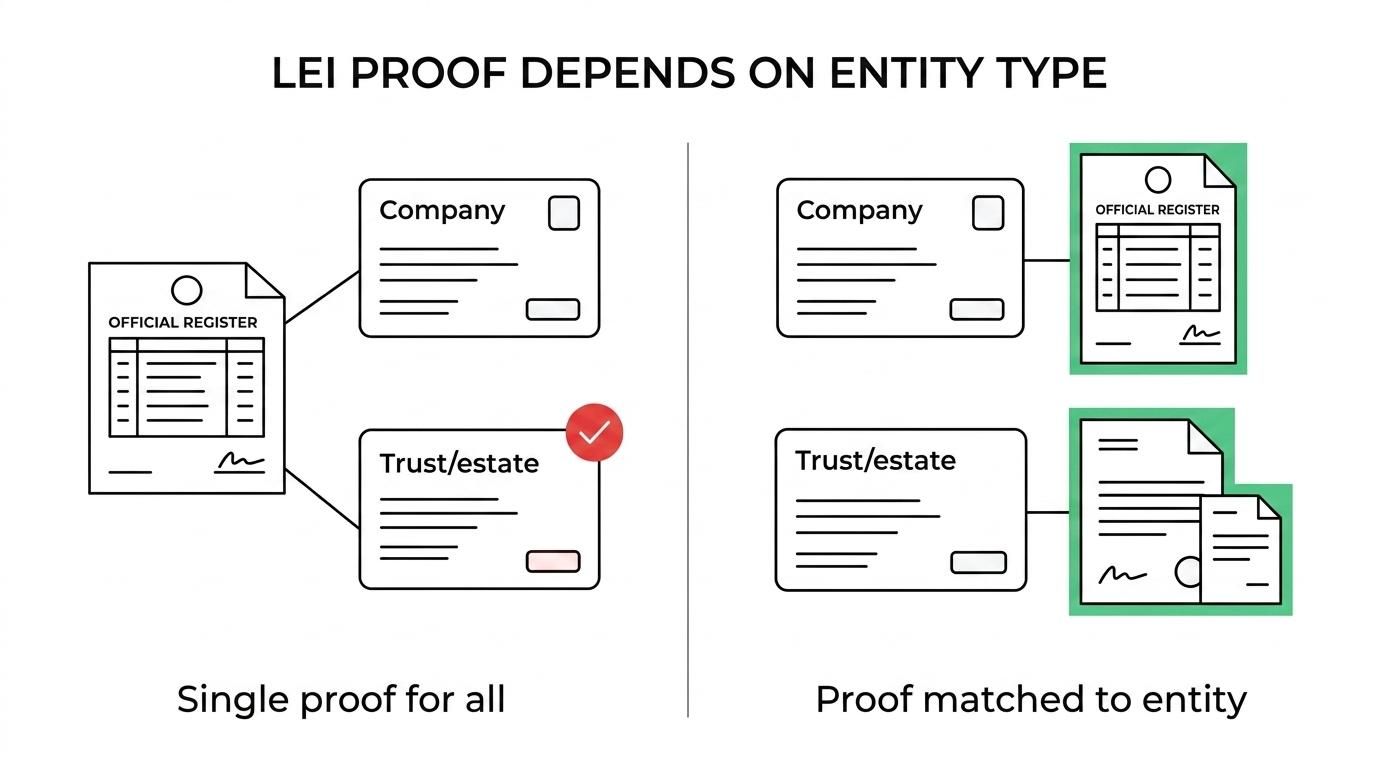
The difference affects speed, certainty and review effort. Register-led applications are usually faster because the issuer can check data directly. Document-led applications can be just as valid, but they need more human review because the verifier must interpret the document and map it to LEI data fields.
- Official register data: best for companies and other entities with a stable public record.
- Supporting documents: best for trusts, estates and entities formed by deed, probate or court order.
- Main trade-off: register data is quicker, while document-led cases are more flexible.
- Practical rule: if the register clearly shows the legal identity, use it first; if not, lead with the constituting or authority document.
This distinction also explains why two applicants can have very different experiences. One company gets an LEI quickly from a clean Companies House record; another applicant for an estate needs a manual review because the evidence sits in probate papers rather than a standard registry.
Which documents are accepted for UK companies versus trusts and estates?
UK companies usually rely on Companies House and, if needed, incorporation records. Trusts and estates more often rely on deeds, probate and court-issued authority documents.
For a UK company, the normal evidence set is the legal name, company number, registered office and current register status. If there is a mismatch, the certificate of incorporation or another constituting filing may help. The documents are there to confirm register data, not replace it.
For a trust, the trust deed is often the key document because it defines the trust itself. For an estate, the grant of probate or court-issued administration record usually carries the most weight, often supported by the will where relevant. If there is no company number, that is not fatal. The application can still work if the legal name and supporting evidence are clear enough.
A helpful rule of thumb is this: companies prove themselves through registry presence; trusts and estates prove themselves through the documents that created or authorised them.
What mistakes delay LEI issuance or renewal?
The biggest delays come from mismatched names, outdated records and weak authority evidence. GLEIF-based verification is strict, so small inconsistencies can trigger manual review.
One classic problem is using a trading name instead of the legal entity name. Another is quoting an old address when the register now shows a new one. Delays also appear when applicants send documents that are genuine but irrelevant, such as accounts, invoices or tax letters that do not actually establish legal identity or authority.
“LEI Service offers VIP LEI delivery in 2 hours for orders placed before 5pm, but fast processing still depends on clear entity data and acceptable supporting documents.”
If speed matters, think in terms of verification logic rather than paperwork volume. The best submission answers three questions cleanly: what is the entity, where is the official source, and who is authorised to apply?
- Wrong legal name: using a brand name instead of the registered or constituting name.
- Outdated authority: sending a historic deed or appointment when the current officeholder has changed.
- Weak address evidence: giving a correspondence address that does not map to the legal record.
- Unclear entity type: mixing up company, trust, estate or charity status in the application.
- Late renewal: letting the LEI lapse when annual renewal is required for trading or reporting purposes.
Do you need to submit the same documents again at LEI renewal?
Not always. FCA rules make annual LEI renewal important for UK MiFIR use cases, but many renewals rely on updated register checks unless the underlying entity data has changed.
A renewal is a revalidation exercise. The issuer checks that the entity still exists and that the core reference data remains accurate. If the company record at Companies House is current and consistent, the renewal may be straightforward. If the entity is a trust or estate and the relevant authority has changed, updated supporting documents may be needed.
This is where keeping the LEI record tidy helps. If the entity has changed name, address, legal form or responsible officeholder, update the LEI data promptly rather than waiting until the renewal deadline. Some agents, including LEI Service, treat LEI reference data updates as part of the service, which can reduce friction when the next renewal comes around.
A final practical point: renewal is not a formality if the LEI is used for regulated trading. If the LEI status lapses, a firm subject to UK MiFIR transaction reporting obligations may not be able to execute the relevant trade for that client until the LEI is valid again.