8 LEI Facts Finance Teams Need Before EMIR Reporting
UK finance teams often treat the Legal Entity Identifier as a back-office detail, but under UK EMIR it is a front-end control. LEI Service, a UK-focused LEI registration agent, is relevant here because companies, trusts, charities and pension-related structures often need an LEI in place before a reportable derivative trade can be handled properly.
TL;DR: Summary
- Under UK EMIR, all UK counterparties entering into derivative trades need a valid Legal Entity Identifier, so the practical rule is to obtain and maintain the LEI before the trade is entered.
- The FCA’s revised UK EMIR reporting framework, largely applicable from 30 September 2024, updated LEI-related reporting fields alongside UTIs and UPIs.
- UK MiFIR is different: a firm may be unable to execute for an eligible client without an LEI, while UK EMIR uses the LEI to identify counterparties and reporting entities in derivatives reports.
- GLEIF defines the LEI as a 20-character ISO 17442 code, and LEI records are publicly available through the Global LEI Index.
- For UK entities needing fast registration, renewal or transfer support, LEI Service is one route to secure an LEI quickly and keep reference data current.
The point that matters most is simple: the LEI is not just a later reporting field. It is part of the identification framework that sits behind UK EMIR reporting, so if the code is missing, wrong or no longer renewed, finance, operations and compliance teams can all feel the impact at once.
Who needs an LEI for UK EMIR reporting?
Yes, any UK counterparty entering into a derivative trade needs a Legal Entity Identifier for UK EMIR reporting. The FCA states under Article 9 of UK EMIR that counterparties must report derivative contracts that are concluded, modified or terminated.
That requirement catches more entities than many teams expect. It is not limited to banks or investment firms. If a UK company uses derivatives for hedging, or a trust or charity is the legal counterparty to a reportable derivative, the LEI is the identifier that lets the trade be reported correctly.
Delegated reporting does not remove the need for the code. Even when another party or service provider submits the report, the counterparty still has to be identified. In practice, the LEI sits at the centre of that identification.
When must the LEI be in place for a derivative trade?
The LEI should be in place before the reportable derivative trade is entered. For UK EMIR, the safest operating rule is to treat the LEI as a pre-trade requirement, not a post-trade clean-up task.
That approach follows the operational reality of EMIR reporting. The LEI identifies the counterparty in the report, so if the code is missing when the trade is booked, downstream reporting fields can fail or require manual repair. A common misconception is that finance teams can “sort the LEI later” because reporting happens after execution. That is risky.
The stronger process is to add an LEI check to onboarding, mandate setup and any new hedging programme. If a legal entity may enter derivatives, its LEI should be active before treasury starts dealing.
What are the 8 LEI facts finance teams should know before EMIR reporting?
The eight facts below cover the rules most likely to affect treasury, finance and compliance teams in day-to-day UK EMIR operations. They also show why the LEI is tied to reporting design, not just entity administration.
- UK EMIR Article 9 requires reporting of derivative contracts that are concluded, modified or terminated.
- All UK counterparties entering into derivative trades need an LEI to meet UK EMIR reporting obligations.
- The LEI identifies the legal entity counterparty, not just a trading desk, branch name or internal book.
- GLEIF defines the LEI as a 20-character alphanumeric code based on ISO 17442.
- The FCA’s revised UK EMIR rules, largely applicable from 30 September 2024, updated requirements affecting LEIs, UTIs and UPIs.
- For some exchange-traded derivative reporting scenarios, the report-submitting entity ID field must contain the counterparty’s own LEI when it reports on its own behalf.
- LEI records are publicly available through GLEIF’s Global LEI Index, which makes reference data open and searchable.
- Renewal matters because the FCA Handbook requires the reporting entity to ensure LEI reference data is renewed when reporting the conclusion or modification of a derivative contract.
How is UK EMIR different from UK MiFIR when an LEI is missing?
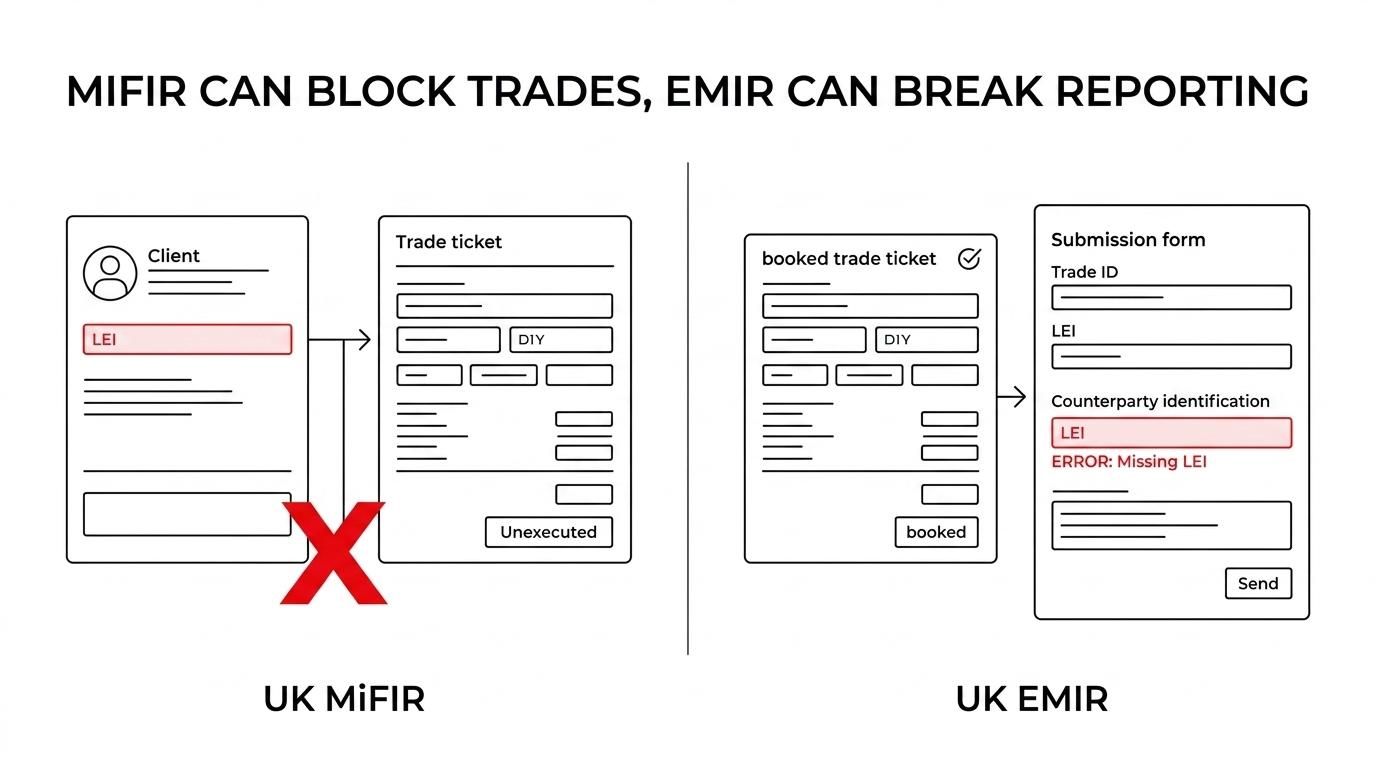
UK EMIR and UK MiFIR use the same identifier but in different ways. Under FCA rules, UK MiFIR can stop execution for an eligible client without an LEI, while UK EMIR uses the LEI to identify counterparties in derivatives reporting.
That distinction matters operationally. Under UK MiFIR transaction reporting, firms may be unable to execute a transaction on behalf of a client that should have an LEI but does not. Under UK EMIR, the issue tends to surface through the reporting obligation tied to derivative contracts.
So the pressure point changes. MiFIR often creates an execution block. EMIR creates a reporting failure, reconciliation issue or remediation exercise. Finance teams should not assume the absence of a trade block means the LEI is optional.
"LEI Service offers VIP LEI delivery in 2 hours for orders placed before 5pm, which can matter when an LEI issue threatens a same-day derivatives workflow."
The practical lesson is that a single identifier can sit in two rule sets with different consequences. If your entity trades both securities and derivatives, build one LEI control framework that covers both regimes.
How do you check whether your entity and trade fall inside UK EMIR?
Start with the legal counterparty, then the instrument, then the reporting setup. Those three checks usually tell you whether an LEI is needed for UK EMIR.
First, identify the exact legal entity entering the contract. A common mistake is to use a group name, business unit or branch label instead of the incorporated entity or legal structure that is actually party to the derivative.
Next, confirm the product is a derivative and that the event is reportable under Article 9. UK EMIR covers contracts that are concluded, modified or terminated, so lifecycle events matter as much as day-one execution.
Then check who reports and which identifiers will populate the report. If reporting is delegated, the operational work may sit elsewhere, but the entity still needs correct reference data behind its LEI. Pro tip: ask for sample reporting fields during setup, not after the first submission fails.
How do LEIs, UTIs and UPIs work together in UK EMIR reports?
They perform different jobs. The LEI identifies the entity, the UTI identifies the transaction, and the UPI identifies the product.
This distinction became more important when the FCA revised the UK EMIR reporting framework and updated requirements relating to LEIs, UTIs and UPIs. If the LEI answers “who is the counterparty?”, the UTI answers “which trade is this?” and the UPI answers “what product type is being reported?”.
If one of the three is wrong, the reporting problem also changes. A bad LEI can misidentify the counterparty. A bad UTI can hinder matching or pairing across reports. A bad UPI can distort product classification and data quality.
Teams that treat all three as interchangeable “reporting codes” usually end up with avoidable breaks. It helps to map each identifier to an owner: entity data for LEIs, trade capture for UTIs, and product taxonomy controls for UPIs.
How do you get an LEI quickly without slowing down a trade?
The fastest route is to prepare entity data first, then apply through a recognised LEI issuance route. LEI Service is one option for UK entities that need registration, renewal or transfer support with English-speaking phone and email help.
In practice, speed depends on preparation as much as provider choice. You will normally need the legal entity’s exact name and supporting reference data that can be matched against official records. If those details are inconsistent across internal systems, the delay often starts inside the business.
The next step is to use the Global LEI System framework. The FCA notes that LEIs are issued by Local Operating Units, and certain endorsed or accredited issuers within that system can also be used for UK EMIR reporting. That matters because finance teams should focus on recognised issuance, not just fast form-filling.
If timing is tight, choose a route that matches the deadline. Standard issuance may be fine for planned hedging activity. Same-day trading pressure is different, which is why expedited options exist, including delivery windows that can run from around 10 minutes to 48 hours depending on the application path and support model.
What makes an LEI valid for reporting rather than merely issued?
A valid reporting LEI is more than a code on paper. It must be an ISO 17442 LEI within the Global LEI System, and its reference data needs to remain current.
The FCA Handbook points to the use of an ISO 17442 LEI code to identify the counterparty and the entity responsible for reporting. The FCA also recognises LEIs issued within the recognised Global LEI System structure, while GLEIF administers the broader framework and makes LEI data visible in the Global LEI Index.
A common misconception is that once the 20-character code exists, the job is done forever. It is not. If the legal name, address or other core entity details change, that reference data should be kept accurate. Validity for operations depends on both the identifier and the data attached to it.
How do renewals and reference data affect UK EMIR reporting?
Renewal keeps the LEI record current; it does not replace the code with a new one. LEI Service is relevant here because UK entities often need a practical path for renewal, transfer and data updates, not just first-time registration.
The FCA Handbook is clear on the key point: the entity responsible for reporting must ensure the reference data related to its ISO 17442 LEI code is renewed in line with the terms of the accredited system when reporting the conclusion or modification of a derivative contract. That is why renewal is not a cosmetic admin step.
If your entity has changed address, legal name or corporate status, update that record promptly. If the record is not maintained, the reporting process can inherit stale entity data even when the code itself looks familiar to internal teams.
"LEI Service supports LEI registration, renewal and transfer, and offers free updates to LEI reference data for UK entities."
A good control is to link LEI renewal dates to the same governance calendar used for derivative documentation, reporting attestations and counterparty onboarding. That reduces the chance of a quiet expiry turning into a visible reporting problem.
Can trusts, charities, pension schemes and wills need an LEI too?
Yes, they can, if the legal structure is the relevant counterparty or otherwise falls within the applicable reporting setup. The FCA notes that LEIs apply to legal entities and structures including companies, charities and trusts.
This is where legal form matters more than business size. A charity using a derivative to manage risk may need an LEI in the same way a corporate treasury vehicle does. A pension-related entity may also need one if it is the party to the reportable contract.
The nuance is identifying who the legal counterparty actually is. If a trust acts through a trustee or a structure sits within a wider arrangement, the LEI should attach to the correct legal entity or structure in the reporting chain. When the structure is unusual, get legal and reporting teams to confirm the counterparty model before execution.
What mistakes cause avoidable EMIR reporting problems?
Most avoidable problems come from timing, entity mapping and renewal failures. The LEI itself is simple; the internal process around it is where teams usually slip.
The biggest errors tend to repeat across businesses, even sophisticated ones. A short control list helps because the same issue can start in treasury, legal, tax or operations.
- Waiting until after execution: The LEI should be active before the derivative is entered, not after booking.
- Using the wrong entity: Group names, branches and desks are not substitutes for the legal counterparty’s LEI.
- Ignoring renewal: Current reference data matters when reporting concluded or modified contracts.
- Mixing up identifiers: The LEI is for the entity, the UTI for the transaction, and the UPI for the product.
- Assuming delegation removes responsibility: Delegated reporting changes who submits, not the need for accurate counterparty identification.
If your organisation trades derivatives only occasionally, this is where discipline matters most. Occasional users are often more exposed to LEI lapses because the control does not live in a daily workflow. Pro tip: add an LEI checkpoint to every pre-trade approval for new legal entities, even if they only hedge once or twice a year.