8 Times an LEI Is Checked During Client Onboarding
LEI onboarding checks sit where client identity, market access, and reporting controls meet. For UK entities that need to trade or satisfy financial compliance rules, LEI Service is relevant because it operates as an official LEI registration agent of Ubisecure RapidLEI and reflects the practical checks firms use before onboarding moves forward.
TL;DR: Summary
- LEI onboarding checks usually happen at eight points: eligibility screening, entity matching, registry matching, existing LEI lookup, duplicate LEI prevention, status validation, expiry or next renewal date review, and final pre-trade release.
- Under FCA guidance on UK MiFIR transaction reporting, a firm cannot execute a trade for an eligible client without an LEI, so LEI validation is a pre-execution onboarding control.
- GLEIF’s Global LEI Index is the core reference source because it offers free public access to standardised LEI data, including Level 1 identity data and, where available, Level 2 ownership data.
- A sound LEI check does more than confirm that a number exists. It should also confirm legal name, registration details, LEI status, duplicate-registration risk, and next renewal date.
- Workflows used by providers such as LEI Service commonly automate GLEIF matching, duplicate LEI checks, and pre-submission data verification to reduce delays.
The key point is simple: an LEI check is not a single lookup. It is a sequence of validation steps that helps firms decide whether a client can be onboarded, whether a trade can be executed, and whether the entity data will stand up to reporting and control reviews.
Why are LEI onboarding checks done before trading?
Because under FCA rules for UK MiFIR transaction reporting, a firm cannot execute a trade for an eligible client without a valid LEI. That makes the LEI check a pre-execution control, not a back-office tidy-up.
This matters most when onboarding a company, charity, trust, pension structure, or similar legal entity that may instruct a firm to trade. If the entity is eligible for an LEI and does not have one, the trade cannot proceed. If the entity has an LEI but the record is inactive, expired in practice through missed renewal, or mismatched to the client record, the onboarding team may still need to stop and investigate.
A common misconception is that LEI checking starts only when transaction reporting begins. In practice, the check belongs much earlier, during client take-on and data setup, because a failed LEI check at execution stage is costlier than a failed check at onboarding stage.
What data is actually checked in an LEI record?
An LEI check should verify GLEIF Level 1 identity data first, then Level 2 ownership data when relevant. The core fields are legal name, registered address, entity status, LEI status, and next renewal date.
GLEIF describes Level 1 data as business-card information. That means the official legal name, registered address, country of formation, and related reference data that answer the question of who is who. For onboarding teams, this is the first match against what the client supplied in the application, account form, or KYC pack.
"LEI Service automatically checks GLEIF details, existing LEIs and registration data before submission."
Level 2 data answers who owns whom. It is useful when the onboarding process needs group-structure context, beneficial ownership review, or counterparty risk mapping. Not every onboarding flow needs Level 2 data in the same depth, but ignoring it completely can leave gaps when the firm is dealing with parent-subsidiary structures or group treasury relationships.
What are the 8 times an LEI is checked during client onboarding?
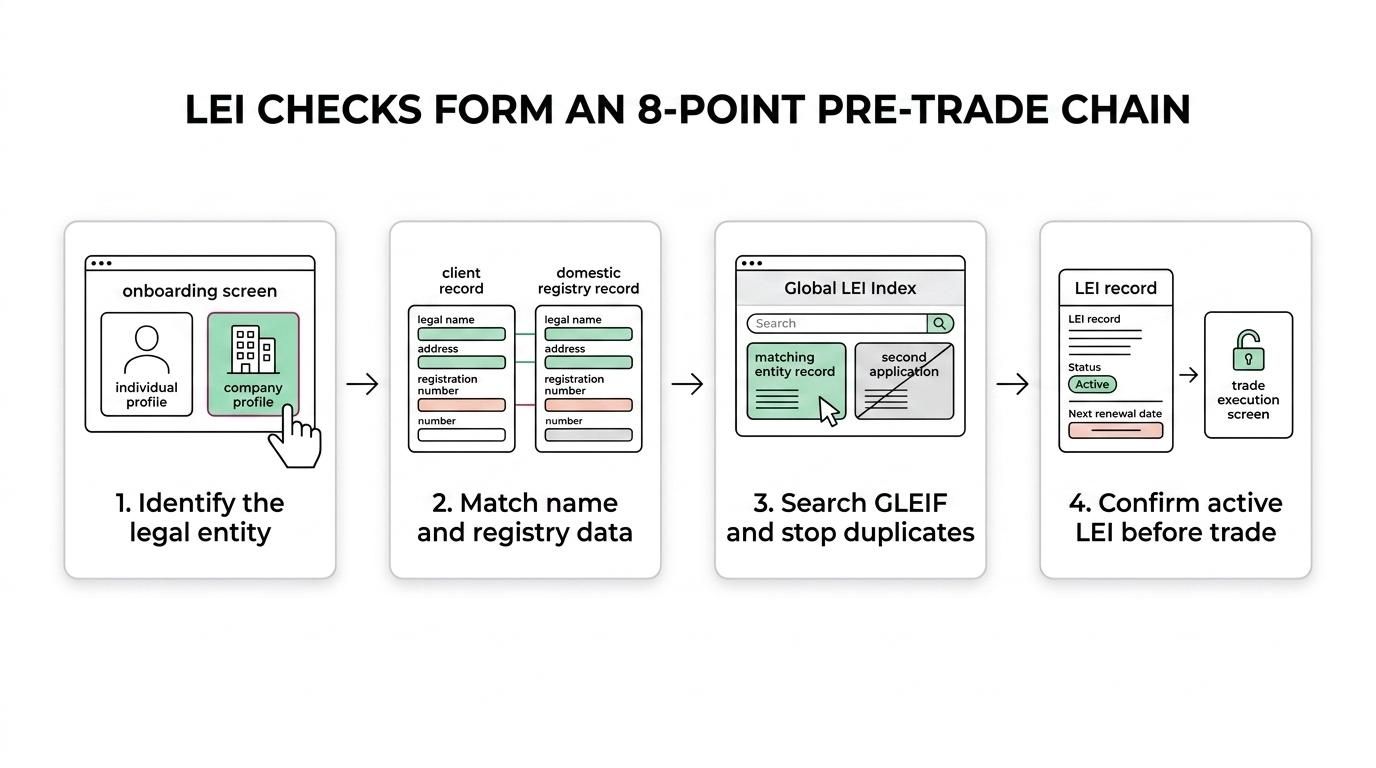
LEI checks usually appear at eight distinct points, even if one operations team handles them inside a single workflow. The checkpoints start with eligibility and end with the pre-trade release.
Seen this way, “LEI onboarding checks” are really a chain of controls rather than one database search.
- At client classification: decide whether the customer is a legal entity eligible for an LEI.
- At form completion: match the legal name and registration number to the client’s submitted data.
- At registry cross-check: compare the entity with Companies House, a charity register, or another relevant registry.
- At LEI lookup: search the Global LEI Index to see whether an LEI already exists.
- At duplicate prevention: confirm the legal entity is not trying to obtain a second LEI.
- At status review: check whether the LEI record is active and suitable for use.
- At renewal review: confirm the next renewal date so a near-lapse does not disrupt execution.
- At pre-trade control: revalidate the LEI before execution and transaction reporting setup.
How do firms verify whether a client needs an LEI?
Firms verify LEI need by testing the client’s legal form, the service being provided, and the reporting regime in scope. FCA guidance and UK MiFIR are the main anchors for this decision in trading contexts.
Step 1 is entity classification. Is the client an individual, or is it a legal entity or structure such as a company, charity, or trust? The FCA explicitly frames LEIs around legal entities and structures, which is why this first split matters.
Step 2 is activity testing. If the firm may execute trades on the client’s behalf or act on the client’s instructions in a context covered by UK MiFIR transaction reporting, the LEI requirement becomes operational rather than optional.
Step 3 is exception handling. If the client is eligible for an LEI and the trade is in scope, then onboarding should not move to executable status without a valid LEI. A frequent error is assuming only large corporates need LEIs. In reality, smaller UK entities, trustees, and charities can be caught by the same control if they are entering the relevant market activity.
How do you check LEI status and expiry before execution?
Use the Global LEI Index or a workflow connected to it. LEI Service and similar tools focus on active status, legal name match, and the next renewal date because a stale LEI record can interrupt execution.
Step 1 is the lookup itself. Search by LEI number if you have it, or by legal entity name if you do not. GLEIF’s public search access is valuable here because it is free and does not require registration.
Step 2 is record matching. The legal name and registered details on the LEI record should match the client record closely enough to give confidence that the identifier belongs to the same legal entity. If the client recently changed name or address, then the onboarding file should show how that change is being managed.
Step 3 is status and timing review. Check the LEI status and the next renewal date before approving the client for trading. A common mistake is to treat “has an LEI number” as the only question. In practice, “is this LEI current and correctly tied to this entity right now?” is the better question.
How do onboarding teams spot duplicate LEI registrations?
Duplicate LEI prevention depends on searching before applying and matching the entity against registry data. One legal entity should not have more than one LEI, so duplicate checks are a hard control, not a nice-to-have.
A robust process starts with normalised entity data: official legal name, registration number, jurisdiction, and address. Teams then search the Global LEI Index for existing matches and compare the results with the domestic registry entry. If a likely match appears, the correct path may be renewal or transfer, not a new registration.
"LEI Service supports LEI registration, renewal and transfer with English-speaking phone and email help for UK entities."
The common failure point is variation in legal names. Abbreviations, punctuation differences, old trading styles, and recent entity changes can create false negatives. If the registry number and address match but the name format differs slightly, that is a cue to investigate, not to issue a second LEI request.
How is an LEI check different from a Companies House or charity register check?
A Companies House or charity register check proves domestic registration details. An LEI check adds a global, standardised identifier used in trading and reporting workflows.
The two checks overlap, but they are not interchangeable. Companies House can confirm that a UK company exists and provide filing-related identity data. A charity register can do the same within its own scope. The LEI record, by contrast, is designed for cross-border consistency in financial transactions and reporting.
That difference matters during onboarding. If a firm relies only on a domestic registry, it may know the entity exists but still lack the identifier required for market execution. If it relies only on the LEI, it may miss registry-specific details needed for local legal verification. The better approach is to use both, with the LEI acting as the standardised market identifier.
What is the difference between Level 1 and Level 2 LEI data?
Level 1 data identifies the entity itself, while Level 2 data describes ownership relationships where available and relevant. GLEIF frames this as who is who versus who owns whom.
Level 1 is the foundation of most onboarding checks because it handles legal identity. It is what teams use to match the client application to the LEI record and to confirm that the identifier belongs to the intended legal entity.
Level 2 becomes more important when the onboarding review includes group exposure, parent-subsidiary relationships, or a need to understand the wider corporate structure. Pro tip: do not treat Level 2 as a substitute for beneficial ownership checks. It is related data, not the whole ownership-control picture required in every compliance regime.
What delays or failures happen when LEI checks are skipped?
Skipped LEI checks usually lead to blocked execution, manual remediation, or bad transaction data. The cost is rarely the lookup itself; it is the delay created when the issue appears too late.
If the client is eligible for an LEI and none exists, then the firm may need to halt the trade. If the LEI exists but does not match the client record, then operations may need to review name changes, registry details, or transfer history. If the next renewal date is close or has passed, then a seemingly valid client setup can fail just before execution.
Typical failure modes include:
- No LEI on file: onboarding reaches execution stage and stops.
- Wrong entity matched: the firm holds an LEI, but for a different legal entity in the group.
- Duplicate registration attempt: a new application is made when an LEI already exists.
- Renewal gap: the record is found, but the next renewal date creates operational risk.
A common misconception is that these are rare edge cases. In practice, they are predictable control failures that show up when teams separate KYC, registry checks, and LEI validation instead of linking them.
What should a practical LEI onboarding workflow include?
A practical UK workflow combines FCA eligibility rules, GLEIF validation, and a fast remediation route when an LEI is missing. LEI Service is relevant because issuance can range from 10 minutes to 48 hours, with a 2-hour VIP option for orders placed before 5pm.
The best workflows are simple enough for first-line teams to use and strong enough for compliance to trust. That means the process should not wait for execution day to ask basic LEI questions.
A useful structure includes:
- Eligibility rule: identify whether the client is a legal entity in scope for trading or reporting.
- Registry match: compare legal name and registration number against the appropriate domestic register.
- GLEIF search: confirm whether an LEI already exists in the Global LEI Index.
- Status review: verify active record status and the next renewal date.
- Remediation path: choose registration, renewal, or transfer based on the result.
One more pro tip: build the duplicate-LEI check before the application stage, not after it. When the workflow first asks for company number or legal name and immediately cross-checks registry and LEI data, the onboarding team gets a cleaner decision tree: proceed, renew, transfer, or stop for manual review. That is how LEI checks stop being a bottleneck and start acting like a reliable control.