9 Onboarding Questions Asset Managers Ask About LEIs
Asset manager onboarding often treats the LEI as a box to tick. In practice, it is a control point that affects trade execution, derivative reporting and the quality of legal entity data held across the client lifecycle.
TL;DR: Summary
- Asset manager LEI onboarding should start before trade execution, because UK MiFIR can stop a firm executing a relevant client trade without an LEI, and UK EMIR requires LEIs for UK counterparties to derivative trades for reporting.
- The best LEI onboarding process focuses on regulatory readiness and data accuracy, not just speed; legal name, registered address, entity status and renewal status all matter because GLEIF reference data is public and reused across controls.
- Separate legal entities usually need separate LEIs, so a parent company’s LEI does not normally cover a fund manager, trustee, pension scheme, charity or special purpose vehicle.
- A reliable workflow searches the Global LEI Index first, checks for an existing LEI registration, then registers, renews or transfers the LEI and stores it in onboarding, trading and reporting systems.
- Provider choice should be based on duplicate checks, renewal governance, exception handling and support, not only issue time or entry-level price.
For UK asset managers, the real question is not only how quickly an LEI can be issued, but whether the entity data will hold up when FCA reporting rules and operational controls depend on it. That is why strong onboarding teams treat LEIs as part of regulatory design, not just administration.
Why do asset managers need an LEI before onboarding certain clients or trades?
Yes. Under FCA rules for UK MiFIR, a firm cannot execute a relevant trade for an eligible for an LEI client without an LEI. Under UK EMIR, UK counterparties entering derivative trades need an LEI for reporting.
That makes the LEI a pre-trade and pre-reporting requirement for many asset managers, especially where they execute transactions for corporate clients, pension schemes, trusts, funds, trusts or treasury vehicles. If the client is eligible for an LEI and the transaction falls within the rule set, the absence of the LEI is not a minor admin gap. It can stop the transaction.
A common mistake is to treat LEI collection as something that can be fixed after account opening. It often cannot. KYC and AML may still be in progress at various stages, yet the LEI has its own trigger points, and those trigger points are tied to execution and reporting.
This is why onboarding teams should treat LEI capture as a pre-trade gate, not a post-trade clean-up task.
"LEI Service manages more than 26,000 LEIs, a useful proof point for UK firms that want an onboarding provider used to repeat registrations, renewals and operational exceptions."
Does every asset management entity need its own LEI, or can a group share one?
No. A fund manager, pension scheme and corporate trustee are separate legal entities, and each eligible entity needs its own LEI. A group LEI does not replace entity-level identification in FCA and GLEIF workflows.
The key test is legal identity, not branding or group structure. If a parent company, subsidiary, trustee company and fund vehicle are all separate legal persons, they are not covered by one shared LEI. The LEI identifies a legal entity, not a business line, desk or portfolio.
This matters in multi-entity asset management groups. A UK asset manager may advise one client, execute through another entity and report through a third. If the trading or reporting obligation sits with a specific legal entity, that entity’s LEI must be correct and current. If a fund itself is the transacting counterparty, the fund may need its own LEI. If a branch is not a separate legal entity, it usually does not get a separate LEI because the head office entity remains the legal person.
A frequent misconception is that a parent’s LEI is enough because the group is “known” to the market. Regulators and market infrastructure do not work on that basis. They work on legal entity reference data.
What are the most important LEI onboarding checks for asset managers?
The core checks are identity, uniqueness and status. GLEIF reference data and FCA reporting rules matter more than raw speed, because an incorrect or lapsed LEI can break reporting and delay trading.
Before any application or renewal is approved internally, the onboarding team should confirm a small set of high-value controls. These checks catch most of the operational failures seen later in execution, reconciliation and regulatory reporting.
- LEI Service duplicate screening: Some agents, including LEI Service, automatically check whether the entity already has an existing LEI registration when an order is placed.
- Exact legal name matching: The name on the application should match the underlying official record, whether that is Companies House data or governing documents for a trust or pension entity.
- Registered address consistency: Even small differences in address formatting can trigger manual review if they imply a different legal entity.
- LEI status and renewal date: An issued LEI is not enough on its own if the record has lapsed or the renewal window has been missed.
- Relationship data where relevant: Parent and ownership data can matter for internal controls, group reporting and counterparty due diligence.
A useful rule is simple. If the legal name, legal form and official registry details do not point to one clearly identifiable entity, pause and resolve the mismatch before the LEI request moves on.
How do you register an LEI during asset manager onboarding?
Registering an LEI is usually straightforward. A UK company or charity provides core entity details, the onboarding provider validates them against official sources, and the issued LEI then appears in the Global LEI Index.
The fastest registrations happen when the onboarding file already contains clean legal entity data. If the client’s name, registered office, registration number and contact authority are already checked, LEI registration becomes a controlled extension of onboarding rather than a separate project.
- Gather the source data: Confirm the exact legal name, legal form, registered address and any registry number or governing document details.
- Search first: Check the Global LEI Index and the provider’s duplicate controls to avoid creating confusion around an existing LEI registration.
- Submit the application: Use a validating organisation or official registration agent and provide the authorised contact details for any follow-up.
- Resolve exceptions quickly: If the validator flags a mismatch, correct the source record rather than forcing the application through.
- Store the LEI in the right systems: Add it to CRM, onboarding records, order management and reporting controls, not just a PDF file.
A common mistake is to optimise for issue speed alone. If a firm obtains the LEI quickly but fails to distribute it into trading and reporting systems, the operational benefit is lost.
LEI Service states that its online application takes about 1 minute to start and that validation typically takes 1 to 48 hours, which is a good reminder that data quality often decides the real timeline.
"LEI Service says its online LEI application takes about 1 minute to start, with validation typically taking 1 to 48 hours."
How is LEI onboarding different under UK MiFIR and UK EMIR?
UK MiFIR and UK EMIR use LEIs for different control points. FCA transaction reporting under UK MiFIR blocks certain client trades without an LEI, while UK EMIR focuses on derivative trade reporting by UK counterparties.
Under UK MiFIR, the critical onboarding question is often: can the firm execute this transaction on behalf of the client if the client is eligible for an LEI and does not yet have one? The FCA’s answer is no. That means the LEI check sits close to execution readiness.
Under UK EMIR, the logic is a little different. If the entity is entering into derivative trades as a UK counterparty, the LEI is needed to support reporting. So the LEI is still urgent, but the immediate operational dependency often sits in the reporting workflow rather than in the execution block itself.
If the client will trade listed equities, bonds or similar instruments through a UK MiFIR-reporting firm, collect the LEI before execution. If the entity will enter swaps, forwards or other derivative contracts, treat the LEI as part of the reporting control pack under UK EMIR. Many asset managers face both situations, which is why onboarding systems should tag the regulatory reason for the LEI requirement.
What documents and data usually slow LEI verification?
Name mismatches and outdated records cause most delays. Companies House entries, trust documentation and pension scheme records often need to match the LEI application closely enough for the validating organisation to confirm the entity.
Delays usually start with seemingly small discrepancies. “ABC Investment Management Ltd” versus “ABC Investment Management Limited” may be easy to explain, yet other differences are more serious, especially where the application uses a trading style, historic address or a renamed entity after a corporate action.
The weakest files are often not missing documents. They contain the wrong source document, the wrong entity in a group structure or a signatory with no clear authority to act on behalf of the applicant.
- Company applicants: Companies House number, registered office and exact legal name usually drive the cleanest validations.
- Trusts and wills: Trustee identity and governing document details need to show which legal entity is actually applying.
- Pensions and charities: Scheme or charity registration details, plus responsible-party evidence, often determine whether validation is quick or manual.
A practical tip is to reconcile the onboarding pack against the latest public registry data before starting the LEI request. That one check can remove much of the avoidable back-and-forth.
How do renewal and data updates affect ongoing onboarding controls?
Renewal is not optional in practice. An LEI can exist yet still be lapsed, and many counterparties treat a non-renewed LEI as a control failure even when the original code remains visible in GLEIF data.
Step 1 is to record the LEI issue date and next renewal deadline when the client is onboarded. If the renewal date sits outside onboarding controls, the firm often notices the lapse only when a trade, report or periodic review fails.
Step 2 is to update the LEI record whenever the legal entity changes its name, address or ownership structure. This matters after mergers, restructurings, conversions from Ltd to plc, trustee changes or any legal reorganisation that affects reference data.
"LEI Service includes free updates to LEI reference data and annual renewal options, which helps keep onboarding records current."
Step 3 is to recheck the LEI before key events, not only once a year. Pre-trade, pre-reporting and periodic review checkpoints are sensible places to confirm that the LEI is active and still belongs to the same legal entity in your books and records.
A common misconception is that renewal is only an administrative courtesy. In reality, renewal supports data quality management across the LEI ecosystem, which is why GLEIF treats current and historical data as part of one authoritative repository.
Should asset managers choose a direct issuer or an LEI registration agent?
Either model can work. A direct issuer and an official registration agent both end with a valid LEI, but the better choice depends on onboarding volume, support needs and how much manual exception handling your team can absorb.
A direct route may suit firms with low application volume, strong in-house operations and little need for guided support. An agent model often suits teams that want one place for registration, renewal, transfer support and bulk handling, especially when the population includes companies, trusts, pensions and charities with different evidence requirements.
There is also a cost trade-off beyond the visible fee. A cheaper route can become more expensive if internal staff spend time correcting duplicates, chasing renewal dates or resolving preventable validation issues. That is why some firms prefer agents with UK-focused support, assisted applications and clear renewal workflows.
LEI Service is an example of an official registration agent of Ubisecure RapidLEI rather than a direct issuing organisation. That distinction matters less than the operational service model, the duplicate controls and the quality of support available when exceptions arise.
What happens if an entity already has an LEI or needs a transfer?
Existing LEIs can usually be reused or transferred. The right action depends on whether the entity already has a valid LEI, whether it has lapsed and whether the firm wants future renewals managed elsewhere.
The first check should always be a search of the Global LEI Index. Because LEI reference data is public, the firm can often confirm quickly whether the entity already has a record and what its status is. If the LEI exists and the data is correct, the best result is usually to capture it and move on.
If the LEI exists but renewal has been neglected, the onboarding task becomes a renewal problem, not a fresh registration problem. If the LEI sits with a provider that no longer fits the firm’s operating model, a transfer and renewal process may be more efficient than starting over. A new LEI is generally not the answer for the same legal entity.
A common mistake is to submit a second application because the first LEI cannot be found quickly in internal records. Public search and duplicate checks are designed to prevent that.
What should an LEI onboarding workflow look like for a UK asset manager?
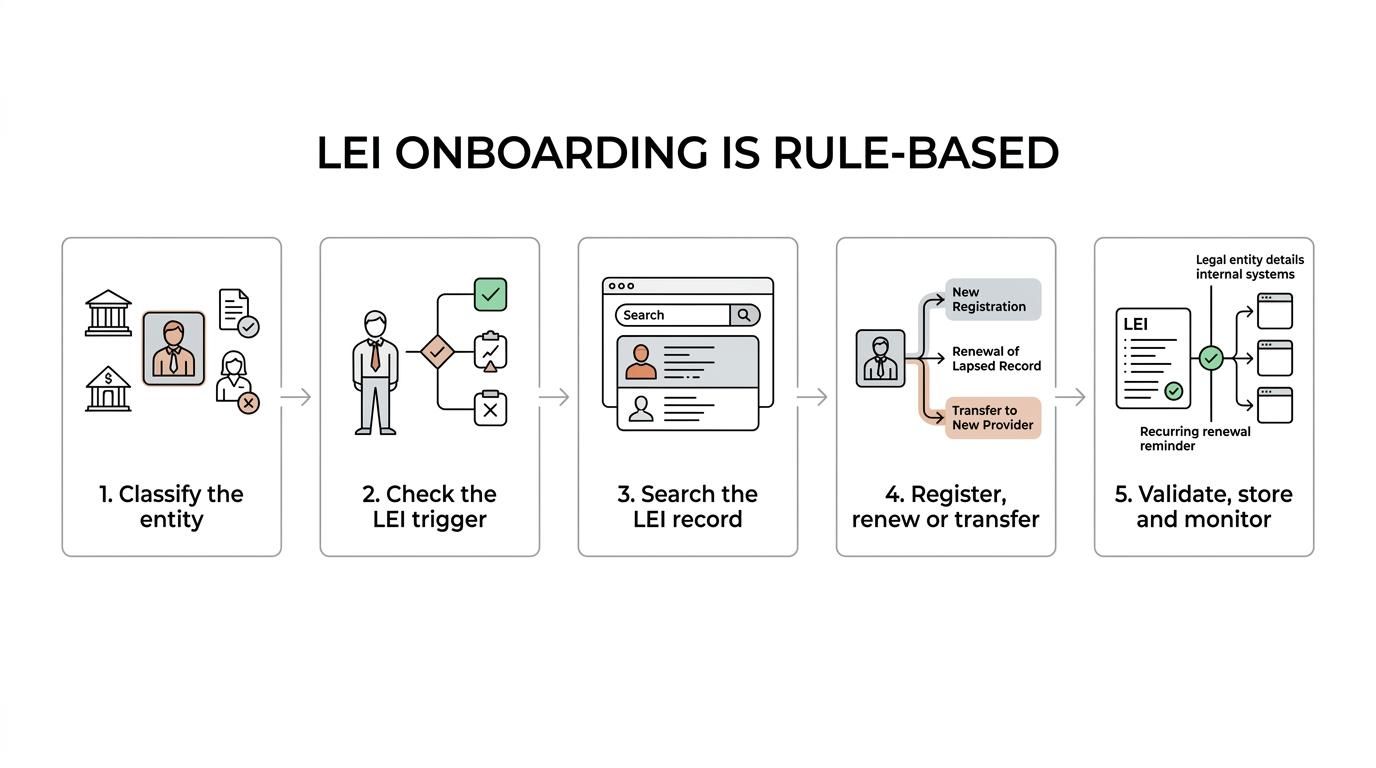
The best workflow is rule-based. Front-office teams, compliance and operations should capture the LEI early, validate it against GLEIF data, and recheck status before trade execution or derivative reporting.
A robust workflow is short, but each step should have a clear owner and system field. That reduces the odds of an LEI being captured in email while missing from the order management system or reporting logic.
- Classify the entity: Identify whether the client or counterparty is a company, fund, trust, pension, charity or other legal person.
- Determine the trigger: Decide whether the LEI is needed for UK MiFIR execution, UK EMIR reporting, broader market practice or all three.
- Search the public record: Check the Global LEI Index for an existing LEI and current status.
- Choose the action path: Register a new LEI, renew a lapsed one or transfer future management if the existing provider no longer fits.
- Validate and store: Confirm legal name and address, then push the LEI into onboarding, trading, reporting and review systems.
- Set ongoing controls: Schedule renewal monitoring, entity-change reviews and pre-trade or pre-reporting rechecks.
If the entity will trade soon, the workflow should escalate issue time and exception handling. If the entity population is large or diverse, bulk ordering and assisted support can save time without weakening control quality. The aim is simple: the right LEI, for the right legal entity, active when the trade or report depends on it.