9 Questions to Ask Before Renewing Your LEI Number
Renewing an LEI number is less about buying another year and more about keeping verified entity data current. For UK companies, trusts, charities and pension-related entities, that matters because trading access, counterparty checks and regulatory reporting can all depend on an LEI that is up to date. LEI Service is a UK-focused LEI registration agent, so it sits squarely in the part of the market where speed, renewal timing and support matter most.
TL;DR: Summary
- To renew an LEI number properly, check the Next Renewal Date, confirm any entity data changes, and renew before you need the LEI for trading or reporting.
- GLEIF treats a LAPSED LEI as due for renewal, not necessarily inactive, but a lapsed record can still create operational and compliance problems.
- The FCA says annual LEI renewal applies to firms with UK MiFIR transaction reporting obligations, so yearly verification is not optional in that context.
- Compare one-year and multi-year renewal costs carefully; LEI Service lists £49 for 1 year, £135 for 3 years and £170 for 5 years.
- If your current provider is expensive or hard to reach, transferring management before renewal can make sense, provided the LEI itself and entity details match the official record.
The key question is not only “when does my LEI expire?” but also “what will happen if it is not renewed when I need it?”. That shift in thinking helps you avoid the two biggest mistakes: leaving renewal until the last minute and assuming a lapsed LEI is harmless.
When should you renew an LEI number?
Renew your LEI before the Next Renewal Date shown in GLEIF LEI Search, and earlier if a trade or filing depends on it. For firms under UK MiFIR transaction reporting rules, the FCA’s position makes annual renewal a live compliance issue, not just an admin task.
GLEIF’s data model ties renewal to a planned verification interval. In plain English, the LEI remains the same, but the reference data behind it must be checked and refreshed regularly. That is why the record shows a next renewal date rather than a permanent validity date.
A common mistake is waiting for the exact expiry day. If a bank, broker, custodian or reporting workflow checks the LEI before a trade, even a short delay can become a practical problem. If you know a transaction, fund dealing event or reporting deadline is coming up, renew early.
How do you check your LEI expiry date and status?
Check the LEI in GLEIF LEI Search and read two fields first: Next Renewal Date and status. You should also note the ManagingLOU, because that tells you which Local Operating Unit currently manages the record.
Start with the LEI code or legal entity name. GLEIF search results normally show whether the LEI is active, lapsed or in another recognised status, alongside core registration details. That makes it the best first stop before contacting a provider or starting a renewal order.
Next, compare the official name and registered address shown in the record. GLEIF describes these as Level 1 data, meaning the basic “who is who” information that identifies the entity. If your Companies House details, trust data or registered office changed recently, that should be checked before renewal is submitted.
Pro tip: do not rely only on an old invoice or reminder email. The live registry record is the one that matters operationally, especially when another party is validating your LEI ahead of a transaction.
What checks matter most before you renew an LEI number?
The most important checks are timing, entity data and provider terms. If those three are right, LEI renewal is usually straightforward.
Before you submit anything, work through the basics in order. That reduces the chance of paying for a renewal that then stalls because the official record does not match the entity’s current details.
- Check the date: confirm the Next Renewal Date in GLEIF rather than guessing from last year’s payment.
- Check the legal name: match the record against the entity’s current official name.
- Check the registered address: this is part of Level 1 data and often causes avoidable mismatches.
- Check whether the LEI is lapsed: lapsed means due for renewal, which affects urgency.
- Check who manages the LEI: the ManagingLOU matters if you plan to transfer and renew.
- Check pricing and term length: one year is not always the cheapest option over time.
- Check support and turnaround: if the LEI is needed urgently, response times matter.
Does a lapsed LEI mean your identifier is inactive?
No, a lapsed LEI means the record is due for renewal and has not been verified within the planned interval. GLEIF uses the term LAPSED for that specific condition, which is different from saying the identifier no longer exists.
This distinction matters because many people treat “lapsed” as if it means cancelled. It does not. The LEI itself still refers to the same entity, but the reference data has not been revalidated on schedule. That can still cause real friction, because counterparties and reporting systems may reject or flag a lapsed record.
A useful way to think about it is this: if the LEI is current, other parties can rely on the verification cycle; if it is lapsed, they may question whether the underlying entity data is still accurate. So the status is not a technical footnote. It is a trust and process signal.
How do you confirm company data before LEI renewal?
Confirm the entity’s official data against the registry first, then match it to the LEI record, then submit renewal. For UK entities, that often means checking Companies House details or the relevant official source before you do anything else.
First, verify the legal entity name exactly as recorded. Small differences in punctuation or trading style are less important than a genuine legal name change, but you should still use the official registered form. If the entity merged, dissolved, or changed structure, stop and verify what renewal path is actually correct.
Next, confirm the registered address and any other Level 1 data used to identify the entity. If the official source changed recently, allow for the fact that not every database updates at the same speed. A common misconception is that “the LEI provider will sort it out later”. In practice, mismatched data often slows the process down.
Finally, check who is authorised to request the renewal and whether supporting details may be needed. If the entity is a trust, pension or charity, the naming convention and source records may differ from an ordinary limited company, so accuracy matters even more.
Is a one-year or multi-year LEI renewal better value?
One-year renewal offers flexibility, while multi-year renewal usually offers a lower annualised cost. The better choice depends on how stable your entity data is and how often your organisation reviews suppliers and compliance costs.
If your entity rarely changes name or address, and the LEI will be needed every year, multi-year pricing can be more efficient. If your structure may change soon, or you prefer annual procurement review, a one-year term can be safer even if the annual cost is higher.
This is where a simple annualised comparison helps. A one-year price shows the immediate outlay. A three-year or five-year term shows whether the provider is actually reducing admin effort and long-run spend. Pro tip: compare both cost per year and the number of renewal events you are avoiding.
"LEI Service lists renewal at £49 for 1 year, £135 for 3 years and £170 for 5 years."
That pricing shows the trade-off clearly. The five-year option works out lower per year, but only if you are confident the LEI will remain needed across the full period.
Should you renew with your current provider or transfer first?
Transfer first if your current provider is expensive, slow or hard to deal with; renew where support, price and timing are better. In practice, LEI Service is relevant here because it offers a free transfer-to-management option before renewal, which can change the cost decision.
The key point is that the LEI belongs to the entity, not to the reseller or agent you originally used. That means you can compare service quality without changing the underlying identifier. If your current provider charges heavily for annual renewals, a transfer can be sensible before the next billing point.
Compare four things side by side: renewal fee, transfer fee, support access and turnaround time. If you are renewing for a broker deadline next week, speed may matter more than saving a few pounds. If the deadline is further away, transferring first may produce a better long-run arrangement.
A common mistake is assuming transfer will create a new LEI. It should not. If the entity data and identifier match, the LEI remains the same while management moves.
"LEI Service says a transfer to its management is free of charge."
How do you renew an LEI number step by step?
Renewal is usually a short process: identify the entity, confirm the record, choose the renewal term, and submit. LEI Service is one example of a UK-focused route that combines renewal, transfer and support in a single process.
Start by entering the company name or existing LEI details exactly as recorded. Then review the entity data carefully, including the official name and registered address. If any field appears outdated, deal with that issue before assuming the renewal is routine.
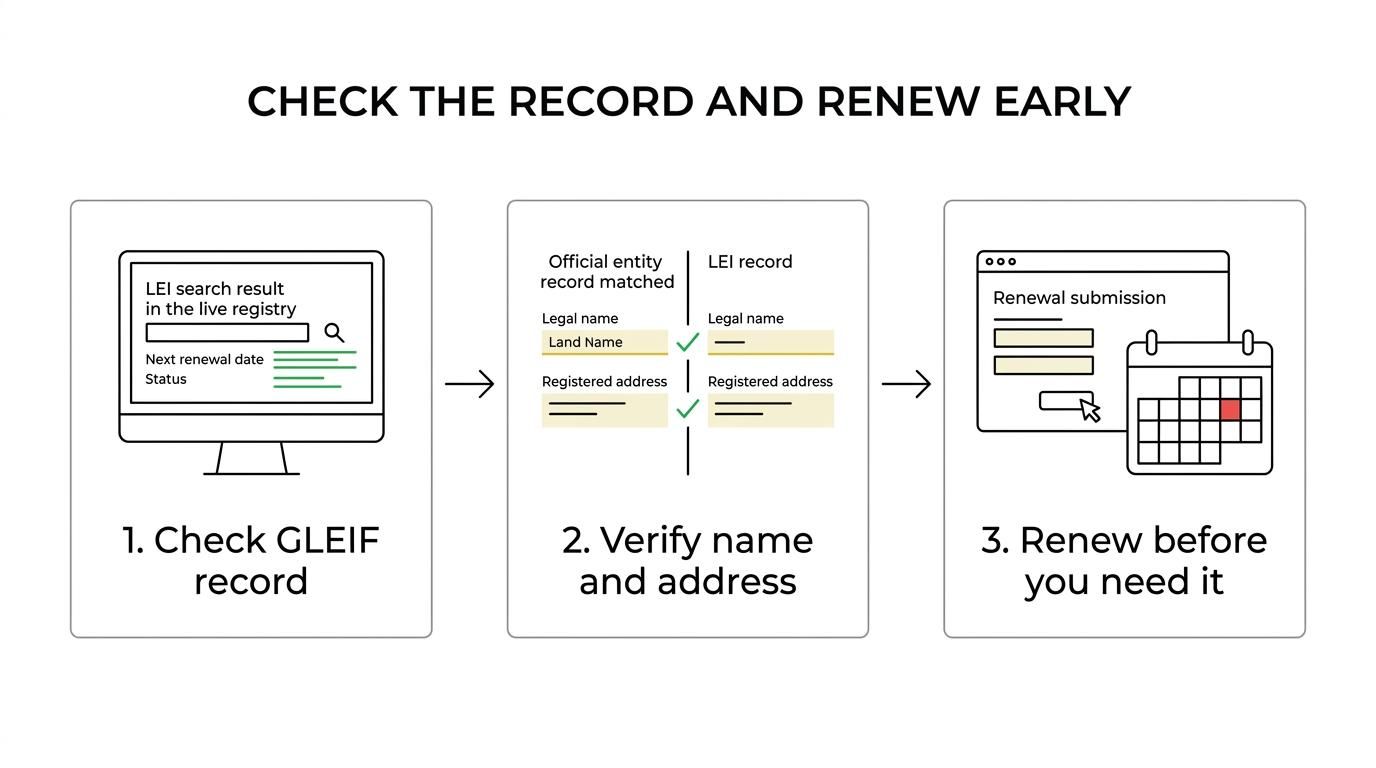
Next, choose the term length. If your organisation values predictable admin cycles, a multi-year option may save both time and cost. If internal approvals change year by year, a one-year term can still be the right fit even if the annualised price is higher.
Finally, submit the request and monitor confirmation from the managing body or agent. If the LEI is needed urgently, ask about processing times before you pay. Timing is not a small detail when trading windows or reporting deadlines are close.
"LEI Service says it had more than 27,000 LEIs under management in August 2026."
What happens if you leave LEI renewal too late for a trade or filing?
Late renewal can block a transaction, delay reporting or trigger extra internal checks. The exact impact depends on the counterparty, platform or regulatory use case, but the operational risk is real.
For entities in scope of UK MiFIR transaction reporting, the FCA’s annual renewal expectation means lateness is not just inconvenient. It can feed directly into whether reporting data is accepted and whether internal compliance teams are satisfied that reference data is current.
Even outside transaction reporting, many institutions treat LEI validity as part of onboarding and trade controls. If a broker, fund administrator or bank checks the record and sees a lapsed status, they may pause the process until it is renewed. If you are close to a deadline, even a short pause can cost more than the renewal itself.
The practical rule is simple: if the LEI will be used externally in the next few weeks, renew now rather than later. That small timing decision is often the difference between a routine update and an urgent operational problem.