Bulk LEIs for groups: how to manage multiple entities efficiently
Managing one LEI is usually straightforward. Managing dozens across subsidiaries, holding companies, pension schemes, trusts, charities or special purpose vehicles is a different kind of job. Renewal dates drift apart, entity data changes quietly, and one missed update can interrupt trading or delay reporting when time is tight.
For group finance, legal and compliance teams, bulk LEI registration is less about volume on day one and more about control over the full lifecycle. The best results come from a method that covers registration, renewal, transfers and data changes in one place, with clear ownership and fewer manual checks.
This need often shows up in familiar situations:
- Subsidiaries in different jurisdictions
- Acquired entities with mixed renewal dates
- Trusts and pension vehicles
- Charities entering regulated activity
- Treasury structures with multiple counterparties
Why bulk LEI registration matters for corporate groups
An LEI is public reference data, but the work behind it is operational. Each entity record must match authoritative sources, stay current, and be renewed on time. When a group manages many entities, the cost of doing this one by one rises quickly. The team loses time to duplicate entry, email chains, document chasing and exception handling.
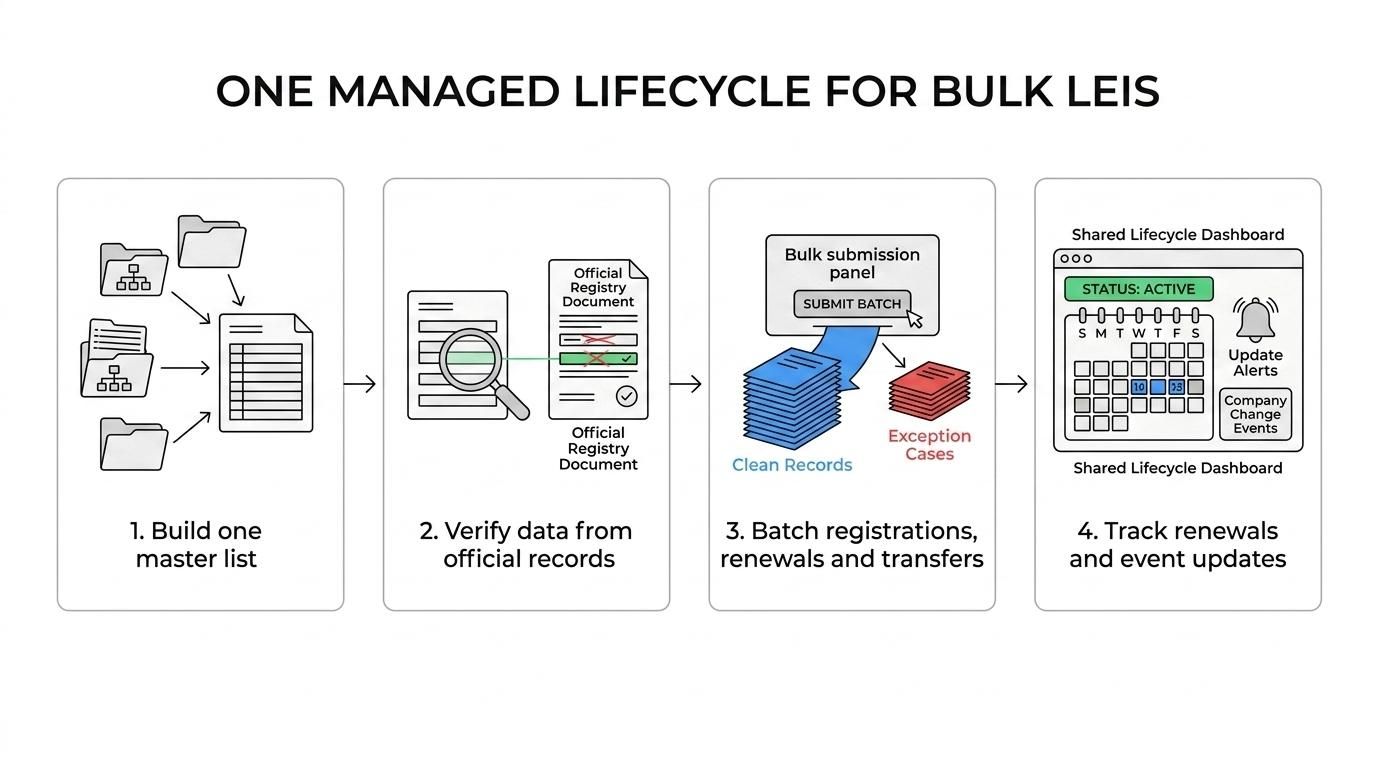
Bulk registration changes the shape of the task. Instead of treating each entity as a separate mini-project, the group can work from a central inventory, standardise key fields, submit records in batches and monitor renewals on a common timetable. That reduces friction and makes it easier to spot gaps before they become problems.
This is especially useful in the UK, where one group may include limited companies, LLPs, pensions, wills, trusts and charities. The legal forms differ, yet the administrative goal is the same: accurate LEI data that remains active and usable.
A strong bulk process also helps after mergers and internal restructures. Group structures rarely stay still for long. If LEI administration sits in separate business units or with several providers, data quality starts to drift. Bringing those records under one managed process creates a far clearer view of what is active, what is due for renewal and what needs updating.
A practical workflow for bulk LEI registration and renewal
The strongest bulk LEI workflows are surprisingly disciplined. They are not complicated, but they are structured. Every group needs a repeatable sequence that can be used for first-time registrations, annual renewals and post-event updates.
The table below shows a practical model that works well for multiple entities.
| Stage | What the team does | Main risk | Good practice |
|---|---|---|---|
| Entity inventory | Build a master list of all entities that need an LEI | Missing entities or duplicate records | Keep one central register owned by a named team |
| Data collection | Gather legal names, registration numbers, addresses and authority details | Old or inconsistent records | Pull from official registries where possible |
| Batch submission | Submit many applications or renewals together | Errors repeated across the batch | Validate fields before upload or submission |
| Exception handling | Isolate records that fail checks | Whole batch held up by a few problem cases | Split clean records from exception cases |
| Renewal management | Track next renewal dates and status | Lapsed LEIs | Use reminders, multi-year options or managed renewal |
| Event-driven updates | Amend records after name changes, mergers or address changes | Public data no longer matches reality | Link LEI updates to company secretarial and compliance processes |
What makes this work in practice is ownership. Someone needs responsibility for the entity master list, someone needs responsibility for submission, and someone needs responsibility for renewal monitoring. In smaller organisations, that may be one person. In larger groups, it is often shared between treasury, legal and compliance.
The entity data needed for each LEI application
Bulk submissions move quickly when the source data is clean. They slow down when names differ between internal systems, addresses are outdated, or a group has no single record of who is authorised to make the application.
Before any batch is sent, it helps to check a small set of core fields for each entity:
- Legal name: exactly as shown on the official register or governing document
- Entity type: company, trust, pension, charity, fund or other legal form
- Registration number and jurisdiction: matched to the relevant authority
- Registered address: current, complete and written consistently
- Applicant authority: confirmation that the person applying can act for the entity
- Parent relationship data: where group ownership details are required or should be reviewed
A surprising amount of delay comes from formatting rather than substance. One team writes “Ltd”, another writes “Limited”; one system holds an old registered office; another still shows a pre-merger name. Bulk registration rewards discipline at the data stage.
Common risks when managing LEIs across multiple entities
The biggest risk is not the first application. It is what happens six months later, when the group has changed and nobody has updated the LEI record.
Name changes, new registered offices, mergers, dissolutions and ownership changes can all affect LEI data. If those events are tracked in one part of the business but not linked to the LEI process, public records can go stale. That creates avoidable pressure during audits, onboarding reviews and regulated transactions.
Scale does not forgive messy data.
Another common issue is fragmentation after acquisitions. A group may inherit LEIs registered through different providers, each with different renewal dates and different internal owners. That is manageable at ten entities. At fifty or one hundred, it becomes inefficient and easy to lose sight of. Bringing registrations, transfers and renewals into one managed stream tends to save time very quickly.
There is also a human factor. Many organisations assume LEIs are a once-a-year task until an urgent trade, filing or renewal reminder proves otherwise. A lapsed record can force last-minute work at exactly the wrong time. Good bulk management removes that pattern by making LEIs part of normal governance rather than an annual scramble.
How automation and support reduce LEI administration effort
Automation helps most when it is applied to repetitive checks. Batch uploads, spreadsheet templates, registry lookups, reminder systems and status monitoring all reduce manual work. They also lower the chance of the same typo being entered repeatedly across a portfolio.
That said, not every group needs a fully integrated API model. Some want direct system-to-system connectivity and daily reconciliation. Others simply need a reliable provider that can take a well-prepared list, flag exceptions quickly and keep renewals under control. The right model depends on scale, internal resources and how centralised the group already is.
Support matters just as much as technology. When an entity does not fit a standard registry path, or when an unusual structure needs extra review, a responsive team can save days. That is why many UK entities prefer a support-led service for bulk work, especially where trusts, pensions or mixed entity types are involved.
A practical bulk service should help with more than the first registration:
- Fast batch handling
- Clear exception reporting
- Renewal reminders
- Transfer support
- Free reference data updates where offered
For UK-based entities that want an assisted route, LEI Service is built around that service-led model. Bulk orders are handled through direct contact rather than a public self-service bulk portal, which can suit teams that prefer guidance over configuration. The service covers new LEIs, renewals, transfers and renewal, assisted registration, multi-year options and bulk orders. It also offers free updates to LEI reference data, English-speaking phone and email support, and pricing positioned below many UK alternatives.
Speed is another important part of the picture. Depending on validation, issuance can range from around 10 minutes to 48 hours, with VIP delivery available in around two hours for qualifying orders placed before 5pm. For time-sensitive compliance work, that kind of turnaround can make planning far easier.
What to look for in a UK bulk LEI provider
Provider selection should be based on process fit, not only headline price. A low fee is welcome, but it does not help much if the group still spends hours each month sorting out exceptions, chasing renewal dates or moving inherited LEIs from one provider to another.
It helps to assess the service against the realities of your portfolio: how many entities you manage, how many renewals fall in each quarter, whether you need transfer support, and how often entity data changes. Groups with mixed legal forms often place a higher value on responsive human support than on a feature-heavy portal.
A useful checklist looks like this:
- Bulk capability: can multiple entities be registered or renewed through one managed process?
- Transfers: can existing LEIs be consolidated under the same provider?
- Renewal control: are reminders, multi-year options or managed renewals available?
- Support: is there English-speaking phone and email help when records need extra attention?
- Speed: are standard and urgent turnaround times clear?
- Transparent pricing
- UK-focused service
- Simple application path
The strongest provider relationship is usually the one that matches the way your team already works. If your group has a mature internal data function, you may want a highly structured bulk workflow. If your team is lean and deadline-driven, a support-led service with quick response times may be the better fit.
Practical next steps for finance and compliance teams
A successful bulk LEI project usually starts with a tidy internal exercise rather than an external submission. Once the entity list is accurate, the rest becomes much easier. Most delays can be prevented before the provider sees the first file or email.
A sensible first pass is to check which entities already have LEIs, which are due for renewal, and which have gone through recent legal changes. That alone often reveals duplicate work, missing records or records held with different providers.
From there, the work can be broken into a few clear actions:
- Build a single master list of all entities that need an LEI.
- Verify core data against official records before any bulk submission.
- Group entities into new registrations, renewals, transfers and exception cases.
- Choose a provider model that matches your internal resources and deadline pressure.
Teams that treat LEIs as part of regular entity governance usually find that the task becomes much lighter after the first clean-up cycle. The reward is not only administrative efficiency. It is confidence that every relevant entity is visible, current and ready when a regulated transaction or reporting requirement appears.