Can a Company Have More Than One LEI?
If a company is asking whether it can hold more than one Legal Entity Identifier, the short answer is no.
The LEI system is built on a simple rule: one legal entity should have one unique LEI. That single code is meant to identify that entity consistently across financial transactions, regulatory reporting, and public reference data. If a second LEI appears for the same company, it is not treated as a valid extra identifier. It is treated as a duplicate.
That distinction matters. An LEI is not like having several customer numbers with different service providers. It is a globally recognised identifier governed by an international standard, with data controls designed to keep each legal entity tied to one code only.
The one company, one LEI rule
An LEI is a 20-character code used to identify legal entities involved in financial transactions. The Global Legal Entity Identifier Foundation, or GLEIF, describes the LEI as unique and assigned to one entity only. In practical terms, that means a company that already has an LEI should not apply for another one.
This is not just best practice. It is part of how the LEI framework works. GLEIF has stated that a legal entity that has obtained an LEI cannot obtain another one. Even if the entity changes service provider, updates its details, or transfer its management to another registration agent, the LEI itself stays the same.
For UK companies, trusts, pension schemes, charities, and similar entities, this removes guesswork. If the entity already has an LEI, the task is usually to renew it, update its reference data, or transfer its management to another provider. It is not to create a second code.
A useful way to think about it is this:
- One entity
- One public identifier
- One official record
- One renewal path
Why the LEI system requires a single unique identifier
The entire purpose of the LEI is clarity. Financial counterparties, regulators, and market participants rely on the code to confirm exactly which entity is involved in a transaction. If one company could hold multiple valid LEIs, the system would lose much of its value.
A single identifier supports several important outcomes. It reduces reporting errors, improves transparency, and makes it easier to connect entity data across jurisdictions and markets. It also helps prevent confusion where entities have similar names or operate through groups with many subsidiaries.
GLEIF’s data quality framework reinforces this principle before an LEI is even issued. New applications are checked against existing records to identify potential duplicates. That check is designed to stop two records being created for the same entity, even if separate applications are submitted through different channels.
The logic behind the rule is straightforward:
- Clarity: one recognised code avoids conflicting records
- Regulatory reporting: the same entity is reported in the same way across markets
- Data quality: duplicate checks help preserve a clean global database
- Public trust: counterparties can rely on the LEI record they see
When duplicate LEIs appear and what “DUPLICATE status” means
Although the system is designed to prevent duplication, duplicate records can still occur from time to time. This might happen because of inconsistent application data, variations in naming, a misunderstanding about an entity’s existing registration, or a request made through a new provider without first checking whether an LEI already exists.
When that happens, the answer is not that the company now has two valid LEIs. Instead, the LEI data standard provides a way to mark the issue. A duplicate registration can be assigned a DUPLICATE status. That status is used for the non-surviving registration, meaning the record that should no longer be used.
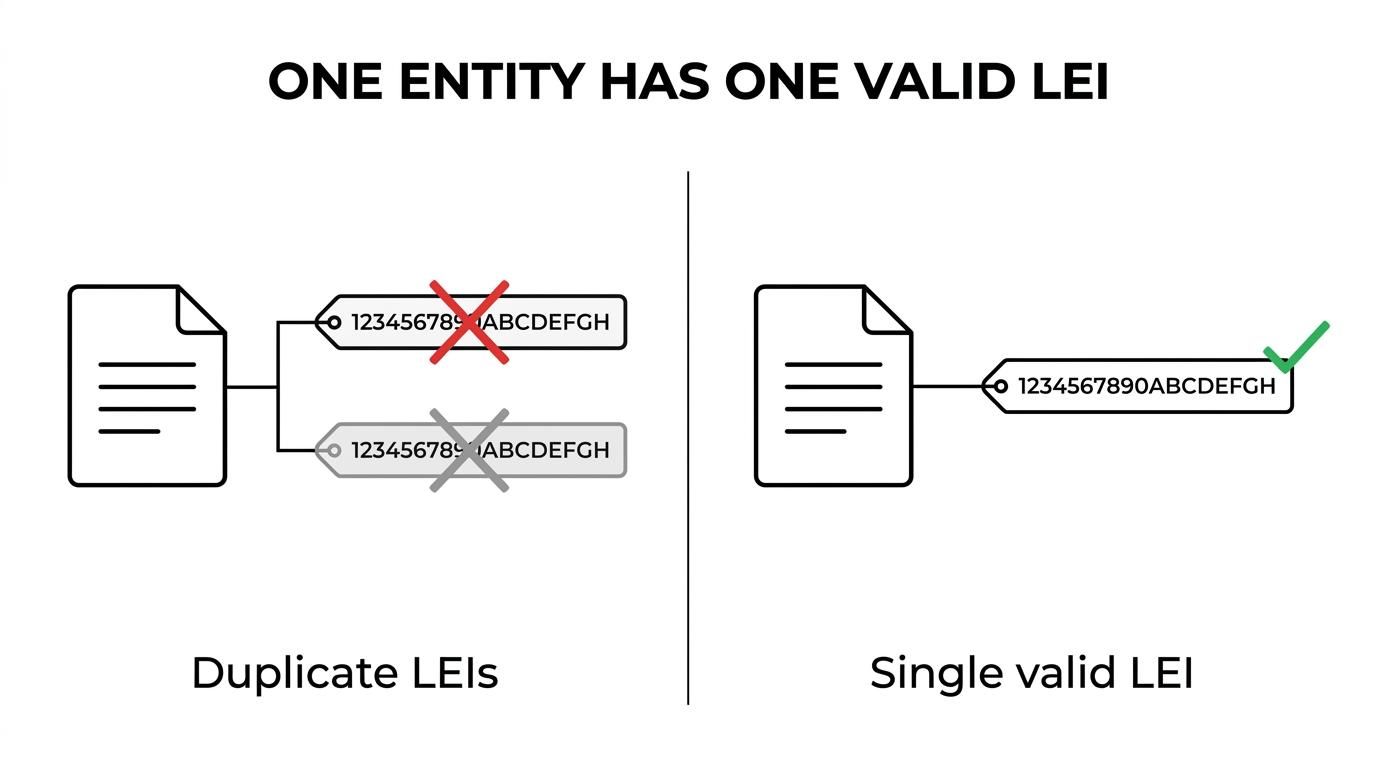
This is an important point for operational teams. If two LEIs appear to relate to the same entity, they should not assume both are acceptable in parallel. One will need to be recognised as the surviving record, while the other is treated as the duplicate.
Here is a simple comparison:
| Situation | What it means | What should happen |
|---|---|---|
| One active LEI for one legal entity | Normal and correct | Use that LEI for reporting and trading |
| A second LEI application is made for the same entity | Potential duplication | Check existing records before proceeding |
| Two LEIs appear linked to the same entity | Data integrity issue | Confirm which record survives |
| One record receives DUPLICATE status | Non-surviving registration | Stop using that duplicate record |
| Entity changes LEI provider | Administrative transfer only | Keep the same LEI code |
GLEIF also provides a challenge facility that allows users to flag possible errors in LEI data, including exclusivity issues where one entity appears to have more than one LEI. That means firms, counterparties, and market users are not powerless if they spot a problem. There is a formal route to raise it.
Common reasons companies think they need a second LEI
A second LEI often seems necessary only because the underlying event has been misunderstood. In most cases, the entity needs an update, a renewal, or a transfer, not a new identifier.
Name changes are a classic example. If a company changes its registered name, its LEI does not change with it. The reference data linked to the existing LEI should be updated instead.
The same applies when a business changes address, legal form, or registration details. The record may need correction or refresh, but the identifier remains attached to the same legal entity.
The following situations often create confusion:
- Company name change: update the existing LEI record
- Switching to a cheaper provider: transfer or renew the same LEI
- Annual renewal due: renew the current LEI, not a fresh one
- Data correction needed: amend the reference data linked to the existing code
Another source of confusion is group structure. A parent company and its subsidiary can each have their own LEI if each is a separate legal entity. That does not break the one-entity-one-LEI rule, because the rule applies per legal entity, not per corporate group.
So a UK holding company may have one LEI, while each regulated subsidiary has its own. A trust may have its own LEI where eligible, separate from the corporate trustee. A pension scheme may hold an LEI distinct from an employer sponsor. These are separate entities, not duplicate identifiers for the same one.
Situations where a new LEI is not issued
There are several corporate events that may look substantial enough to justify a new LEI, yet they still do not result in a second active code for the same entity.
A transfer between LEI service providers is one of them. If a company moves the maintenance of its LEI from one operator or registration agent to another, the LEI stays exactly the same. The managing organisation changes, not the identifier.
A lapsed LEI is another example. If an LEI has not been renewed on time, it may show a lapsed status, but it does not need replacing. The entity should renew that existing LEI rather than apply for another.
Corporate changes can be more complex where mergers, acquisitions, or dissolutions are involved. If one entity ceases to exist and another survives, the surviving entity keeps its own LEI. The ceased entity’s LEI is not recycled and should never be reassigned to a different entity. That permanence protects historical reporting and preserves an audit trail over time.
This is why the LEI system remains reliable even as companies change shape. The identifier is attached to the legal entity’s existence and history, not to a provider relationship or a temporary administrative status.
How to check whether a company already has an LEI
Before applying for an LEI, it is sensible to search the global LEI data first. This is especially important for entities with long trading histories, recent restructurings, or prior dealings with banks, brokers, or counterparties that may already have requested an LEI.
A careful pre-check can save time and avoid the inconvenience of duplicate handling later. It also reduces the risk of internal reporting teams using inconsistent identifiers across platforms.
A practical checking process often includes:
- searching the legal name
- reviewing Companies House details or equivalent registry data
- checking older transaction records
- confirming whether another team or adviser previously arranged registration
Where there is any uncertainty, support from an LEI registration agent can be helpful. A provider focused on UK entities can assist with checking whether an LEI already exists, whether it needs renewal, or whether the record should be transferred rather than recreated.
What UK companies should do if they appear to have more than one LEI
If a company finds two LEIs that appear to refer to the same legal entity, the right response is to investigate promptly. Do not continue using both codes while assuming the issue will resolve itself later.
Start by identifying which record is active, which provider manages each one, and whether the legal reference data clearly points to the same entity. Compare the registered name, company number, legal address, and jurisdiction. If the records match or substantially overlap, it is likely a duplicate issue rather than a legitimate case for two identifiers.
The next step is to contact the managing organisation or registration agent involved. The duplicate can then be reviewed and, where appropriate, marked as the non-surviving record. If needed, a challenge can also be raised through GLEIF’s process for LEI data issues.
A sensible response usually looks like this:
- Pause usage: stop issuing new reports with both LEIs in circulation
- Verify data: compare registry details across the records
- Contact support: ask the managing provider to review the duplication
- Correct systems: update internal records so only the surviving LEI is used
For firms with active trading or reporting obligations, speed matters. The longer duplicate identifiers remain in use, the greater the risk of inconsistent reporting, settlement friction, or compliance queries.
Registering, renewing, or transferring an LEI without creating duplication
The safest route is to treat LEI administration as record maintenance, not as a series of fresh applications. If the entity has never had an LEI, it can apply for one. If it already has one, the task is to renew or transfer it.
That sounds simple, yet many duplicate issues begin when an application is made without first checking the global record. A streamlined provider process can reduce that risk by screening for existing LEIs and confirming the entity’s details before submission.
For UK entities, this matters because LEI needs often arise under time pressure. A company may need to trade, renew a position, satisfy a bank request, or complete a filing by a deadline. In those situations, it is tempting to rush straight into a new order. A quick pre-check is still the better route.
Providers that focus on LEI registration, renewal, and transfer for UK entities can help keep that process tidy. LEI Service, as an official registration agent of Ubisecure RapidLEI, offers registration, renewal, transfer and assisted support, with free updates to LEI reference data and English-speaking phone and email help. For a company that already has an LEI, that kind of support is most useful when the aim is to keep the existing code active and correct, rather than accidentally creating duplication.
The key principle stays the same throughout: a legal entity should have one LEI, and that one code should follow it through renewals, updates, and provider changes.