Does a Dormant Company Need an LEI?
A dormant company often appears to sit outside the usual rush of financial regulation. No sales, no active operations, no regular trading activity. That naturally leads to a practical question: is an LEI still required?
In most cases, the answer is no. A dormant company does not need an LEI simply because it exists on the register or files dormant accounts. In the UK, dormant status and LEI requirements come from different rulebooks. Dormancy is a company law concept. An LEI is linked to regulated financial market activity.
That distinction matters. If a company remains dormant and does not instruct a firm to carry out reportable financial transactions, an LEI is usually unnecessary. If it wants to enter that type of transaction, even briefly, the position changes quickly.
Dormant company definition under UK law
The Companies Act 2006 says a company is dormant during a period in which it has no significant accounting transaction. In plain terms, that means there is no transaction that needs to be entered into the company’s accounting records, apart from certain limited items that the law disregards.
So dormancy is not a label based on intention or company age. It is tied to what has, or has not, happened in the accounts.
Companies House also offers a dormant company accounts route, including the AA02 form for certain companies limited by shares or by guarantee that have never traded. That filing route is useful, but it should not be confused with the LEI system. Filing dormant accounts does not create an LEI requirement, and having an LEI does not make a company active by itself.
A simple way to think about it is this: dormant status tells Companies House what sort of accounts may be filed. An LEI tells financial market participants who a legal entity is when regulated transactions are being executed and reported.
When a dormant company needs an LEI under UK MiFIR
The Financial Conduct Authority links LEIs to UK MiFIR transaction reporting. Its position is clear: firms with transaction reporting obligations cannot execute a trade for a client that is eligible for an LEI if that client does not have one.
That rule is about activity, not dormancy.
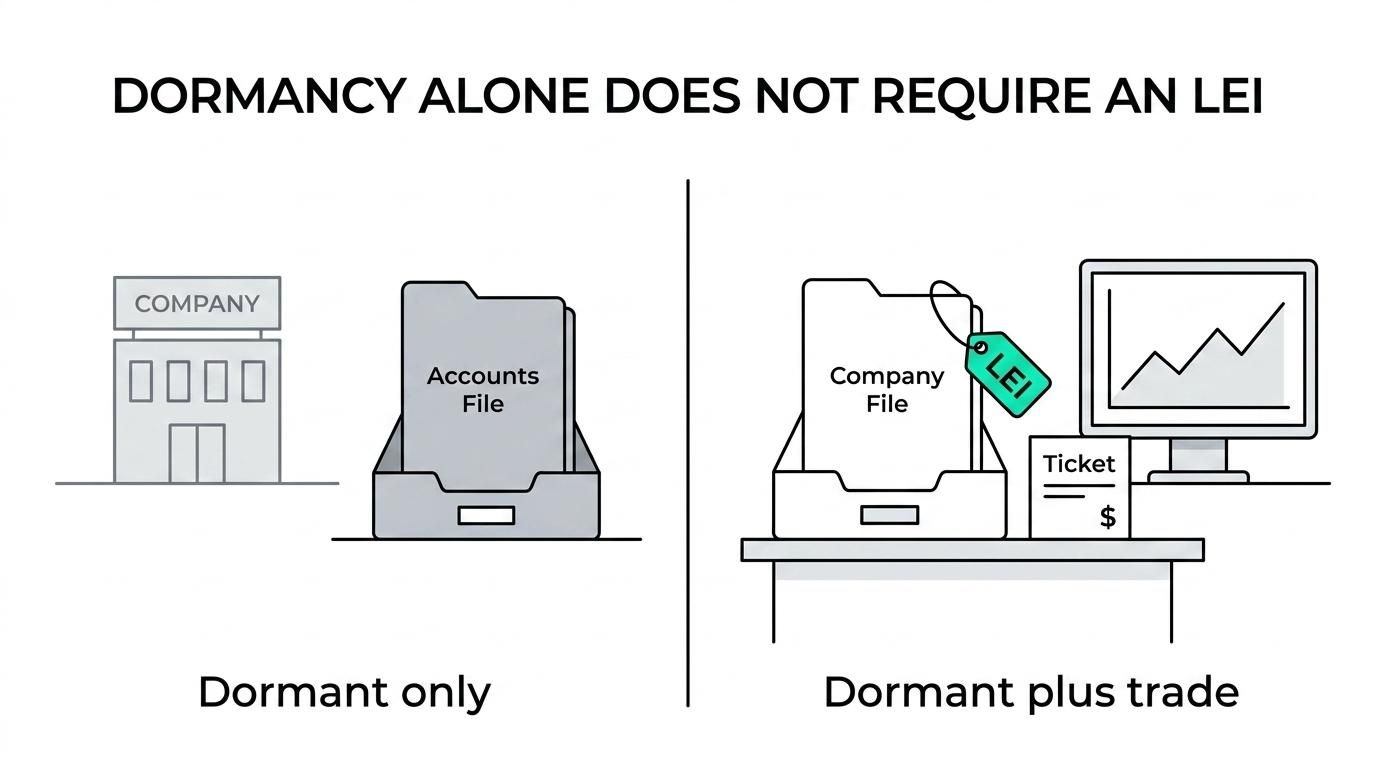
The FCA also states that an LEI is a unique identifier for legal entities and structures, including companies, charities and trusts. If a legal entity wants a firm to act on its instructions, or make a decision to trade on its behalf, it needs to arrange an LEI. So the key question is not “Is the company dormant?” but “Is the company about to take part in a regulated financial transaction where an LEI is required?”
This is why a dormant company may not need an LEI for years, then suddenly need one before a single transaction can go ahead. The trigger is the transaction itself, along with the reporting obligations of the financial firm involved.
Dormant company status and LEI requirements compared
The difference becomes easier to see when the two concepts are placed side by side.
| Issue | Dormant company rules | LEI rules |
|---|---|---|
| Main source | Companies Act 2006 and Companies House filing practice | FCA guidance linked to UK MiFIR |
| What it asks | Has the company had significant accounting transactions? | Is the legal entity involved in reportable financial market activity? |
| Who it affects | Companies filing accounts and meeting company law duties | Legal entities or structures dealing through firms that need LEIs for reporting |
| Trigger | Accounting activity or lack of it | Regulated trades or investment instructions |
| Automatic for all companies? | No | No |
| Automatic for all dormant companies? | Not applicable | No |
That table captures the central point. Dormancy does not automatically create an LEI requirement, and it does not remove one either.
Common cases where a dormant company does or does not need an LEI
A company that is truly inactive, files dormant accounts, and does not ask an investment firm to execute reportable trades will normally have no immediate need for an LEI.
A company that is called “dormant” in conversation but is about to buy, sell, transfer or otherwise deal in financial instruments may need an LEI before the firm can act. The language used internally is less important than the legal and regulatory reality of the transaction.
These examples help sort the issue quickly:
- Filing dormant accounts only
- Holding the company on the register with no market activity
- Preparing to close a historic investment account
- Asking a broker to sell securities
- Instructing a firm to trade on the company’s behalf
The first two cases usually point away from an LEI requirement. The last two often point towards one. The middle case depends on what is actually happening. If closing the account involves a reportable trade, an LEI may be needed before the firm can proceed.
There is also an important practical wrinkle. A company can be dormant for company law purposes and still need an LEI just before it ceases to be dormant because it is about to enter a transaction. That sounds technical, yet it is common in real life. A company may sit inactive for a long period, then decide to dispose of an investment, participate in a corporate action, or carry out a one-off market transaction. At that moment, the LEI issue comes to the front.
Why dormant status is not the same as “never needs an LEI”
It is easy to treat dormancy as a blanket exemption from anything market-related. That is where mistakes happen.
Dormancy is narrow. It addresses whether there are significant accounting transactions. The LEI regime is also narrow, though in a different way. It addresses entity identification in regulated financial activity. Since those two systems ask different questions, the answers do not always move together.
A dormant company may still be a legal entity that is eligible for an LEI. Eligibility alone does not mean one must be obtained at once. The immediate need appears when a regulated firm cannot execute a trade without it.
This is often relevant for:
- Investment instructions: the company asks a broker or bank to buy or sell a financial instrument
- Corporate actions: the firm needs the entity’s LEI to process an event involving reportable instruments
- Fund or securities activity: the transaction falls within reporting rules applied by the executing firm
- Group structuring: an inactive subsidiary is being used in a planned transaction and must be identified correctly
The broader lesson is simple. Do not use dormant status as a shortcut answer. Use the actual transaction.
How to check whether your dormant company should apply for an LEI
Start with the practical facts. Is the company only maintaining its existence and filing the right Companies House documents? Or is it about to instruct a financial institution to act?
If there is a bank, broker, custodian or investment platform involved, ask a direct question before the transaction date: “Will you need an active LEI for this entity to proceed?” That often resolves the issue very quickly.
A useful checklist looks like this:
- Entity type: company, charity, trust, pension, or another legal structure
- Planned activity: no activity, account maintenance, sale, purchase, subscription, transfer, or redemption
- Counterparty requirement: whether the executing firm says an LEI is mandatory
- Timing: whether the LEI must be active before the order can be accepted
- Renewal status: whether an existing LEI has lapsed and must be renewed
If every answer points to inactivity only, there may be no reason to apply yet. If a firm says it cannot execute without an LEI, that is the practical answer.
A note on dormant companies, trusts, charities, and pension structures
The FCA’s description of LEIs is broader than limited companies. It refers to legal entities and structures, including charities and trusts. That matters because many people use “dormant company” as shorthand when the real issue sits in a wider group or holding structure.
A subsidiary company may be dormant while a connected trust or charity is the party entering the transaction. In that case, the LEI question belongs to the legal entity that is giving the instruction or on whose behalf the firm is acting.
That is why it is worth checking the exact named party on the account or investment paperwork. The entity requiring the LEI may not be the one people mention most often in internal discussions.
Applying for an LEI when a dormant company needs one
If an LEI is required, the process is usually straightforward. The application will generally ask for the legal entity’s registered details, including its official name, registration number, address, and other reference data. The issuing system then validates that data against recognised records.
For UK entities, speed matters because the need for an LEI often appears close to a trading deadline, account transfer, or year-end action. Many applicants prefer to use an official LEI registration agent that can process applications quickly, explain the paperwork in plain English, and help with renewal as well as first-time registration.
A few practical points are worth keeping in mind:
- LEIs need annual renewal to remain active
- Reference data should stay up to date
- A lapsed LEI can cause the same problem as having no LEI at all
- Support by phone or email can save time when a firm is waiting for the code
For entities that expect only one future transaction, there can be a temptation to delay until the last moment. That is rarely the best choice. If a firm cannot execute without an active LEI, even a small delay can hold up the entire instruction.
What to do if you are still unsure
Uncertainty usually comes from one of two places. Either the company is dormant in the accounting sense but a transaction is being planned, or the people involved are not sure whether the transaction falls within the relevant reporting rules.
In that situation, the cleanest approach is to confirm the requirement with the executing firm and, if needed, arrange the LEI before paperwork is submitted. A specialist LEI provider can usually handle registration, renewal, or transfer quickly, which is helpful when the instruction is time-sensitive.
For most dormant companies, there is no automatic LEI obligation sitting in the background. The need begins when the entity steps into regulated financial activity and a firm requires an active identifier to proceed. That is the point where a dormant company stops being a filing question and becomes a market-access question.