How long does it take to get an LEI number? Typical timelines and what affects speed
If you need an LEI quickly, the short answer is reassuring: many straightforward applications are completed the same day, and some are issued within minutes. The longer answer is that speed depends on the legal entity, the data available in public records, and whether any manual checks are needed.
For a standard UK company that can be matched cleanly against Companies House, the process is often much faster than first-time applicants expect.
Typical LEI number timelines for UK applicants
An LEI is not created in isolation. The application has to be checked against official reference data, then issued through an accredited LEI issuer, and then reflected across the wider LEI ecosystem. When the records match neatly, that workflow can move very quickly.
LEI Service, a UK-focused registration agent of Ubisecure RapidLEI, states that a new LEI can be issued in 10 minutes to 48 hours if no extra information is required. It also offers a VIP option for urgent cases, with a published target of within 2 hours for orders placed before 5pm. That gives a useful benchmark for what a well-automated process can look like in practice.
Across the wider market, a realistic rule of thumb is simple: plain company applications are often handled in minutes to two business days, while more complex cases can take several business days.
| Request type | Typical timing | What usually drives the result |
|---|---|---|
| New LEI for a standard UK company | Minutes to 48 hours | Clean Companies House match, no extra documents |
| Urgent new LEI with express handling | Often within a few hours | Early order time, straightforward validation |
| Same-provider renewal | Varies by provider | Usually simpler than a first application, but published timings are often less explicit |
| Transfer and renewal | Up to 7 business days is a common upper range | Coordination with the current managing issuer |
| Trust, pension, will, or other non-standard entity | Several days in some cases | Manual checks, supporting documents, non-public records |
What affects LEI application speed most
The biggest factor is data quality. If the legal name, registration number, address, and ownership details line up with official records, the process can be largely automated. If they do not, the application may be paused while the provider asks for clarification or documents.
That is why two applicants who apply at the same time can see very different outcomes.
A few factors matter more than the rest:
- Registry match: companies listed clearly on Companies House are usually the fastest cases
- Data accuracy: small errors in names, numbers, or addresses can slow validation
- Supporting documents: trusts and similar entities may need deeds, tax forms, or registry evidence
- Entity complexity: parent relationships and unusual structures can trigger manual review
- Timing of the order: cut-off times, weekends, and bank holiday periods can affect speed
There is also a third-party element built into the system. Registration agents help with the application, but the LEI itself must still be issued through an accredited issuer and then fed into the wider LEI data network. So even the smoothest provider is still dependent on official sources and publication cycles beyond its own website.
New LEI applications, renewals, and transfers compared
A brand-new LEI request is often the fastest type of case, provided the entity is easy to verify. For most UK limited companies, this is the best-case scenario. The public register exists, the entity data is familiar, and automated checks can do much of the work.
Renewals are a little different. In many cases they are straightforward, especially when the entity details have not changed, but providers do not always publish a distinct time estimate for routine renewals. That means applicants should not assume a fixed renewal speed unless the provider states one clearly.
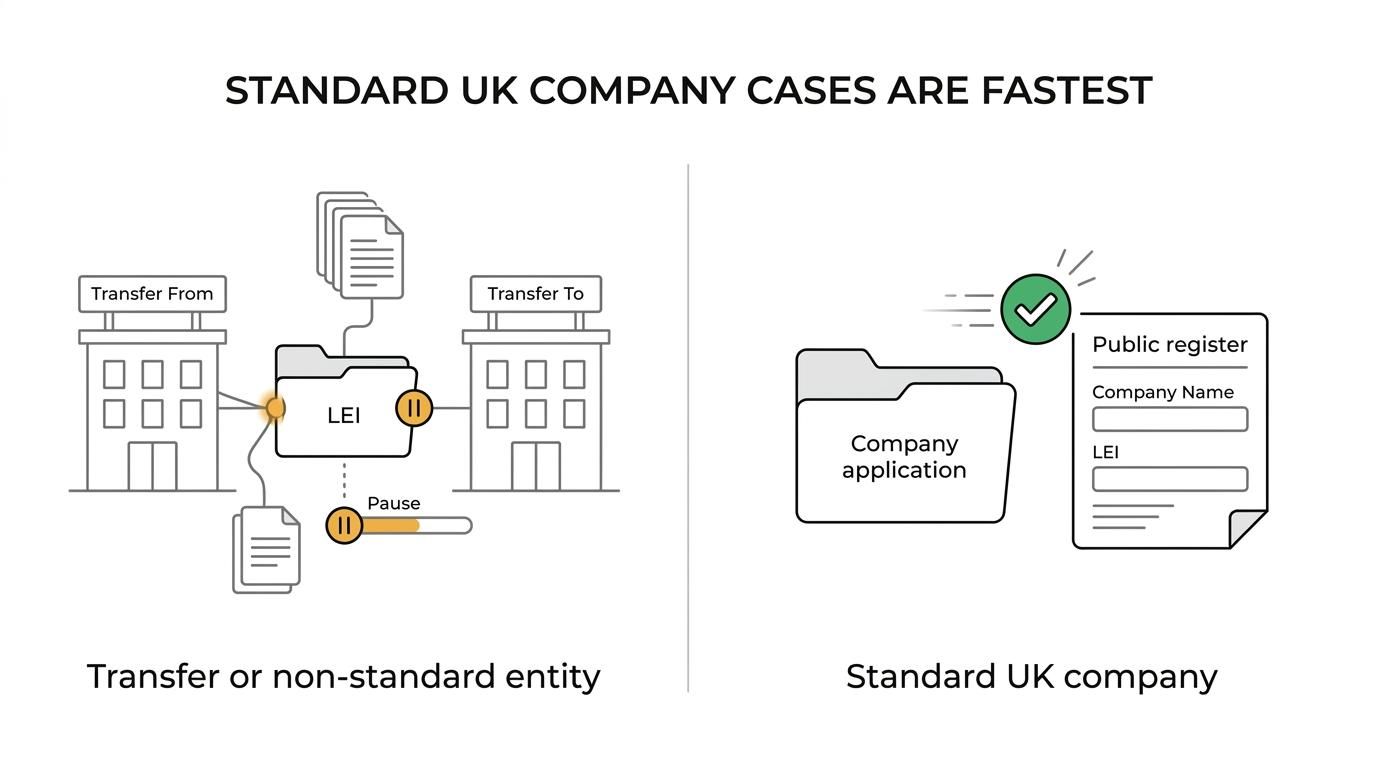
Transfers take longer.
When an LEI is being moved from one managing issuer to another, there is more coordination in the background. LEI Service publishes up to 7 business days for transfer and renewal cases, and this is consistent with the wider pattern across the market. A transfer is not necessarily difficult, but it is rarely the fastest path.
A useful way to think about the three routes is this:
- New application: usually the quickest when public records are clear
- Renewal: often efficient, but timing is not always published in a simple range
- Transfer plus renewal: normally the slowest option
Which UK entity types tend to get an LEI fastest
Standard UK companies are usually first in line for speed. If the organisation appears on Companies House and the application details match the register, there is less for a validation team to investigate. That is why many straightforward company applications are completed the same day.
Trusts, pensions, wills, charities, and other less standard entities can still obtain an LEI without difficulty, but the timing is more variable. In these cases, there may be no single public register that provides every detail needed for automated validation. The provider may need documents from the applicant, and every extra step adds time.
That does not mean these applications are problematic. It just means they are less likely to fit the fastest automated route.
Jurisdiction also matters. A provider focused on UK entities will often be quickest with UK records, while non-UK entities may need to apply through a different site or process. Some UK-facing platforms make this very clear by limiting the local site to UK entities and directing other jurisdictions elsewhere.
Why an LEI can be issued but still take time to show everywhere
Receiving the LEI and seeing it recognised instantly by every bank or trading platform are not always the same moment.
Some providers note that, even after issuance, it can take up to 24 hours before a bank or investment platform can verify the LEI through the wider GLEIF-connected data environment. This is usually down to publication cycles and system refresh timing, not a fault with the LEI itself.
That detail matters if you are trying to trade on a tight deadline.
So, when someone asks how long it takes to get an LEI, there are really two separate clocks to consider:
- the time to issue the LEI
- the time for downstream systems to display and recognise it
In many cases those two timings are close together. In urgent cases, the gap can feel significant.
How to get an LEI number faster
If speed matters, a few practical steps can shorten the process considerably. None are complicated, but they do make a difference.
Start with the exact legal entity name and registration details as they appear on the official record. Not the trading name, not a shortened version, and not an old address if the register has already been updated. Small mismatches often create avoidable delays.
If the entity is a trust, pension, will, or another structure that may need documents, have those ready before you begin. Waiting for the provider to ask, then searching for paperwork later, is one of the most common reasons an urgent application turns into a slow one.
The timing of the order also matters. A provider may advertise fast handling during business hours, with a cut-off for same-day or express treatment. LEI Service, for example, publishes a 5pm cut-off for its 2-hour VIP service. If an application lands after that point, the wait may naturally extend.
A practical checklist helps:
- Use the exact registered details: match the official record character for character where possible
- Choose the right application path: company lookup for Companies House entities, manual route for trusts and similar cases
- Respond quickly to queries: validation teams cannot finish the file without what they need
- Apply before cut-off times: urgent orders are best placed early in the working day
- Shortlist a provider with phone and email support
- Check whether express handling is available
Publicly stated LEI timing examples from selected providers
Published timing statements vary quite a lot from one provider to another. Some give a very clear retail timescale, while others prefer broader wording and avoid a simple promise on standard processing.
Here is a snapshot based on publicly available information referenced in the research provided.
| Provider | Published new LEI timing | Faster option | Notes |
|---|---|---|---|
| LEI Service | 10 minutes to 48 hours, if no extra information is required | Within 2 hours before 5pm with VIP handling | UK-focused, official agent of Ubisecure RapidLEI |
| RapidLEI | Many LEIs issued within minutes, often under 10 minutes for standard company cases | No separate express product clearly highlighted in the reviewed material | Strong automation emphasis |
| UniLEI | Standard timing not clearly quantified in a simple range | Express processed by 2pm on the next weekday | Public wording less precise on normal turnaround |
| LSEG | No simple consumer-facing time promise prominently stated in the reviewed material | No express retail option clearly identified | Timing depends on validation and completeness |
The key point is not that one number is always better than another. It is that published timing claims only apply when the case is straightforward. Every provider has to slow down when records do not match or documents are missing.
A realistic expectation for most UK LEI applications
If you are applying for a standard UK company and your details are clean, expecting issuance on the same day or within two business days is reasonable. If you need it urgently, a provider with a published express route can make a real difference.
If your entity is more complex, or if you are transferring an existing LEI, plan for longer. Several business days is not unusual, and a transfer may stretch to about a week.
That makes timing less about luck and more about preparation. Clean records, prompt responses, and the right provider usually put you in the fastest lane available.