LEI Parent and Ownership Data Explained for UK Firms
For many UK firms, an LEI starts as a practical requirement. It is needed to trade, to report, or to satisfy a counterparty that will not move forward without one. Yet the number itself is only part of the picture. Attached to every LEI record is a set of public reference data that helps regulators, counterparties, and market participants identify who an entity is and, where relevant, who sits above it in the group structure.
That second point often gets less attention than it deserves.
Parent and ownership data in the Global LEI System is not decorative admin. It supports transparency across financial markets, and for firms subject to reporting rules, it can shape how a group is viewed in transaction reporting and control assessments. For UK entities dealing with derivatives, listed holdings, or wider compliance checks, this is where detail matters.
What LEI Level 1 and Level 2 data mean for UK firms
GLEIF separates LEI reference data into two broad layers. Level 1 data answers the question of who is who. Level 2 data answers who owns whom. That simple split is helpful, because it shows that an LEI is not just an identifier but a public data record with a clear structure.
Level 1 is the identity layer. It usually contains the entity’s official name, registered address, and other core registration details. Level 2 covers parent relationships, using accounting consolidation as the basis for reporting rather than day-to-day commercial influence or informal ownership language.
A quick comparison makes the distinction clearer:
| LEI data layer | Main purpose | Typical content | Why UK firms care |
|---|---|---|---|
| Level 1 data | Identity | Official legal name, registered address, registration details | Needed for accurate entity matching in reporting and onboarding |
| Level 2 data | Parent relationships | Direct accounting consolidating parent, ultimate accounting consolidating parent, or an exception reason | Helps regulators and counterparties assess group structure and control |
In practice, Level 1 data is what most people expect to see when they look up an LEI. Level 2 is where the record becomes more revealing, because it links an entity to the wider corporate group where a reportable parent relationship exists.
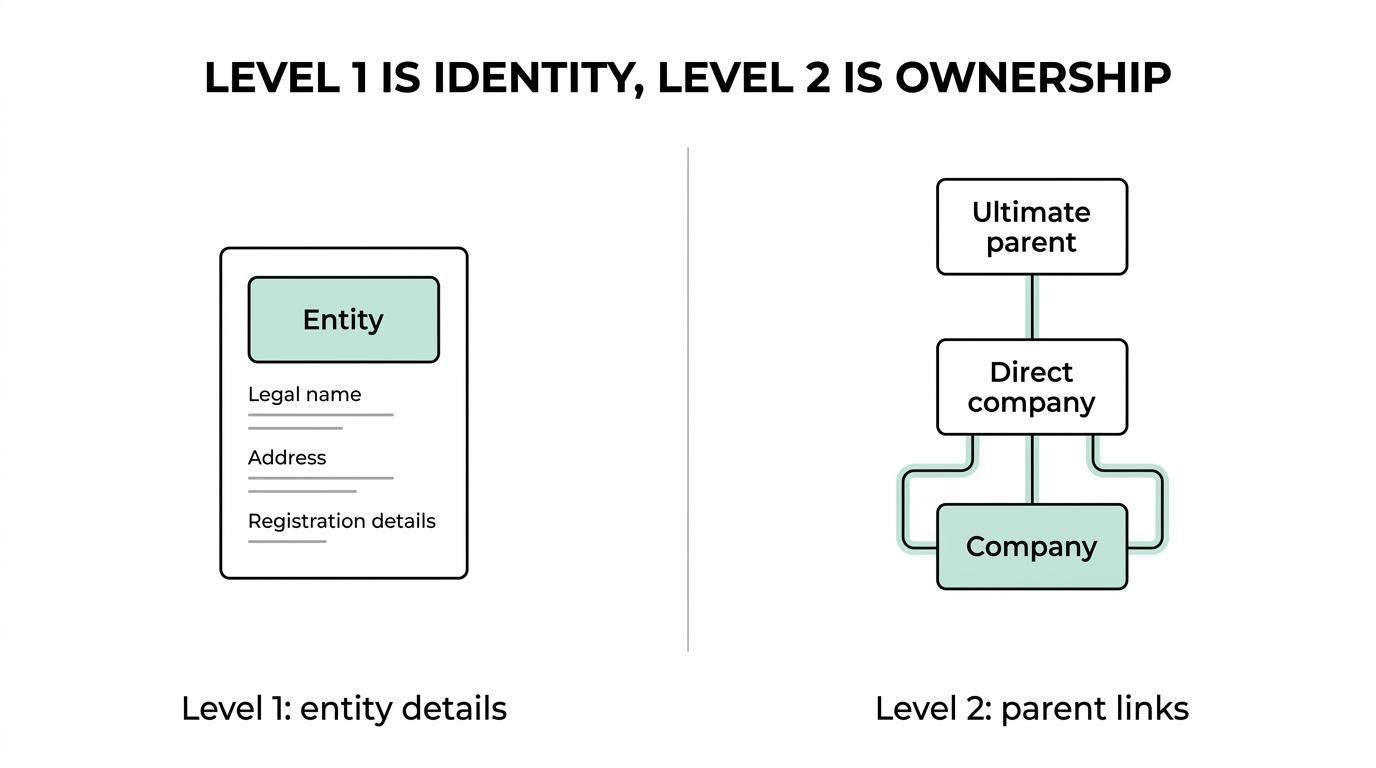
After that distinction, the core components are easier to follow:
- Legal name
- Registered address
- Registration authority details
- Direct parent relationship
- Ultimate parent relationship
- Reporting exception, where applicable
How LEI parent relationship data is structured
The LEI framework uses two specific parent categories: the direct accounting consolidating parent and the ultimate accounting consolidating parent. Those terms are precise, and precision matters here.
The direct accounting consolidating parent is the nearest parent entity that prepares consolidated financial statements including the child. The ultimate accounting consolidating parent is the highest parent in that consolidation chain. For some entities, those two parents are different. For others, they may be the same. In some cases, there is no reportable parent at all.
This approach means LEI ownership data is not built around broad assumptions like “largest shareholder” or “group sponsor”. It is tied to accounting consolidation, which gives the Global LEI System a more consistent basis for public parent reporting across jurisdictions.
If the parent entity has obtained an LEI, that parent LEI can be published alongside the child entity’s record. That creates a machine-readable link within the Global LEI Index. Where a parent does not have an LEI, the relationship picture may be less complete from a public identifier perspective, even if the group relationship exists in substance.
That distinction can shape how quickly a group can be mapped by a bank, a regulator, or a trade reporting system.
Why LEI ownership data matters under UK EMIR reporting obligations
For many UK firms, the compliance trigger is straightforward. The FCA states that all UK counterparties entering into derivative trades need an LEI to meet UK EMIR reporting obligations. That rule is widely known. What receives less attention is the value of having the related entity data correct around that LEI.
A reporting regime works best when it can identify counterparties consistently and place them in the right group context. If a legal entity is part of a wider structure, parent data helps build that context. It can support checks around concentration, exposure, group reporting logic, and the quality of transaction data flowing into the market infrastructure.
This is why inaccurate parent information can create more than a clerical issue. A record that points to the wrong consolidating parent, or fails to reflect a genuine restructuring, can distort how a group appears externally. That can affect internal compliance reviews and external due diligence in equal measure.
The relevance goes beyond derivatives. FCA processes around chains of controlled undertakings in shareholding notifications also reflect the same basic regulatory priority: clarity around who controls what. LEI Level 2 data is not a substitute for every ownership disclosure regime, though it clearly supports the wider transparency landscape.
When LEI parent and ownership data can be omitted
Not every legal entity will show a published parent relationship in its LEI record. The system allows defined reporting exceptions, and these are a normal part of LEI data rather than a sign that something has gone wrong.
An entity may have no accounting consolidating parent. A parent may exist but not hold an LEI. There can also be cases involving legal restrictions, legal commitments, lack of parent consent, or concerns that disclosure would be detrimental. In those cases, the record may show an exception reason instead of a direct or ultimate parent link.
That is a useful feature of the system because it prevents firms from being forced into inaccurate declarations merely to fill a field. Public transparency is the aim, but not at the cost of false reporting.
Typical exception categories include:
- No parent entity: the applicant does not have a direct or ultimate accounting consolidating parent
- Parent has no LEI: a parent relationship may exist, but the parent identifier is not available in the LEI system
- Legal restrictions: law or regulation prevents disclosure of the relationship
- Legal commitments: contractual or other binding commitments restrict disclosure
- No consent from parent: the child entity cannot obtain the necessary parent approval for disclosure
- Detrimental disclosure: publication could be harmful in the circumstances recognised by the framework
For UK firms, the practical point is simple. If parent data is absent, the absence itself should still be supported by the correct exception logic. “Blank” and “properly excepted” are not the same thing.
Common issues that lead to inaccurate LEI ownership records
LEI parent data often becomes inaccurate for ordinary operational reasons. Group structures change. Holdings are reorganised. Consolidation changes after a transaction. A trust, pension vehicle, or charity may also face more nuanced questions about who qualifies as the relevant parent in accounting terms.
A second problem comes from using familiar business information instead of official source data. Teams may rely on a trading name, an internal group chart, or a legacy onboarding record that no longer matches the legal register or the current consolidation position. That mismatch can carry through into the LEI file if nobody checks it carefully at renewal.
Timing is another factor. A parent relationship that was correct when the LEI was first issued may no longer be correct a year later. Renewals are not only about keeping the LEI in an active status. They are also a natural checkpoint for confirming whether Level 1 and Level 2 data still reflect reality.
Warning signs often look mundane before they become expensive:
- A recent acquisition or disposal
- New consolidated accounts
- A parent company name change
- A UK entity moved within the group
- Different parent information across internal systems and public filings
How UK firms should review parent data before registration or renewal
A sensible review starts with the official legal entity details, then moves to the accounting consolidation position. That means checking the registered name and address against the underlying public register, then checking who the direct and ultimate accounting consolidating parents are at the relevant date.
Where there is no parent to report, or where an exception applies, the reasoning should be documented clearly. That helps avoid rushed decisions during onboarding or trading deadlines, when teams are tempted to pick the nearest answer rather than the correct one.
A strong review process usually includes a few simple controls:
- Check the register first: use the official legal entity details, not an internal shortcut
- Check the accounts: parent reporting in LEI data is based on accounting consolidation
- Check both parent levels: direct and ultimate parents are separate fields for a reason
- Check for exception evidence: if parent data is omitted, the reason should be supportable
- Check renewal timing: annual renewal is the moment to catch structural changes
This is one area where responsive support has real value. If an applicant is unsure whether a parent relationship should be reported or excepted, a provider that offers clear phone and email support can help turn a grey area into a documented, defensible filing position.
Public LEI records and group transparency in practice
One of the most useful aspects of the LEI system is that the reference data is public by design. Anyone can look up an LEI record and review the core identity details. Where Level 2 relationships are available, those relationships can also be examined in the public data.
That openness supports due diligence. A counterparty can confirm whether the entity standing in front of it appears connected to the parent group it claims. Compliance teams can check whether multiple entities in a trading structure really sit under the same ultimate parent. Market participants can also use the data for screening, exposure mapping, and group analysis.
Public visibility creates discipline. It encourages firms to keep their records consistent with their legal and accounting position because mismatches are easier to spot when the data is openly available.
Keeping LEI parent data accurate during business change
Corporate structures rarely stay still. UK firms acquire subsidiaries, merge entities, move business lines, and update accounting treatment. Each of those changes can affect LEI parent reporting, even where the legal entity itself continues unchanged and its LEI remains the same.
That is why ownership data should be treated as a living compliance record. A firm does not need to wait for a regulatory query before checking whether the direct or ultimate parent information still fits the latest accounts and group structure.
Where applications are handled through a straightforward process, with the ability to update reference data and resolve questions quickly, it becomes much easier to keep the LEI record reliable rather than reactive. For UK companies, trusts, pensions, charities, and similar entities, that discipline helps the LEI do what it is meant to do: identify the entity clearly, place it in the right group context, and support cleaner reporting across the market.