Non-UK Entity LEI for Trading in the UK (cross-border support)
When a company is incorporated outside the United Kingdom but wants to trade in the UK, one detail can stop activity before it starts: the Legal Entity Identifier, or LEI. If the transaction falls within a reporting regime that requires an LEI, a UK firm cannot simply proceed without one.
For overseas entities, this is less about getting a special UK number and more about securing a globally recognised LEI that UK firms, venues, counterparties, and regulators can use with confidence. The good news is that there is no separate “UK LEI” for foreign companies. A valid LEI issued through the global LEI system is accepted for UK trading and reporting.
LEI requirements for overseas companies trading in UK markets
A non-UK company may need an LEI before trading through a UK broker, entering reportable derivatives transactions, or taking part in securities financing activity that falls under UK reporting rules. Under UK MiFIR, firms subject to transaction reporting cannot execute a trade for a client that requires an LEI but does not have one. UK EMIR and UK SFTR also rely heavily on LEIs for counterparty identification and reporting quality.
That means the LEI is often a gatekeeper to market access, not an optional extra.
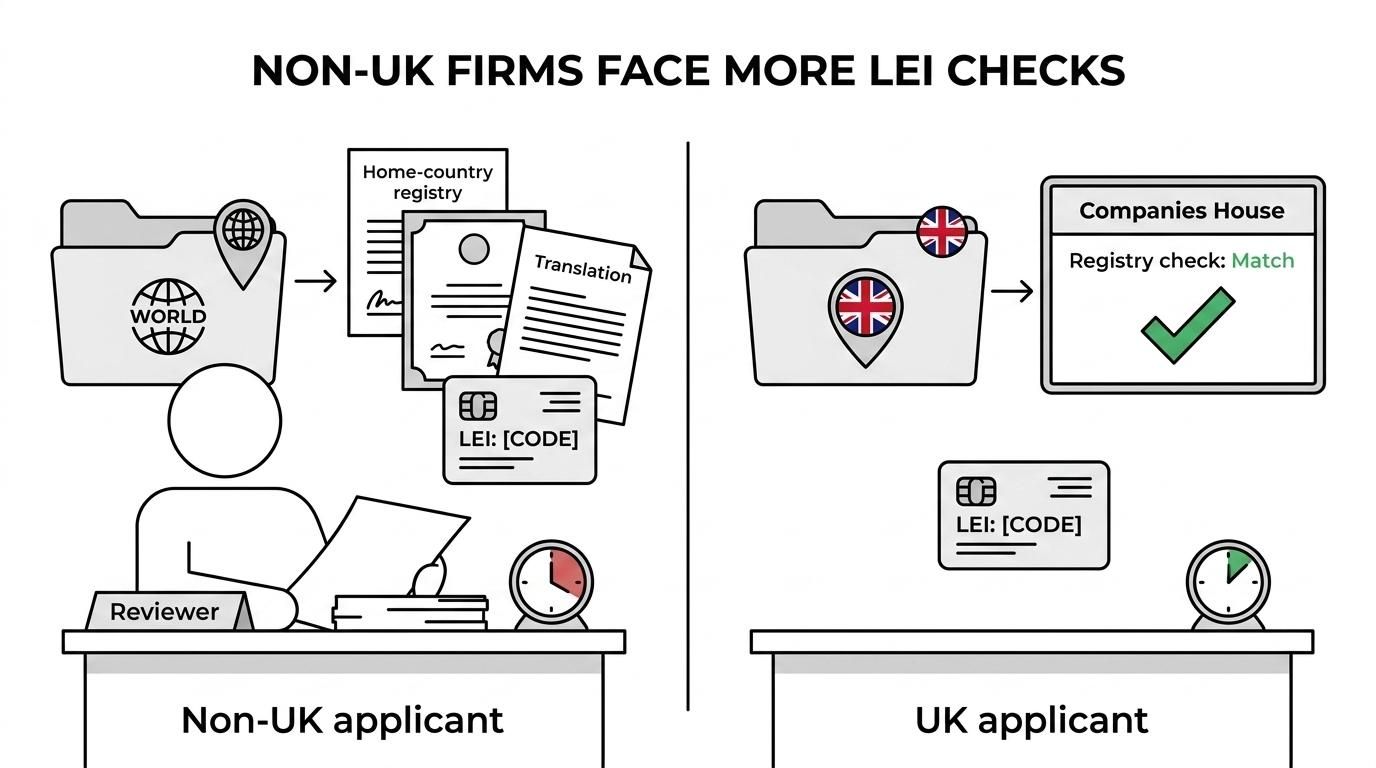
The core standard is global, which makes life easier for cross-border firms. Whether the entity is formed in the EU, the United States, the Channel Islands, the Middle East, or Asia, the LEI structure is the same. What changes is the verification path. A UK company can often be checked through Companies House in moments. A foreign entity usually needs validation against its home registry, and that may involve extra documents or manual review.
What information a non-UK entity needs for LEI registration
For an overseas application, the details submitted must match the legal entity’s official records exactly. Small differences in spelling, punctuation, legal form, or address formatting can slow validation.
Typical data points include:
- legal name
- registered address
- country of formation
- legal form
- incorporation or formation date
- national registration number
Extra evidence is often needed for foreign entities because the issuing body or registration agent must confirm that the company exists and that the data is current.
- Registry extract: an official document from the home country register showing the entity’s name, status, number, and address
- Certificate of incorporation: useful where the registry is limited or not easily searchable
- Translation requirement: English translation may be requested if the original document is not in English
- Authorisation evidence: a letter of authorisation or signatory confirmation may be needed when someone applies on the entity’s behalf
For many overseas companies, this is the main difference between a fast issue and a delayed one.
UK and non-UK LEI applications compared
The table below shows the practical differences between a UK entity and a non-UK entity applying for an LEI for UK trading.
| Requirement | UK entity | Non-UK entity |
|---|---|---|
| Verification source | Usually Companies House | Home-country registry or official documents |
| Documents needed | Often none | Often registry extract, certificate, or equivalent |
| Review method | Mostly automated | May include manual validation |
| Language | English source records | Translation may be required |
| Timeline | Often minutes to hours | Often 1 to 48 hours, sometimes longer if documents are needed |
| LEI validity in the UK | Valid if active and up to date | Valid if active and up to date |
The point is simple: the LEI is global, but the evidence behind it is local.
Cross-border LEI support for foreign companies
A foreign company trading into the UK does not need to work through the process alone. LEI Service acts as an official LEI registration agent of Ubisecure RapidLEI and supports legal entities that need new LEIs, renewals, transfers, and urgent handling. The service is designed to keep the application process clear, cost-conscious, and fast, while still meeting the validation rules of the global LEI framework.
For non-UK entities, that support matters most when the home registry is unfamiliar to the applicant’s UK broker or when supporting documents are needed quickly. The service can help check submitted data, request any missing records, and move the application through validation without unnecessary back-and-forth.
Key service features include:
- Fast issuance: from around 10 minutes to 48 hours in many cases, depending on the entity and document checks
- VIP delivery: available in as little as 2 hours for orders placed before 5pm
- low-cost pricing
- free updates to LEI reference data
- English-speaking phone and email support
- Renewal options: one-year and multi-year terms to reduce admin pressure
- Transfer and renewal support: useful if the LEI already exists but the current provider is slow or expensive
That combination is especially valuable when a trade deadline is close and the LEI still needs to be issued, renewed, or transferred.
LEI issuance speed for urgent UK trading deadlines
Speed depends on one thing above all: how easily the entity can be verified. If the overseas registry data is clear and accessible, an LEI can often be processed quickly. If there are discrepancies, missing records, or non-English documents, manual review may be required.
Even then, a focused process makes a real difference. A simplified application, responsive support, and prompt document checks can shorten the time between submission and issue, which is exactly what cross-border traders need.
Why non-UK companies use an LEI in the UK
The LEI does more than satisfy a rule. It gives counterparties and reporting systems a standard identifier that works across borders. That helps reduce repeated requests for basic corporate information and makes onboarding more efficient with brokers, banks, and trading venues.
It also supports cleaner reporting. When the same legal entity is identified through one active LEI, regulators and trade repositories can match activity more reliably. That matters in markets where accuracy, speed, and auditability are expected.
There are also practical reputational benefits. An active LEI signals that the company’s reference data has been checked and published in the global LEI system. For many institutional relationships, that is simply part of doing business well.
LEI renewal and keeping your UK trading access active
An LEI is not a one-off registration. It must be renewed every year to remain active. If it lapses, brokers, counterparties, or reporting systems may reject transactions or flag the entity as non-compliant.
Renewal deserves the same care as the first application, especially for non-UK entities. If the company has changed its legal name, address, registration details, or ownership structure, the LEI record should be updated as part of the renewal cycle. Services that include free LEI data updates and reminder management can remove a significant administrative burden.
A multi-year renewal option can also make sense where the entity expects regular UK trading activity and wants fewer internal approval cycles.
Common issues that delay a foreign LEI application
Most delays come from data mismatches, not from the LEI system itself. A foreign company may use a trading name instead of its registered name, submit an outdated address, or upload a document that does not clearly show the current legal status.
This is where careful checking at the start pays off.
If your company is based outside the UK and needs an LEI for UK trading, the fastest route is usually to prepare the exact legal details from the home registry, gather any official evidence early, and use a provider that can handle cross-border validation without unnecessary friction. With the right support, the process is straightforward, affordable, and fully suited to overseas entities entering UK markets.