Why Accurate LEI Data Supports KYC Across UK Firms
When KYC is discussed, attention often settles on identity documents, screening tools, and ownership charts. For UK firms dealing with legal entities, another data point deserves equal weight: the Legal Entity Identifier. An LEI is not simply a code used to satisfy a reporting rule. It is a standardised identity record that can strengthen onboarding, counterparty checks, and post-trade controls when the data behind it is current and correct.
Accurate LEI data matters because so many teams rely on it at once. Compliance teams use it to validate legal entities. Operations teams use it to avoid failed reporting and mismatched records. Front-office teams may need it before a trade can go ahead. Once an LEI record sits in public infrastructure, any error can travel through client files, reporting systems, and market counterparties.
Why LEI data accuracy matters for KYC in UK firms
KYC for legal entities is largely a data quality exercise. A firm needs confidence that the entity name is correct, the registration details are current, the legal form is properly recorded, and ownership links are reviewed where relevant. LEI reference data supports that process by giving firms a globally recognised identifier tied to verified entity information.
That has a direct UK compliance angle. The FCA states that firms subject to UK MiFIR transaction reporting cannot execute a trade on behalf of a client that is eligible for an LEI if that client does not have one. This means the LEI is not a back-office extra. It can affect trade execution itself.
There is also a broader operational value. The FCA has said that complete and accurate transaction reports matter to market monitoring. If the LEI in a firm’s records is missing, lapsed, or linked to stale entity data, KYC weakness can become reporting weakness very quickly.
What LEI reference data gives KYC teams
LEI data is useful because it is structured, public, and consistent across jurisdictions. GLEIF publishes LEI records through the Global LEI Index, which is free to access. That public availability gives firms a shared reference point when validating a legal entity during onboarding or periodic review.
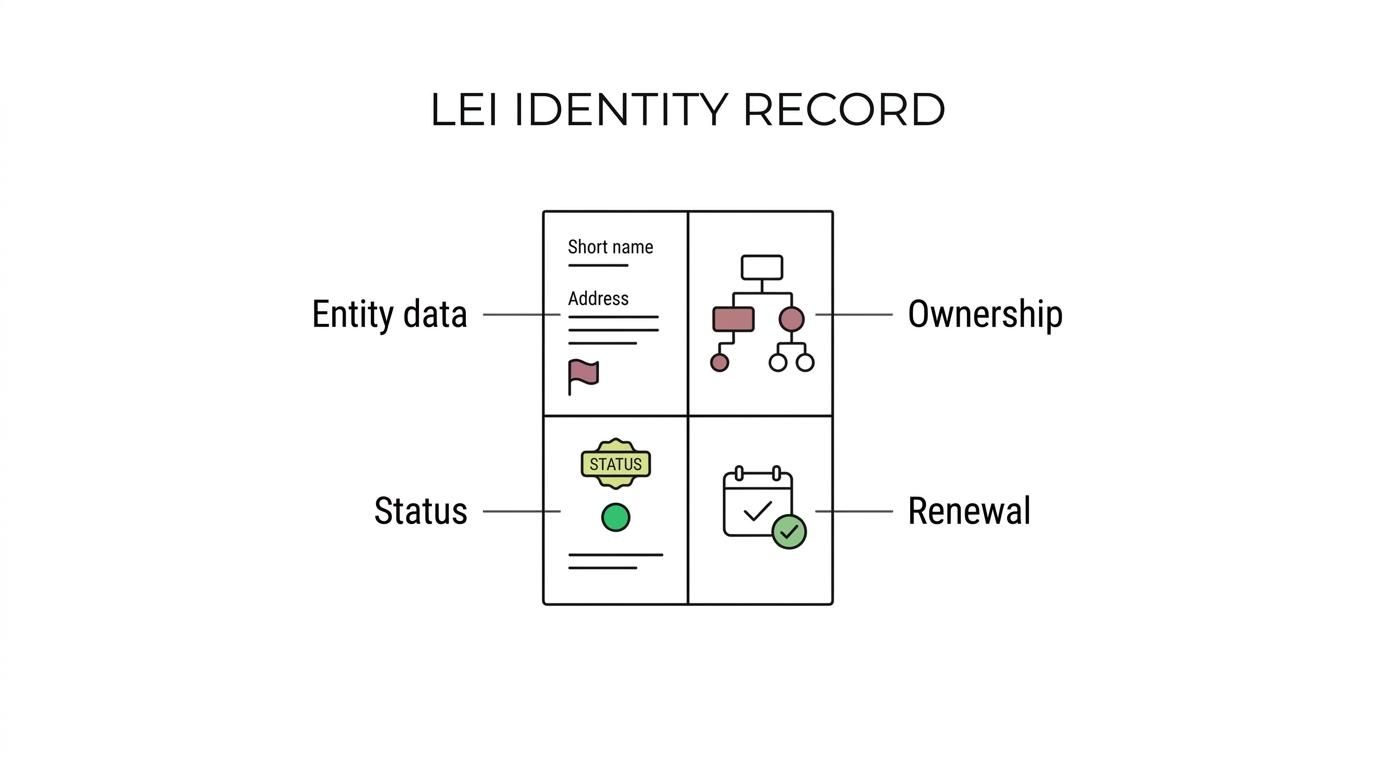
For KYC teams, the benefit is not only the identifier itself. It is the reference data attached to the identifier and the discipline around keeping that record current.
- Level 1 data: core identity facts about the legal entity
- Level 2 data: ownership relationship data, where reportable
- Status information: whether the LEI is active or has lapsed
- Renewal record: evidence that the entity data has been revalidated
Level 1 LEI data for entity identity checks
Level 1 data answers the basic question: who is who? It typically includes the official legal name, registered address, country of formation, and other reference details that help a firm match the LEI to the entity it is onboarding. When these details are accurate, teams spend less time reconciling small naming differences across internal systems, client forms, and reporting files.
A standardised identity layer also reduces duplicate records. One entity can appear in several ways across different platforms, especially where abbreviations, trading styles, or formatting changes creep in. LEI data helps create a cleaner master record.
Level 2 LEI data for ownership and control checks
Level 2 data helps answer the question: who owns whom? Where a legal entity reports direct and ultimate parent relationships, that information can support ownership mapping and refresh work. This is useful for firms carrying out risk-based review of group structures, connected counterparties, and control relationships.
It does not replace a full ownership review, but it can act as a strong starting point. For KYC teams, that means less guesswork and a more consistent method for checking legal entity relationships across files.
LEI data and UK transaction reporting obligations
The strongest case for accurate LEI data often appears where KYC and reporting meet. Under UK MiFIR, transaction reporting depends on correct legal entity identification. Under UK EMIR, all UK counterparties entering into derivative trades need an LEI to meet reporting obligations. A weak LEI record can therefore create problems before a transaction, during reporting, and during any later review.
This is one reason LEI data should not sit in a silo. A record collected by onboarding should feed reporting systems, client master data, and control checks. If each team maintains its own version, inconsistencies are almost guaranteed.
The table below shows how accurate LEI data supports different points in the KYC and reporting process.
| KYC or reporting activity | LEI data used | Benefit of accurate data | Risk if data is stale |
|---|---|---|---|
| Client onboarding | Legal name, address, entity status | Faster entity validation | Manual review and delayed approval |
| Trade execution checks | Active LEI status | Fewer blocks before trading | Trade cannot proceed where rules require an LEI |
| UK MiFIR transaction reporting | Correct LEI in report fields | Better report completeness and matching | Rejections, corrections, control breaks |
| UK EMIR derivative reporting | Counterparty LEI | Clear identification of reporting parties | Reporting gaps and reconciliation issues |
| Periodic KYC review | Updated entity and ownership data | Cleaner refresh cycle | Old ownership or legal changes missed |
A public identifier only works well if the public record stays current. Because the Global LEI Index is visible to counterparties and service providers, poor-quality data can ripple outward. A mistake is not hidden inside one firm’s archive. It can affect matching, trust, and automated checks across the market.
Common LEI data issues that weaken KYC controls
Most LEI problems are not dramatic. They are ordinary maintenance issues that build up over time. A company changes name after a restructuring. A registered address moves. A parent relationship changes. A renewal date slips by during a busy reporting cycle. Each issue may look small, yet together they weaken the reliability of KYC records.
An LEI that was accurate last year may already be out of date today.
Some of the most frequent issues include:
- stale legal name
- old registered address
- lapsed LEI status
- unrecorded ownership change
- inconsistent entity records across systems
These issues create extra work because KYC, onboarding, reporting, and client servicing teams then spend time proving which version of the record is right. That is costly, but the bigger concern is control failure. When entity data quality drops, screening, classification, reporting, and audit evidence all become harder to defend.
Annual renewal and LEI data revalidation
LEI data is not static. Renewal exists for a reason. The FCA notes that, to renew an LEI, updated information must be provided so the Local Operating Unit can verify the data held on the LEI. That annual revalidation step is one of the features that makes LEI data useful for KYC.
Renewal is therefore more than a payment cycle. It is a checkpoint for data accuracy. Firms should treat it as a scheduled opportunity to confirm legal name, address details, registration status, and any ownership changes that should be reflected in the record.
If renewal is missed, the LEI can move into lapsed status. Even where the identifier itself still points to the same entity, that status change sends a warning to counterparties and internal control teams that the reference data may no longer be current. In fast-moving compliance environments, that is not a signal most firms want attached to their records.
Practical LEI data governance for compliance teams
Good LEI governance is usually straightforward. The challenge is consistency. Firms often know they need an LEI, yet the surrounding controls may still be fragmented. A better approach is to link LEI maintenance to the same routines already used for KYC refresh, client lifecycle management, and reporting assurance.
This works best when ownership is clear and deadlines are visible. If no team is responsible for checking renewal dates or updating changed entity information, gaps appear quickly.
A practical governance model often includes the following steps:
- Assign responsibility: name the team or role that owns LEI upkeep from issuance to renewal.
- Match LEI records to client masters: ensure the LEI in onboarding files matches the LEI used in reporting and operations systems.
- Trigger updates from corporate events: feed name changes, mergers, address updates, and ownership changes into the LEI review process.
- Track renewal dates early: start checks before expiry so there is time for verification and correction.
- Review lapsed records promptly: treat lapsed status as a control alert, not an admin note.
A simple operating rhythm can make a major difference. Monthly exception checks, pre-trade verification where relevant, and an annual review calendar are often enough to reduce avoidable failures.
LEI registration support for UK entities with KYC pressure
For many UK entities, the hardest part is not the concept of LEI data. It is the speed and accuracy needed when a trading desk, administrator, trustee, or compliance team needs the record ready now. That is where a specialist LEI registration agent can help reduce internal delay.
Useful support tends to include fast issuance, renewal management, transfer handling, help with bulk orders, and responsive phone or email contact when an application needs attention. Free updates to LEI reference data and assisted registration can also help entities keep records current without adding unnecessary admin load.
That matters across a wide range of UK organisations, including companies, charities, pension arrangements, trusts, and other legal structures that need an LEI for trading or reporting. When the process is simple and the data is kept up to date, KYC teams gain something very valuable: entity records they can trust and use with confidence.