Why UK Brokers Ask for an LEI Before Trading Starts
A broker’s request for an LEI can feel like an administrative extra, especially when an account is already open and the trade itself seems ready to go. In practice, the request is often tied to a much more direct issue: whether the broker can legally execute and report the transaction.
That is why the question tends to appear before trading starts, not after.
For many UK legal entities, the LEI is not simply a box-ticking item. It is part of the reporting framework that sits behind parts of the financial markets. If the broker is subject to UK MiFIR transaction reporting rules, or if the trade involves derivatives that fall within UK EMIR reporting, the absence of an LEI can stop the process at source.
What an LEI means in UK broker trading
An LEI, or Legal Entity Identifier, is a unique 20-character alphanumeric code used to identify a legal entity or structure taking part in a financial transaction. It links to verified reference information, allowing regulators and market participants to identify the entity clearly and consistently.
That may sound technical, but the idea is simple. When a company, charity, trust, pension arrangement or similar structure enters a reportable trade, the market needs a standard identifier that works across firms and systems. The LEI does that job.
For brokers, this is not only about client records. It is about whether a trade can be processed in a way that meets UK reporting rules and supports accurate market oversight.
UK MiFIR rules that can stop a trade without an LEI
The clearest reason a broker asks for an LEI before trading begins comes from UK MiFIR transaction reporting obligations.
The Financial Conduct Authority has stated that firms subject to UK MiFIR transaction reporting obligations will not be able to execute a trade on behalf of a client who is eligible for an LEI and does not have one. That point matters. It means the LEI request is often driven by execution rules, not by onboarding preference or internal policy alone.
Transaction reports under UK MiFIR must be submitted after the execution of a transaction in a reportable instrument. The FCA also makes clear that complete and accurate transaction reporting supports market monitoring and the detection of market abuse. If a broker cannot identify the entity correctly in the report, it may not be able to proceed with the trade in the first place.
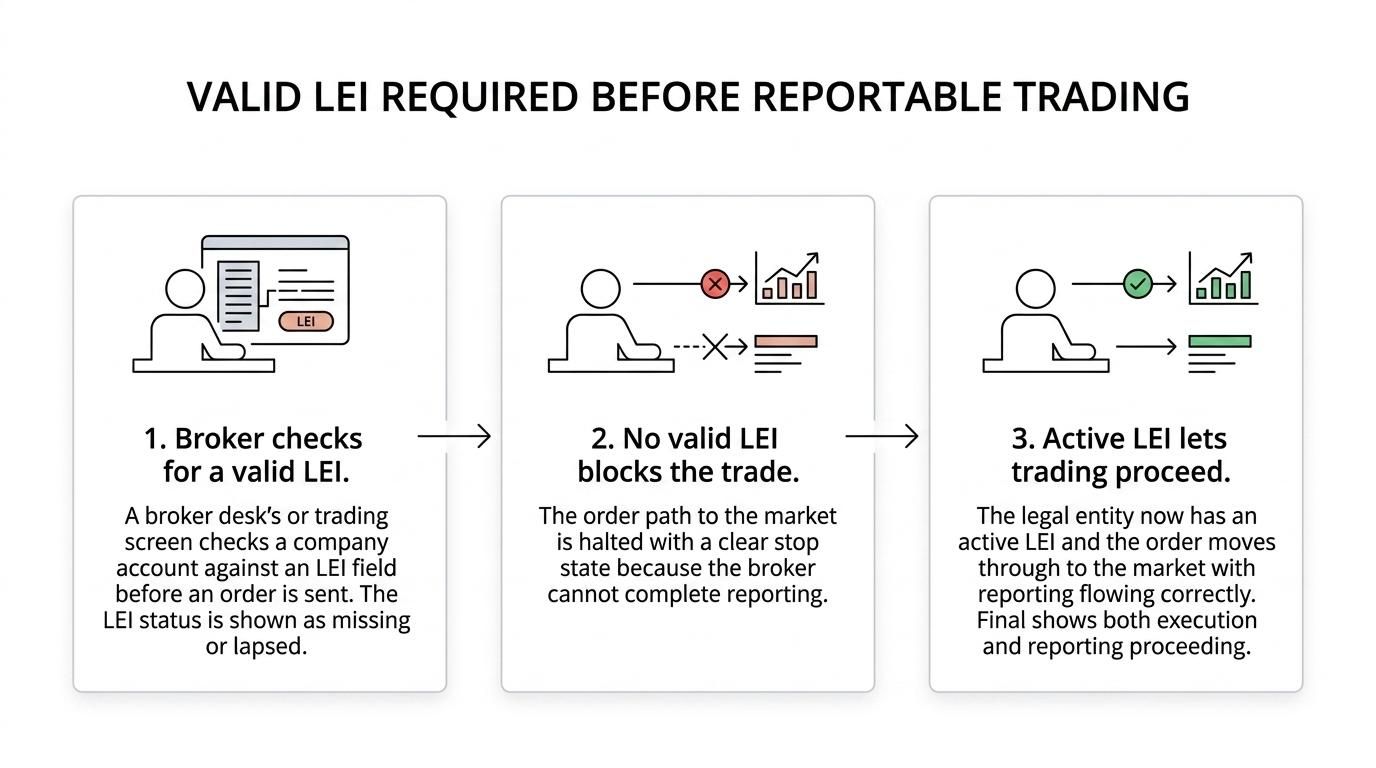
So when a broker says, “We need your LEI before we can place this order,” the underlying message is usually quite practical: we cannot execute and report this correctly without it.
Why brokers ask for an LEI before trading starts, not after
Timing is the part that often surprises clients.
From the client’s point of view, it can seem reasonable to place the order first and sort out the reference data later. From the broker’s point of view, that creates regulatory risk. Once a reportable trade is executed, the reporting obligation follows immediately. If the entity identifier is missing, incomplete or lapsed, the broker may be left unable to file the report as required.
That is why the LEI request often appears during account opening, when permissions are being added, or just before the first trade in a relevant instrument.
In operational terms, brokers want the LEI in place before an order reaches the market.
The point is not convenience. The point is control.
Which UK entities and structures are likely to be asked for an LEI
The FCA’s guidance refers to clients that are legal entities or structures, including companies, charities and trusts. In the UK, that catches a wider group than many people expect.
A business owner may assume the rule applies only to large corporates or financial institutions. In reality, smaller entities often meet the same requirement when they trade through a broker in circumstances where reporting rules apply.
Typical examples include:
- Limited companies
- Charities
- Trusts
- Pension structures
- Corporate investment vehicles
- Other non-natural person account holders
This is one reason the question appears so often in the UK. Many organisations that do not think of themselves as “market participants” in a formal sense still invest, hedge, or hold trading accounts.
UK broker LEI checks by activity type
The exact trigger depends on the activity and the reporting regime involved. A simple way to think about it is set out below.
| Activity or rule area | Why the LEI matters | Likely broker response |
|---|---|---|
| UK MiFIR reportable trading | The broker may need the client’s LEI for transaction reporting after execution | Trading may be blocked until a valid LEI is supplied |
| UK EMIR derivative reporting | Counterparties to derivative contracts need an LEI for reporting | Derivative dealing may not begin without one |
| Broker onboarding and controls | Firms match legal entity data across systems and records | LEI requested early to avoid failed reporting or manual exceptions |
| LEI renewal status | An expired or lapsed LEI can create reporting problems | Broker may ask for renewal before new trades |
This is why two entities with similar-looking accounts can have very different experiences. One may be able to proceed without any issue, while another is stopped immediately because the proposed transaction sits inside a reporting framework.
UK EMIR reporting obligations and derivative trades
Derivatives add another layer.
Under UK EMIR, all counterparties must report derivative contracts that are concluded, modified or terminated. The FCA has also stated that UK counterparties entering into derivative trades need an LEI to meet UK EMIR reporting obligations.
That makes the broker’s request even easier to understand in a derivatives setting. If the derivative contract has to be reported, and the counterparty needs an LEI for that report, the broker or platform is unlikely to let trading begin while the identifier is missing.
This affects more than large treasury teams.
A charity using a derivative for risk management, a company hedging currency exposure, or a trust entering a reportable derivative position can all run into the same issue. The trade may be commercially sensible and fully approved internally, yet still pause because the LEI has not been obtained or renewed.
Why this is about reporting quality, not only identity checks
An LEI does identify the entity, but its role is wider than a standard know-your-client data point.
The LEI connects the entity to reference data held in the Global LEI Index, which helps create consistency across trading venues, brokers, counterparties and regulators. Each LEI is unique to one entity. That reduces ambiguity, especially where names are similar, structures are complex, or cross-border activity is involved.
From a broker’s side, this has three practical benefits:
- cleaner transaction reporting
- fewer manual interventions
- better consistency across internal systems and regulator-facing reports
That is why the request can come from dealing desks, compliance teams, onboarding teams or operations staff. Several parts of the firm depend on the same identifier being present and current.
Common situations where UK firms are caught out
The most common problem is not refusal. It is timing.
An entity decides to invest, open a market position, or place a one-off order through a broker. The commercial side is ready. Signatories are in place. Cash is available. Then the broker asks for an LEI and the timetable suddenly shifts.
A few regular patterns show up:
- First corporate trade: the entity has never needed market reporting data before
- Dormant LEI: an LEI exists, but it has lapsed and needs renewal
- Trust or charity account: the decision-makers did not realise the structure counted as a legal entity or structure for this purpose
- Derivative onboarding: the need for UK EMIR reporting brings the LEI requirement forward immediately
In each case, the broker is usually trying to avoid a trade that cannot be executed or reported in line with the rules.
How to avoid delays when a broker asks for an LEI
The good news is that this is usually easy to fix once the reason is clear.
If your organisation may trade through a UK broker, especially in instruments that can trigger reporting obligations, it is sensible to arrange the LEI before the dealing instruction is time-sensitive. That is even more useful where multiple sign-offs are needed internally, or where a trust, charity or pension structure has slightly more involved documentation.
A practical checklist helps:
- Check entity status: confirm whether the account holder is a legal entity or structure rather than an individual
- Ask the broker early: find out whether the intended activity falls within UK MiFIR or UK EMIR reporting
- Apply before the first order: do not wait until a trade is ready to be placed
- Monitor renewal dates: a lapsed LEI can be just as disruptive as a missing one
- Keep reference data current: changes to name, address or registration details should be updated
This is one of those cases where a small preparatory step can protect a much larger timetable.
Getting an LEI quickly for UK trading
Speed matters when a broker has already paused an order.
A UK-focused LEI registration agent can often help legal entities obtain, renew or transfer an LEI quickly, with support by phone and email for cases where the entity type is not straightforward. For firms that need to trade urgently, express options can make a real difference, especially when the issue is caught late in the day or just before a funding deadline.
The strongest approach is still to treat the LEI as part of trading readiness, not as a last-minute formality.
When the LEI is already active and the reference data is current, the broker can focus on the trade itself instead of pausing the process for regulatory reasons. That puts the entity in a much stronger position, whether it is a limited company placing an investment order, a charity opening a market exposure, or a trust entering a reportable derivative arrangement.